Within Project Mogul Balloon
How Balloons Could Hear an Atomic Test
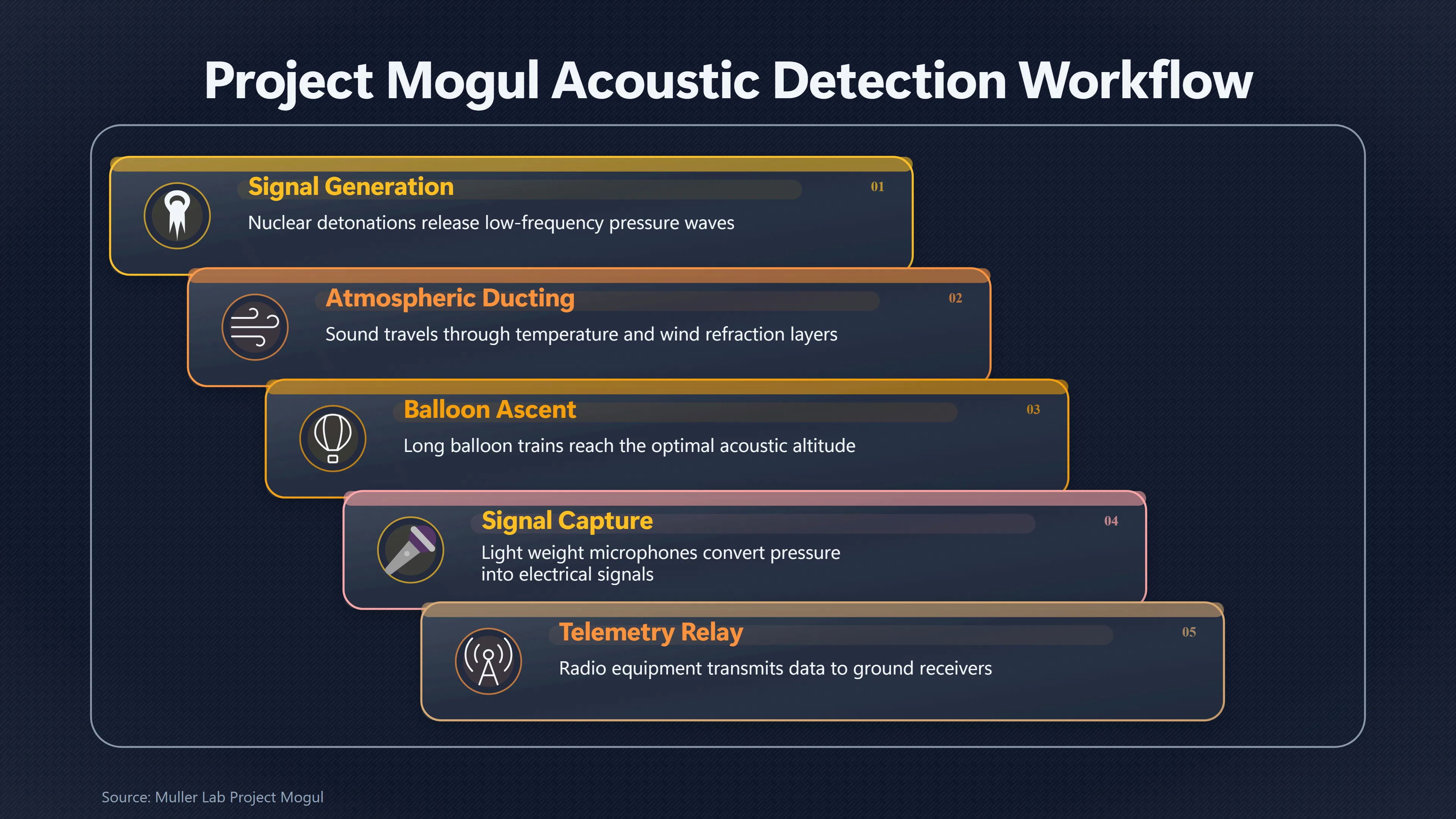
Project Mogul placed microphones high in the atmosphere to detect infrasound from nuclear explosions thousands of miles away.
On this page
- The upper atmosphere sound channel
- Microphones, telemetry and signal detection
- Why the concept outlasted the balloon system
Page outline Jump by section
Introduction
Project Mogul was built around a deceptively simple idea: if a nuclear explosion created an enormous low-frequency pressure wave, perhaps that sound could be detected thousands of kilometres away without crossing Soviet borders. Rather than relying on conventional ground stations, the programme sought to lift sensitive acoustic equipment into a layer of the upper atmosphere where infrasound—sound below the range of human hearing—might travel unusually long distances. This concept lay at the heart of Mogul’s strategic value and explains why an otherwise ordinary-looking balloon train became part of a highly classified Cold War intelligence project. Although the balloon system itself proved difficult to operate and was eventually overtaken by other technologies, the scientific principles behind it influenced later long-range infrasound monitoring and nuclear test detection.[Muller Lab]muller.lbl.govMuller Lab Project MogulMuller Lab Project Mogul

The upper-atmosphere sound channel
Project Mogul grew from research by geophysicist Maurice Ewing, whose wartime work had demonstrated that low-frequency sound could travel extraordinary distances through the ocean’s SOFAR (Sound Fixing and Ranging) channel. Ewing proposed that the atmosphere might contain an analogous acoustic duct: a region where changes in temperature and wind refracted sound waves back towards a preferred altitude instead of allowing them to disperse. If such a channel existed, the immense infrasound pulse from a nuclear explosion might remain detectable over continental or even intercontinental distances.[lbl.gov]muller.lbl.govMuller Lab Project MogulMuller Lab Project Mogul
The sounds of interest were not the loud blast heard near an explosion but extremely low-frequency pressure waves. Nuclear detonations release energy across a broad spectrum, including infrasound with wavelengths long enough to travel efficiently through the atmosphere. Scientists believed that positioning instruments within the suspected sound channel would improve the chance of intercepting these signals before they weakened or were distorted by lower atmospheric turbulence.[Muller Lab]muller.lbl.govMuller Lab Project MogulMuller Lab Project Mogul
The atmospheric duct remained largely theoretical in the mid-1940s. Unlike the oceanic SOFAR channel, which had already been demonstrated experimentally, its atmospheric counterpart had not yet been characterised with the same confidence. Mogul therefore combined operational intelligence goals with fundamental atmospheric research, making every flight both an experiment and a potential surveillance mission. Modern observations have since confirmed that SOFAR-like acoustic ducts can exist in the stratosphere, lending retrospective scientific support to the principle that motivated the programme, even though the available technology in 1947 was limited.[AGU Publications]agupubs.onlinelibrary.wiley.comAGU PublicationsThe AtmoSOFAR Channel: First Direct Observations of an Elevated Acoustic Duct - Albert - 2023 - Earth and Space Science…
Microphones, telemetry and signal detection
The central technical challenge was not merely lifting a microphone into the sky but creating a complete airborne listening system capable of remaining at the correct altitude and sending usable information back to observers.
According to later Air Force documentation, Project Mogul concentrated on three linked technologies:
- lightweight microphones sensitive to very low-frequency pressure waves;
- telemetry equipment capable of transmitting recorded signals to ground or airborne receivers;
- balloon systems able to maintain a relatively constant altitude within the suspected acoustic duct.[Muller Lab]muller.lbl.govMuller Lab Project MogulMuller Lab Project Mogul
Constant-altitude flight was essential. Ordinary weather balloons simply rise until they burst, passing quickly through different atmospheric layers. Mogul instead experimented with long balloon trains and specialised “constant-level” balloon systems intended to keep instruments near the altitude where acoustic propagation was expected to be most favourable. Remaining within that layer for extended periods increased the likelihood of detecting distant signals.[Muller Lab]muller.lbl.govMuller Lab ROSWELL INCIDENT REPORTMuller Lab ROSWELL INCIDENT REPORT
The microphones generated electrical signals rather than stored audio recordings. These signals were relayed by radio telemetry, allowing researchers to monitor the experiment without recovering every instrument package. Because the target frequencies were extremely low and often masked by atmospheric noise, scientists also had to distinguish genuine acoustic events from wind effects, balloon motion and electronic interference. This processing challenge proved almost as significant as the hardware itself.[Muller Lab]muller.lbl.govMuller Lab Project MogulMuller Lab Project Mogul
Responsibility for these components was divided among specialist teams. The New York University group developed the balloon platforms and telemetry equipment, while researchers associated with Columbia University worked on the acoustic sensing technology. This compartmentalisation also helped preserve secrecy, since not everyone involved knew that the ultimate objective was monitoring Soviet nuclear activity.[Muller Lab]muller.lbl.govMuller Lab ROSWELL INCIDENT REPORTMuller Lab ROSWELL INCIDENT REPORT

Why balloon listening was so difficult
The scientific concept was promising, but turning it into a dependable intelligence system proved far more complicated.
The atmosphere is constantly changing. Winds, temperature gradients and seasonal conditions alter the paths along which sound travels, meaning that the most favourable acoustic layer can shift in altitude or disappear altogether. A balloon drifting only a modest distance vertically could move out of the optimal listening region.[AGU Publications]agupubs.onlinelibrary.wiley.comAGU PublicationsThe AtmoSOFAR Channel: First Direct Observations of an Elevated Acoustic Duct - Albert - 2023 - Earth and Space Science…
The balloon platforms themselves introduced practical limitations:
- maintaining nearly constant altitude for many hours was technically demanding;
- instrument payloads had to remain light enough for long balloon flights;
- telemetry range and battery life constrained observations;
- weather frequently interrupted launches or prevented stable operations.[Muller Lab]muller.lbl.govMuller Lab Project MogulMuller Lab Project Mogul
These operational difficulties help explain why Project Mogul remained experimental rather than becoming a mature surveillance network. The programme demonstrated important concepts but struggled to provide the reliability needed for continuous strategic monitoring during a rapidly evolving Cold War.[Muller Lab]muller.lbl.govMuller Lab Project MogulMuller Lab Project Mogul
Why the concept outlasted the balloon system
Although Project Mogul itself was relatively short-lived, its underlying idea proved durable. Scientists continued studying atmospheric infrasound propagation, while advances in electronics, digital signal processing and global sensor networks eventually made long-range acoustic monitoring far more practical than it had been in the 1940s.[AGU Publications]agupubs.onlinelibrary.wiley.comAGU PublicationsThe AtmoSOFAR Channel: First Direct Observations of an Elevated Acoustic Duct - Albert - 2023 - Earth and Space Science…
Modern nuclear-test monitoring relies on ground-based and international infrasound networks rather than balloon trains. These systems can detect and analyse low-frequency pressure waves from large explosions across great distances with vastly improved accuracy. In this sense, Mogul was less a technological dead end than an early proof of concept for a field that matured decades later.[National Academies]nationalacademies.orgOpen source on nationalacademies.org.
Within the Roswell story, this technical purpose is significant because it explains why apparently mundane materials—balloons, radar reflectors, wires and lightweight structural components—could belong to a programme of exceptional military importance. The secrecy surrounded the mission of listening for Soviet atomic tests, not because the physical hardware resembled advanced aircraft, but because revealing the programme’s purpose would have disclosed an emerging American intelligence capability during the opening years of the Cold War.[Muller Lab]muller.lbl.govMuller Lab Project MogulMuller Lab Project Mogul
Amazon book picks
Further Reading
Books and field guides related to How Balloons Could Hear an Atomic Test. Use these as the next step if you want deeper reading beyond the article.
The Sound Book: The Science of the Sonic Wonders of the World
A professor of acoustic engineering provides a tour of the world's most amazing sound phenomena, including creaking glaciers, whispering...
Command and Control: Nuclear Weapons, the Damascus Accident,...
From famed investigative journalist Eric Schlosser, author of Fast Food Nation, comes Command and Control a ground-breaking account of th...
The Weather Machine: A Journey Inside the Forecast
From the acclaimed author of Tubes, a lively and surprising tour through the global network that predicts our weather, the people behind...
eBay marketplace picks
Marketplace Samples
Live-tested eBay searches with available results related to this page.
Selected fromweather balloon model oneBay.co.uk.


Endnotes
1.
Source: muller.lbl.gov
Title: Muller Lab Project Mogul
Link:https://muller.lbl.gov/teaching/physics10/Roswell/USMogulReport.html
2.
Source: agupubs.onlinelibrary.wiley.com
Link:https://agupubs.onlinelibrary.wiley.com/doi/10.1029/2023EA003149
Source snippet
AGU PublicationsThe AtmoSOFAR Channel: First Direct Observations of an Elevated Acoustic Duct - Albert - 2023 - Earth and Space Science...
3.
Source: dosits.org
Link:https://dosits.org/science/movement/sofar-channel/history-of-the-sofar-channel/
4.
Source: muller.lbl.gov
Title: Muller Lab [ROSWELL INCIDENT]({{ ‘the-1980-book/’ | relative_url }}) REPORT
Link:https://muller.lbl.gov/teaching/physics10/Roswell/RoswellIncident.html
5.
Source: nationalacademies.org
Link:https://www.nationalacademies.org/read/5875/chapter/13
6.
Source: agupubs.onlinelibrary.wiley.com
Link:https://agupubs.onlinelibrary.wiley.com/doi/abs/10.1002/2015GL066570
7.
Source: history.com
Link:https://www.history.com/articles/roswell
8.
Source: military-history.fandom.com
Title: SOFAR channel
Link:https://military-history.fandom.com/wiki/SOFAR_channel
9.
Source: military-history.fandom.com
Title: Project Mogul
Link:https://military-history.fandom.com/wiki/Project_Mogul
10.
Source: muller.lbl.gov
Link:https://muller.lbl.gov/teaching/Physics10/PffP_textbook/PffP-07-waves-5-27.htm
11.
Source: youtube.com
Title: Project Mogul
Link:https://www.youtube.com/watch?v=mBcYtSsPIuU
Source snippet
The Roswell Incident Mystery Finally Solved...
Additional References
12.
Source: sandia.gov
Link:https://www.sandia.gov/research/publications/details/the-atmosofar-channel-first-direct-observations-of-an-elevated-acoustic-duc-2023-10-01/
Source snippet
The AtmoSOFAR Channel: First Direct Observations of an Elevated Acoustic Duct – Publications – ResearchOctober 1, 2023 — THE ATMOSOFAR CH...
Published: October 1, 2023
13.
Source: dosits.org
Title: It was found that the discrepancy between th
Link:https://dosits.org/people-and-sound/history-of-underwater-acoustics/world-war-ii-1941-1945/
Source snippet
World War II: 1941-1945 – Discovery of Sound in the SeaJune 16, 2021 — Following WWII, research showed that the deep scattering layer was...
Published: June 16, 2021
14.
Source: youtube.com
Link:https://www.youtube.com/watch?v=TV0Xm9ZgiKQ
Source snippet
The Mystery of the Roswell Incident Finally Solved...
Published: July 1947
15.
Source: youtube.com
Title: The [Roswell UFO Crash]({{ ‘roswell-ufo-crash/’ | relative_url }}) (Overview)
Link:https://www.youtube.com/watch?v=ZltLHh_WsZs
Source snippet
8th July 1947: First flying saucer as [Roswell Army Air]({{ 'roswell-army-air/' | relative_url }}) Base reports debris of a 'flying disc'...
Published: July 1947
16.
Source: stratocat.com.ar
Title: MOGU L PROJECT
Link:https://stratocat.com.ar/fichas-e/1947/HMN-19470605.htm
Source snippet
MOGUL PROJECT - 6/5/1947May 31, 2026 — PURPOSE OF THE FLIGHT AND PAYLOAD DESCRIPTION Project Mogul was a top secret project carried out b...
Published: May 31, 2026
17.
Source: youtube.com
Title: The Roswell Incident Mystery Finally Solved
Link:https://www.youtube.com/watch?v=Pz0vYcc4KiI
Source snippet
[The Roswell UFO]({{ 'the-roswell-ufo/' | relative_url }}) Crash (Overview) - Jimmy Akin's Mysterious World...
18.
Source: theguardian.com
Title: Atmospheric sound channels – good for sleuths but not UFOs | UFOs | The Guardian
Link:https://www.theguardian.com/news/2017/jul/11/atmospheric-sound-channels-good-for-sleuths-but-not-ufos
19.
Source: scientificamerican.com
Title: Advances in Monitoring Nuclear Weapon Testing | Scientific American
Link:https://www.scientificamerican.com/article/advances-in-monitoring-nuclear/
20.
Source: scribd.com
Title: [Roswell Report]({{ ‘the-roswell-report/’ | relative_url }}): Fact vs. Fiction | PDF | [Unidentified]({{ ‘unidentified/’ | relative_url }}) Flying Object
Link:https://www.scribd.com/document/831210606/Roswel-Fact-or-Fiction
21.
Source: skepticalinquirer.org
Title: The Roswell Incident at 70: Facts, Not Myths | Skeptical Inquirer
Link:https://skepticalinquirer.org/2017/12/the-roswell-incident-at-70-facts-not-myths/