Within Project Mogul Balloon
Why Mogul Balloons Were So Unusually Large
Mogul linked many neoprene balloons and instruments into trains that could stretch hundreds of feet and hold a chosen altitude.
On this page
- Keeping the payload near a target altitude
- Balloons, instruments and connecting lines
- Operational problems with long experimental trains
Page outline Jump by section
Introduction
Project Mogul’s balloon systems were unusually large because the programme’s scientific objective demanded something far more capable than an ordinary weather balloon. Instead of simply carrying a lightweight radiosonde through the atmosphere, Mogul needed to keep sensitive acoustic instruments near a chosen altitude for extended periods while allowing ground crews to track the entire system over long distances. In 1947, the practical solution was to connect many neoprene meteorological balloons, radar reflectors, parachutes and instrument packages into a single elongated “balloon train” that could stretch for hundreds of feet. This distinctive design became one of the key reasons why later investigators argued that Mogul debris could be mistaken for something unfamiliar during the Roswell incident.[Muller Lab]muller.lbl.govMuller Lab Project MogulMuller Lab Project Mogul
Keeping the payload near a target altitude
The defining engineering challenge of Project Mogul was not simply lifting equipment into the sky but keeping it within an atmospheric layer where long-distance infrasound travelled most effectively. Scientists believed that nuclear explosions generated low-frequency pressure waves that could be channelled through particular layers of the upper atmosphere, but detecting them required instruments to remain close to those altitudes rather than continually rising or descending.[Muller Lab]muller.lbl.govMuller Lab Project MogulMuller Lab Project Mogul
Early rubber weather balloons naturally expanded as they climbed until they burst. A single balloon therefore produced a relatively short flight and little control over the payload’s altitude. Mogul engineers attempted to overcome this limitation by using clusters of many balloons that shared the lifting load. As individual balloons gradually lost lift or burst, the remaining balloons could continue supporting the instrument train, producing a more stable and longer-lasting flight than a conventional meteorological launch. This arrangement represented an experimental “stop-gap” approach while researchers worked on more advanced constant-level balloon designs.[Muller Lab]muller.lbl.govMuller Lab Project MogulMuller Lab Project Mogul
New York University’s balloon research group was specifically contracted to develop these constant-level systems. Although later Mogul flights adopted large polyethylene balloons that performed much better, the earliest New Mexico launches relied on linked neoprene balloons because those newer designs were still under development.[Muller Lab]muller.lbl.govMuller Lab Project MogulMuller Lab Project Mogul
Balloons, instruments and connecting lines
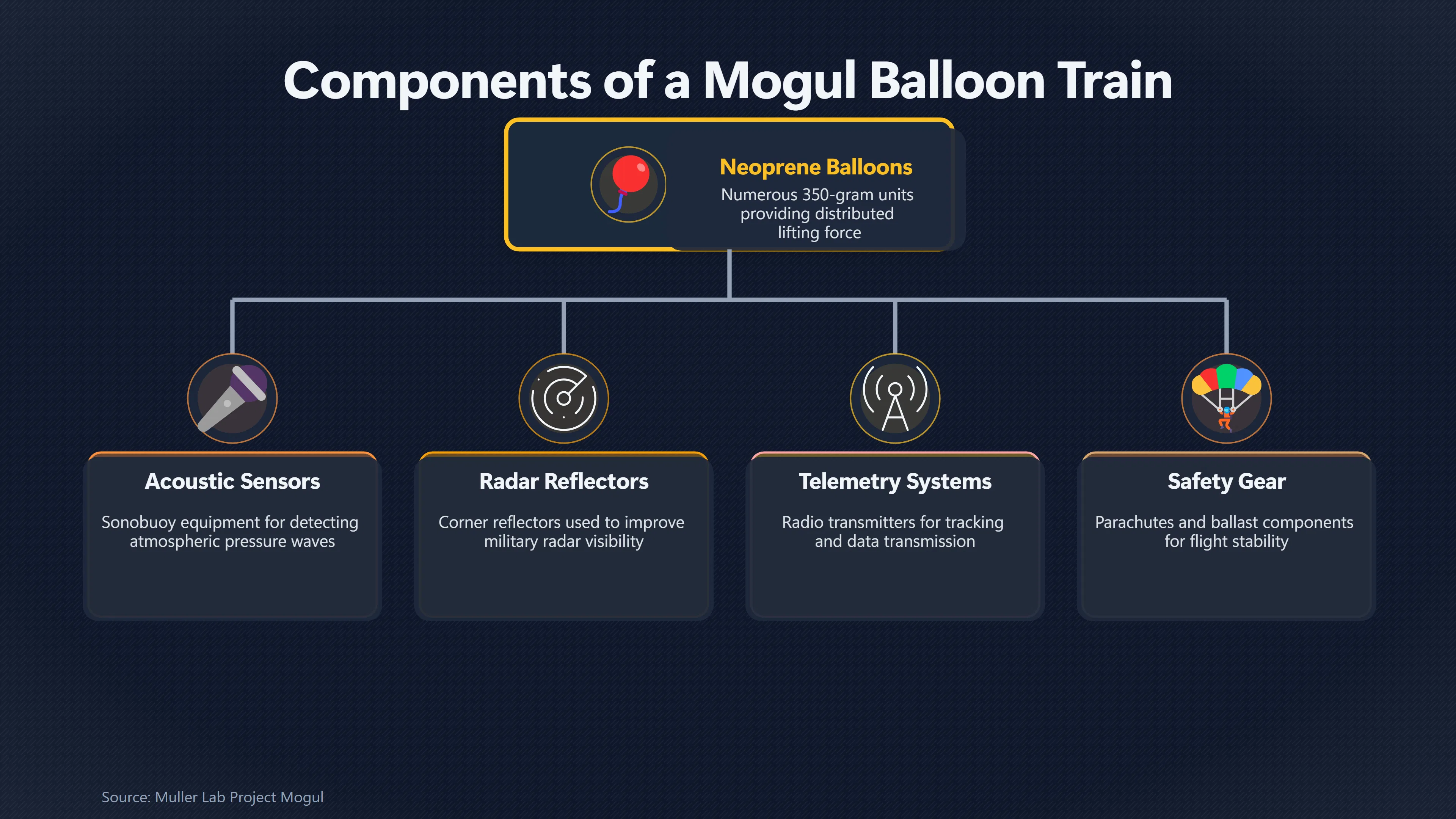
Unlike a normal weather balloon carrying one instrument package beneath a single balloon, an early Mogul flight consisted of multiple interconnected components suspended along a lengthy line.
A typical experimental train could include:
- numerous 350-gram neoprene meteorological balloons providing distributed lift;
- acoustic sensors or sonobuoy equipment for detecting atmospheric pressure waves;
- radio transmitters and telemetry equipment;
- pressure and altitude instruments;
- parachutes and ballast components;
- several radar corner reflectors positioned along the train to improve tracking by military radar.[Muller Lab]muller.lbl.govMuller Lab Project MogulMuller Lab Project Mogul
The long connecting lines served practical purposes beyond simply joining the components. They separated individual payloads, reduced interference between instruments and spread the lifting force across many balloons. The result was a flexible airborne structure rather than a compact object.
Radar tracking presented another challenge. Charles Moore and his colleagues found that a single lightweight radar reflector often produced a weak radar return, so they experimented with attaching three to five corner reflectors to improve visibility. These additions made the train even longer and introduced extra foil-covered, balsa-supported structures that would later become important in comparisons with debris reportedly recovered near Roswell.[Muller Lab]muller.lbl.govMuller Lab Project MogulMuller Lab Project Mogul
Operational problems with long experimental trains
The enormous balloon trains solved some engineering problems but created several new ones.
The first difficulty was handling. Launching dozens of interconnected balloons demanded careful coordination on the ground, especially in desert winds. The New York University team regarded the June 1947 field work partly as an opportunity to perfect procedures for handling these unusually large flight trains rather than simply collecting scientific data.[Muller Lab]muller.lbl.govMuller Lab Project MogulMuller Lab Project Mogul
Reliability also proved problematic. Neoprene balloons deteriorated rapidly in sunlight, leaked lifting gas and changed their physical properties during flight. Charles Moore later described recovered balloon remnants as shredded, darkened fragments that could become scattered over a wide area after landing, especially if residual buoyancy allowed the train to drag across the ground. These shortcomings encouraged the programme’s transition to much larger polyethylene balloons, which retained helium better and maintained altitude more effectively.[Muller Lab]muller.lbl.govRoswell IncidentMuller LabROSWELL INCIDENT REPORTJuly 1, 1994…
Tracking methods also evolved. Early flights depended heavily on radar reflectors, but experience showed that improved radiosonde telemetry could often provide more reliable position information. As radio tracking improved during later tests, the programme increasingly reduced its reliance on multiple radar targets, simplifying subsequent flight configurations.[Muller Lab]muller.lbl.govMuller Lab Project MogulMuller Lab Project Mogul
Why the balloon trains matter in the Roswell context
The unusual size of Mogul balloon trains helps explain why the Air Force later distinguished them from ordinary weather balloons when reassessing the Roswell incident.
According to the Air Force’s reconstruction, a conventional weather balloon typically involved one neoprene balloon, a radiosonde and, if radar tracking was required, a single corner reflector. By contrast, a Mogul train could include more than twenty balloons spaced along an extended line together with several radar reflectors, parachutes, electronics and experimental sensor packages, producing a debris field that looked very different after impact. The report argued that this complexity made misidentification understandable, particularly because the programme’s true purpose remained classified even though many of its individual components were not.[Muller Lab]muller.lbl.govMuller Lab Project MogulMuller Lab Project Mogul
Not all historians accept every aspect of the Air Force’s reconstruction, particularly the identification of a specific June 1947 launch as the source of the Roswell debris. However, there is broad agreement that Project Mogul’s early experimental flights were fundamentally unlike ordinary meteorological balloon launches. Their exceptional length resulted directly from the engineering challenge of keeping sensitive instruments near a desired altitude while carrying enough tracking equipment for researchers to follow an experimental airborne system across the New Mexico desert.[DAF History]dafhistory.af.milDAF History The Roswell ReportDAF History The Roswell Report
Amazon book picks
Further Reading
Books and field guides related to Why Mogul Balloons Were So Unusually Large. Use these as the next step if you want deeper reading beyond the article.
Falling Upwards: How We Took to the Air
Documents the experiences of the pioneers of human flight to offer insight into the character qualities that inspired their ambitions and...
The Aeronauts: Travels in the Air
The True Story Behind the Major Motion Picture — and one of the greatest daredevil stories in the history of aviation In 1862, ambitious...
The Weather Machine: A Journey Inside the Forecast
From the acclaimed author of Tubes, a lively and surprising tour through the global network that predicts our weather, the people behind...
Weather: A Very Short Introduction
From deciding the best day for a picnic, to the devastating effects of hurricanes and typhoons, the weather impacts our lives on a daily...
eBay marketplace picks
Marketplace Samples
Live-tested eBay searches with available results related to this page.
Selected fromUFO collectible pin oneBay.co.uk.

Endnotes
1.
Source: muller.lbl.gov
Title: Muller Lab Project Mogul
Link:https://muller.lbl.gov/teaching/physics10/Roswell/USMogulReport.html
2.
Source: dafhistory.af.mil
Title: DAF History [The Roswell Report]({{ ‘the-roswell-report/’ | relative_url }})
Link:https://www.dafhistory.af.mil/Portals/16/documents/AFD-101201-038.pdf
3.
Source: Wikipedia
Title: Project Mogul
Link:https://en.wikipedia.org/wiki/Project_Mogul
4.
Source: muller.lbl.gov
Title: Roswell Incident
Link:https://muller.lbl.gov/teaching/physics10/Roswell/RoswellIncident.html
Source snippet
Muller LabROSWELL INCIDENT REPORTJuly 1, 1994...
Published: July 1, 1994
5.
Source: history.com
Link:https://www.history.com/articles/roswell
Source snippet
New Mexico, Alien & UFOs | HISTORY...
6.
Source: globalsecurity.org
Link:https://www.globalsecurity.org/intell/systems/mogul.htm
7.
Source: military-history.fandom.com
Title: Project Mogul
Link:https://military-history.fandom.com/wiki/Project_Mogul
Additional References
8.
Source: kevinrandle.blogspot.com
Title: A Different Perspective: Another Mogul Rant (But Deserved!)
Link:https://kevinrandle.blogspot.com/2025/07/another-mogul-rant-but-deserved.html?m=1
Source snippet
Given the records, there were only two dates that worked for the Project [Mogul explanation]({{ 'mogul-explanation/' | relative_url }}) to be viable. These were June 4, 1947, which w...
Published: June 4, 1947
9.
Source: ciphermysteries.com
Title: Where are all the Project Mogul documents?
Link:https://ciphermysteries.com/2026/01/12/where-are-all-the-project-mogul-documents
Source snippet
Cipher MysteriesJanuary 12, 2026 — 12Jan 2026 WHERE ARE ALL THE PROJECT MOGUL DOCUMENTS? by nickpelling ⋅ 3 Comments For decades, Roswell...
Published: January 12, 2026
10.
Source: seattleballooning.com
Title: When Was The Hot Air Balloon Invented?
Link:https://seattleballooning.com/when-was-the-hot-air-balloon-invented/
Source snippet
Wild HistoryFebruary 27, 2026 — Called project Mogul, it was so secret that even the name Mogul was not known to the launch team until de...
Published: February 27, 2026
11.
Source: common-sense-in-america.com
Title: What is Project Mogul?
Link:https://common-sense-in-america.com/2024/09/03/what-is-project-mogul/
Source snippet
Common Sense and Ramblings In AmericaSeptember 3, 2024 — MOGUL PROJECT DEVELOPED BY WATSON LABORATORIES, ARMY AIR FORCE AMC / RESEARCH...
Published: September 3, 2024
12.
Source: youtube.com
Title: The Top Secret Project That Spawned [the Roswell UFO]({{ ‘the-roswell-ufo/’ | relative_url }}) Incident
Link:https://www.youtube.com/watch?v=h54XMccPH-Q
Source snippet
Government Secrets and UFOs | Roswell | FULL DOCUMENTARY...
13.
Source: stratocat.com.ar
Title: MOGU L PROJECT
Link:https://stratocat.com.ar/fichas-e/1947/BET-19470508.htm
Source snippet
MOGUL PROJECT - 5/8/1947May 31, 2026 — PURPOSE OF THE FLIGHT AND PAYLOAD DESCRIPTION Project Mogul was a top secret project carried out b...
Published: May 31, 2026
14.
Source: youtube.com
Title: The Roswell Incident Mystery Finally Solved
Link:https://www.youtube.com/watch?v=Pz0vYcc4KiI
Source snippet
The Top Secret Project That Spawned the Roswell UFO Incident...
15.
Source: astronomyufo.com
Link:https://www.astronomyufo.com/UFO/Mogul.htm
16.
Source: garvandwane.com
Link:https://www.garvandwane.com/conspiracy/projectmogul.html
17.
Source: academia-lab.com
Link:https://academia-lab.com/encyclopedia/project-mogul/