Within Roswell
The Role
Memory is central to the Roswell UFO controversy because the most dramatic version of the story was not assembled in 1947. It emerged more than thirty years later, when investigators began interviewing retired military personnel, local residents and relatives of people connected with the recovery.
Page outline Jump by section
Introduction
Memory is central to the Roswell UFO controversy because the most dramatic version of the story was not assembled in 1947. It emerged more than thirty years later, when investigators began interviewing retired military personnel, local residents and relatives of people connected with the recovery. These recollections transformed a brief dispute about unusual debris into a much larger narrative involving an extraterrestrial craft, multiple crash sites, alien bodies and an organised cover-up.
That does not mean every late witness was dishonest or every recollection was false. It means Roswell must be assessed as both a historical event and a memory problem. Human memory is reconstructive: people retain fragments of experience and rebuild them using later information, expectations and conversations. In Roswell, the long delay before systematic interviews, repeated media exposure, suggestive questioning and contact between witnesses created unusually favourable conditions for memories to change. At the same time, gaps in surviving official records made those memories appear more important than they would have been in a better-documented case.[washington.edu]staff.washington.eduMike's erroneous report is analogous to the thousands of erroneous reports after the receipt of misinformation that have been obtained in…
Roswell was rebuilt decades after the event
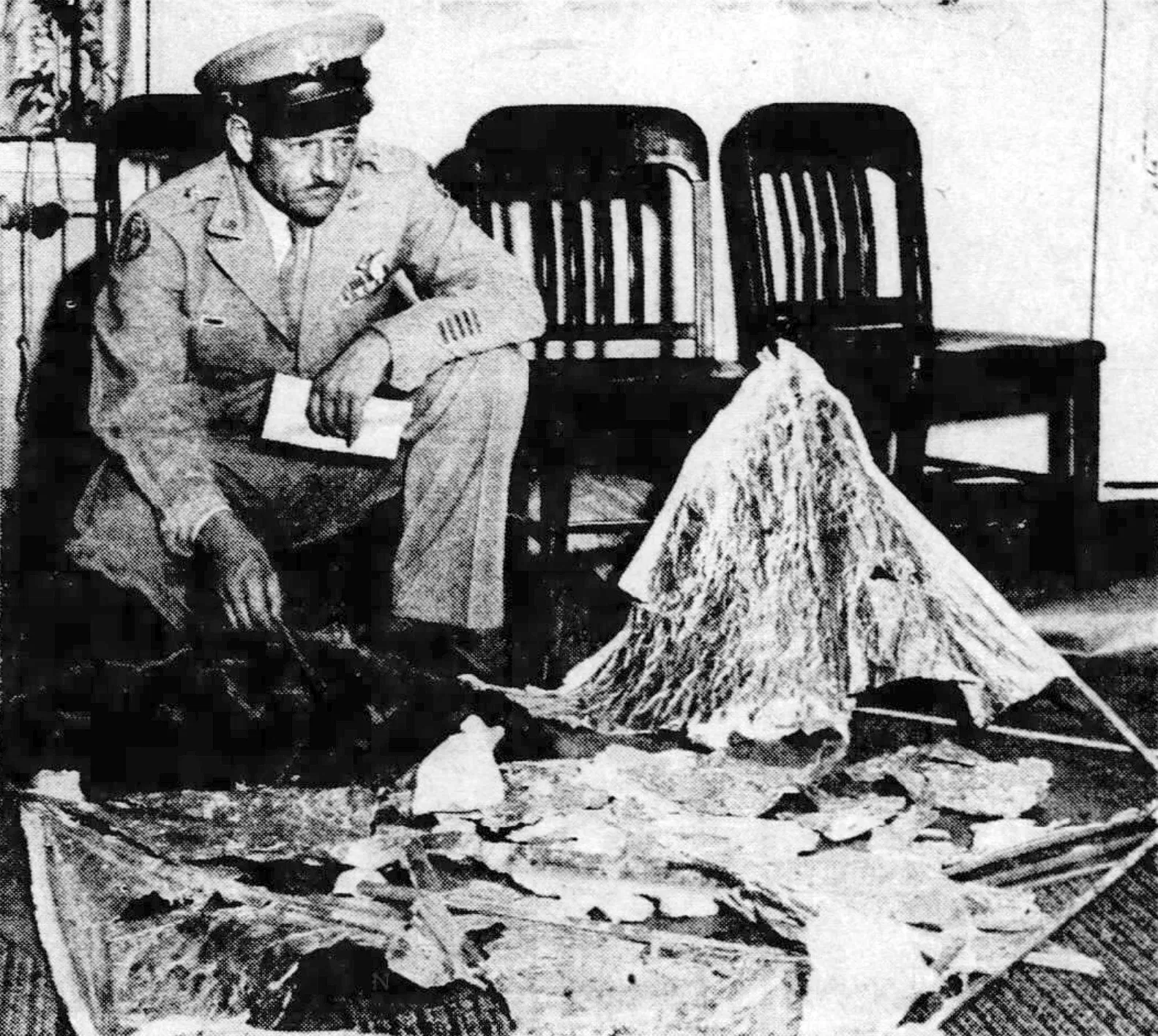
The basic events of July 1947 were documented at the time: rancher William Brazel reported scattered debris; Roswell Army Air Field announced the recovery of a “flying disc”; and senior officers soon presented balloon-like material while withdrawing the original claim. What was largely absent from contemporary reporting was the elaborate story later associated with Roswell. The surviving 1947 accounts did not establish an intact spacecraft, a military cordon around alien bodies or a secret autopsy.
Public interest revived after UFO researcher Stanton Friedman interviewed former intelligence officer Jesse Marcel in the late 1970s. Marcel recalled that the material collected from the ranch had extraordinary qualities and said he believed it had not originated on Earth. His testimony became a foundation for The Roswell Incident, published in 1980, and prompted investigators to seek additional witnesses. Roswell consequently changed from an obscure debris episode into a retrospective witness investigation.[TIME]time.comHow the Roswell UFO Theory Got StartedBrazel encontró restos extraños en su rancho cerca de Roswell, N.M. Tras contactar al Sheriff George Wilcox, quien a su vez llamó la base…
This chronology matters. A witness interviewed in 1978 was not simply retrieving an untouched record stored since 1947. During the intervening decades, flying saucers had become a familiar cultural idea; reports of alien occupants had entered books, films and television; and official secrecy had become closely associated with conspiracy narratives. Later witnesses were remembering the original period from within a very different cultural setting.
The distinction is not proof that Marcel or other witnesses invented their experiences. Marcel may sincerely have remembered unusual material. However, his description must be weighed against the delay, the absence of preserved samples and photographs from Fort Worth showing conventional-looking balloon and radar-target debris. Even Roswell researchers who favour a more extraordinary interpretation acknowledge that eyewitness descriptions and photographic evidence pull in different directions.[Journal of Scientific Exploration]journalofscientificexploration.orgSource details in endnotes.
Why sincere witnesses can still be mistaken
Memory does not function like a recording that can be replayed without alteration. Each act of recall is a reconstruction. Details may be retained accurately, forgotten, inferred or combined with information acquired afterwards. Research on the “misinformation effect” has repeatedly shown that misleading post-event material can alter what witnesses later report about an experience. The influence may come from interview questions, news coverage, photographs, other witnesses or repeated retellings.[washington.edu]staff.washington.eduMike's erroneous report is analogous to the thousands of erroneous reports after the receipt of misinformation that have been obtained in…
Several mechanisms are particularly relevant to Roswell:
- Source-monitoring errors: A person may remember a detail but lose track of whether it came from personal observation, another person’s story, a newspaper account or a later reconstruction.
- Temporal compression: Separate events from different years may become remembered as parts of one episode, especially when they share a location, institution or emotional theme.
- Rehearsal and narrative sharpening: Repeatedly telling a story can stabilise its main structure while uncertain details become cleaner, more dramatic or more definite.
- Social reinforcement: When witnesses speak with researchers, relatives or one another, shared details can begin to feel like independent recollections.
- Confidence inflation: Repetition and validation can increase certainty without necessarily increasing accuracy.
None of these processes requires conscious deception. A witness can speak earnestly, provide vivid sensory details and remain consistent during one interview while still being wrong about when, where or how an event occurred. For that reason, sincerity is evidence about a person’s belief, not conclusive evidence about the historical event being described.[cambridge.org]cambridge.orgOpen source on cambridge.org.
Memory research also does not justify dismissing all delayed testimony. People can preserve important experiences for decades, particularly when an event was unusual or personally significant. The correct question is therefore not whether a memory is old, but how well it is supported. Early written statements, independently recorded accounts, stable details and corroborating physical evidence increase its value. Recollections first documented after extensive publicity, especially when they change across interviews, require greater caution.
How interviews helped shape the Roswell narrative
Roswell witnesses were usually interviewed by people already investigating the possibility of a crashed extraterrestrial craft. That created a structural risk: investigators knew the story they were attempting to confirm and often approached witnesses with names, places or scenarios gathered from previous interviews.
Even without deliberate pressure, the form of a question can affect an answer. Asking, “Did you see unusual writing on the metal?” differs from asking, “Describe everything you remember seeing.” The first question introduces both the existence of writing and the assumption that the object was metal. Once supplied, such details may later be difficult for a witness to separate from the original recollection.
Repeated interviewing creates an additional problem. A tentative response in one conversation can become a fixed element in later retellings, particularly after it appears in a book or documentary. Published accounts may then influence other witnesses, whose apparently corroborating memories are no longer fully independent. The resulting body of testimony can look like numerous separate lines of evidence even though some details may share a common source.
Roswell research also involved investigators competing over witnesses, crash-site locations and publication claims. As the story expanded, witnesses were sometimes asked to adjudicate between already developed versions. This can encourage a recollection to take the shape of the available alternatives rather than emerge in the witness’s own language.
The problem is methodological rather than uniquely “ufological”. Modern eyewitness practice favours open questions, careful records of every interview, early separation of witnesses and disclosure of information supplied by the interviewer. Many important Roswell interviews occurred before such controls were applied, and complete recordings or first-interview transcripts are not always available. That makes it difficult to determine which details were volunteered spontaneously and which appeared only after prompting.
Alien-body accounts and displaced memories
Claims involving recovered bodies illustrate the dispute over memory especially clearly. Most appeared long after 1947 and varied substantially over the number, appearance and location of the bodies. The US Air Force’s 1997 report argued that some witnesses had combined the Roswell story with memories of later military activities in New Mexico, including high-altitude balloon experiments using anthropomorphic test dummies and aircraft accidents involving injured or dead personnel. The report described this as “time compression”: events from the 1950s could have migrated backwards in memory and become attached to July 1947.[U.S. Air Force]af.milU.S. Air Force The Roswell Report The Roswell Report: Case Closed … "Aliens" observed in the New Mexico desert were actually anthropomoU.S. Air Force The Roswell Report The Roswell Report: Case Closed … "Aliens" observed in the New Mexico desert were actually anthropomo
The explanation is plausible as a memory mechanism but remains contested as a complete account of the testimony. Critics point out that the dummy drops began several years after the original debris recovery. If a witness gave a precise, independently documented 1947 account, a later dummy operation would not explain it merely because both occurred in New Mexico.
That objection identifies the real evidentiary test. The question is whether each body account was independently tied to July 1947 before the witness encountered the developed Roswell story. In many cases, the date was reconstructed through association: the person remembered an unusual military event and later concluded that it must have been connected with Roswell. Under those circumstances, a chronological mismatch does not disprove temporal displacement; it may be evidence of it.
The Air Force report’s broad treatment of different witnesses also has limits. It sought common terrestrial events that could account for categories of recollection, but that does not show exactly how a particular person formed a particular memory. Official explanations therefore should not be treated as psychological diagnoses of individual witnesses. They provide possible sources of confusion that must be tested case by case.
When memorable testimony collapsed under checking
The history of Roswell research contains examples in which vivid testimony initially appeared important but weakened when investigators checked documents, biography or internal consistency. These cases show why memory cannot be assessed through confidence and narrative detail alone.
Jim Ragsdale, for example, claimed that he and a companion had been close to a crashed disc and had seen bodies. Psychologist James Houran and forensic psychologist Stephen Porter applied statement-validity and fact-pattern analysis to his account. They identified a major contradiction and details they considered implausible. Their conclusion was not that they could prove deliberate fraud, but that the story was consistent either with fabrication or with a sincerely held memory of an event that did not occur as described.[ResearchGate]researchgate.netOpen source on researchgate.net.
That distinction is crucial. A failed claim does not always reveal whether its origin was deception, confusion, suggestion or ordinary autobiographical reconstruction. Historical analysis can often determine that an account is unreliable without determining exactly why its narrator believed or repeated it.
Other celebrated witnesses were challenged through ordinary documentary work rather than psychological theory. Roswell investigators themselves eventually rejected or reduced their reliance on some accounts after discovering false credentials, incompatible timelines or changing stories. This self-correction is significant because it demonstrates that scepticism about testimony did not come only from government officials or opponents of the extraterrestrial hypothesis. Researchers sympathetic to Roswell also found that apparently impressive memories could fail external checks.
Yet discredited accounts often continued circulating after researchers abandoned them. Books, television programmes and websites preserve earlier versions, while corrections attract less attention. Public memory therefore retains evidence differently from historical scholarship: a dramatic story can remain part of the Roswell legend even after its original evidential role has disappeared.

Missing records increased the power of recollection
Witness memory became unusually influential partly because the documentary record is incomplete. A US Government Accountability Office search found that some Roswell Army Air Field administrative records and outgoing messages from the relevant period had been destroyed. The surviving disposal documentation did not establish who authorised their destruction or precisely when it occurred. The GAO did not report finding records that demonstrated an extraterrestrial recovery, but the missing material left questions that documents could no longer answer.[Government Accountability Office]gao.govnsiadGAOPursuant to a congressional request, GAO provided information on the 1947 weather balloon crash at Roswell Army Air Field (RAAF), New…
Such gaps have opposite effects on different readers. For believers in a cover-up, missing records appear consistent with suppression. For sceptics, they mean that unverifiable memories cannot be checked against the paperwork that might have corrected them. Neither conclusion follows automatically from the destruction itself, which may reflect routine records management rather than concealment.
The practical consequence is that testimony carries more argumentative weight while becoming harder to validate. A witness can claim that an order, telephone call or security operation once existed, and the absence of files can neither confirm nor decisively refute the recollection. Roswell thus contains a recurring evidential trap: missing documentation is treated as a reason to rely on memory, while the same absence prevents memory from being properly tested.
Personal, family and community memory
Roswell recollections were not formed only by isolated individuals. They were also preserved within families and the local community. Relatives repeated stories about debris, military warnings or unexplained activity; investigators returned to the same households; and Roswell gradually embraced the incident as part of its public identity.
Family testimony can preserve valuable information, but it is not automatically independent corroboration. When a parent and child discuss an event over many years, their later accounts may converge. Each may sincerely remember personal details while also absorbing elements from the other’s story. The same applies when a relative reports what a deceased witness supposedly said: the evidence is about both the original event and the family’s subsequent transmission of it.
Community memory operates on a larger scale. Once Roswell became internationally famous, local recollections were organised around a recognised plot: unusual recovery, military secrecy and suppressed truth. Ambiguous experiences could then acquire a clearer meaning. A recollection of soldiers on a road, a hospital inquiry or wreckage from an unrelated accident might be reinterpreted as part of the 1947 episode.
This does not make community memory worthless. It reveals how an event becomes culturally durable. Roswell survived not because every detail remained stable, but because a simple central pattern accommodated changing testimony: something extraordinary happened, the military concealed it and witnesses later broke their silence. Contradictions could be explained as the effects of secrecy, intimidation or compartmentalisation, allowing the larger narrative to persist even as particular claims failed.
How Roswell memories should be weighed
The strongest approach is neither to accept witnesses because they appear sincere nor to reject them merely because they spoke late. Each account should be assessed through several connected questions:
- When was it first recorded? A statement documented close to 1947 generally carries more weight than one first made after decades of publicity.
- Was it volunteered or prompted? Details supplied before an interviewer introduced them are more valuable than responses to leading questions.
- Is the witness’s access established? A person’s job title, location and opportunity to observe should be independently verified.
- Did the account remain stable? Significant changes in crash location, bodies, materials or personal involvement weaken reliability.
- Is corroboration genuinely independent? Witnesses who shared information, belonged to the same family or read the same books may not represent separate sources.
- Does external evidence support it? Documents, photographs, dated correspondence and physical material provide stronger anchors than confidence or vividness.
- Are ordinary sources of confusion available? Later balloon operations, aircraft accidents, rumours and media accounts should be considered before invoking extraordinary causes.
Applied consistently, these criteria leave a mixed picture. The earliest record securely establishes a debris recovery and a confused military announcement. Later testimony adds information about how participants remembered the episode, including a persistent belief among some that the displayed balloon material did not tell the whole story. It does not, by itself, securely establish alien bodies or an extraterrestrial spacecraft.
Memory is part of the event, not merely a flaw in it
The role of memory in Roswell is larger than the question of whether individual witnesses remembered correctly. Memory was the mechanism through which the modern incident was created. The events of 1947 supplied a puzzling core, but interviews, books, family stories, official reports and public controversy repeatedly reconstructed what that core meant.
This explains why Roswell can contain genuine historical facts, sincere witnesses, demonstrably unreliable accounts and unresolved questions at the same time. Memory does not force a choice between “everything happened exactly as recalled” and “everyone lied”. It produces a more demanding conclusion: testimony must be treated as evidence shaped by time, suggestion, social contact and later knowledge.
Roswell remains compelling partly because the surviving evidence never fully closes the gap between the modest contemporary record and the extraordinary story remembered afterwards. Understanding how that gap was filled does not solve every dispute about the debris. It does, however, explain why late recollections cannot simply be added together as though they were independent recordings made in July 1947—and why the evolution of the testimony is itself one of the most revealing parts of the Roswell story.
Amazon book picks
Further Reading
Books and field guides related to The Role. Use these as the next step if you want deeper reading beyond the article.
The Seven Sins of Memory: How the Mind Forgets and Remembers
Rating: 3.5/5 from 5 Google Books ratings
A New York Times Notable Book: A psychologist's "gripping and thought-provoking" look at how and why our brains sometimes fail us (Steven...
The Memory Illusion: Remembering, Forgetting, and the Science...
THE INTERNATIONAL BESTSELLER 'Truly fascinating.' Steve Wright, BBC Radio 2 - Have you ever forgotten the name of someone you’ve met doze...
Eyewitness Testimony
Every year hundreds of defendants are convicted on little more than the say-so of a fellow citizen. Although psychologists have suspected...
Searching for Memory: The Brain, the Mind, and the Past
Memory. There may be nothing more important to human beings than our ability to enshrine experience and recall it. While philosophers and...
eBay marketplace picks
Marketplace Samples
Live-tested eBay searches with available results related to this page.
Selected fromUFO memorabilia oneBay.co.uk.
Endnotes
1.
Source: gao.gov
Title: nsiad 95 187
Link:https://www.gao.gov/products/nsiad
Source snippet
Pursuant to a congressional request, GAO provided information on the 1947 weather balloon crash at Roswell Army Air Field (RAAF), New...
2.
Source: time.com
Title: How the Roswell UFO Theory Got Started
Link:https://time.com/3916193/roswell-history/
Source snippet
Brazel encontró restos extraños en su rancho cerca de Roswell, N.M. Tras contactar al Sheriff George Wilcox, quien a su vez llamó la base...
3.
Source: cambridge.org
Link:https://www.cambridge.org/core/journals/episteme/article/reevaluating-the-credibility-of-eyewitness-testimony-the-misinformation-effect-and-the-overcritical-juror/B8F651467F46D7D1BCA7F73D46C93FE4
4.
Source: researchgate.net
Link:https://www.researchgate.net/profile/James-Houran/publication/237370361_Statement_Validity_Analysis_of_The_Jim_Ragsdale_Story_Implications_for_the_Roswell_Incident/links/00b49533952c7f2029000000/Statement-Validity-Analysis-of-The-Jim-Ragsdale-Story-Implications-for-the-Roswell-Incident.pdf
5.
Source: researchgate.net
Title: RESEARC H A Grounded Theory Update on the Roswell UFO Incident
Link:https://www.researchgate.net/publication/362854511_A_Grounded_Theory_Update_on_the_Roswell_UFO_Incident/fulltext/63a499df097c7832ca5912b6/362854511_A_Grounded_Theory_Update_on_the_Roswell_UFO_Incident.pdf
6.
Source: gao.gov
Link:https://www.gao.gov/products/154832
7.
Source: gao.gov
Title: afmd 93 39r
Link:https://www.gao.gov/products/afmd-93-39r
8.
Source: gao.gov
Title: b 226375 om
Link:https://www.gao.gov/products/b-226375-om
9.
Source: gao.gov
Title: lcd 78 104
Link:https://www.gao.gov/products/lcd
10.
Source: gao.gov
Title: b 168491
Link:https://www.gao.gov/products/b-168491
11.
Source: gao.gov
Title: b 61666
Link:https://www.gao.gov/products/b-61666
12.
Source: gao.gov
Title: b 149213
Link:https://www.gao.gov/products/b-149213
13.
Source: gao.gov
Title: b 142058
Link:https://www.gao.gov/products/b-142058
14.
Source: gao.gov
Title: b 139886
Link:https://www.gao.gov/products/b-139886
15.
Source: gao.gov
Title: b 130692
Link:https://www.gao.gov/products/b-130692
16.
Source: gao.gov
Title: b 53418
Link:https://www.gao.gov/products/b-53418
17.
Source: staff.washington.edu
Link:https://staff.washington.edu/eloftus/Articles/hoff.htm
Source snippet
Mike's erroneous report is analogous to the thousands of erroneous reports after the receipt of misinformation that have been obtained in...
18.
Source: journalofscientificexploration.org
Link:https://journalofscientificexploration.org/index.php/jse/article/view/2635
Source snippet
"36 No. 2 (2022) A Grounded Theory Update on the Roswell UFO Incident Research Articles [https://doi.org/..."](https://doi.org/...")...
19.
Source: researchportal.port.ac.uk
Link:https://researchportal.port.ac.uk/en/publications/how-to-protect-eyewitness-memory-against-the-misinformation-effec/
20.
Source: pmc.ncbi.nlm.nih.gov
Link:https://pmc.ncbi.nlm.nih.gov/articles/PMC11680610/
21.
Source: pubmed.ncbi.nlm.nih.gov
Link:https://pubmed.ncbi.nlm.nih.gov/38696106/
22.
Source: af.mil
Link:https://www.af.mil/[The-Roswell-Report
23.
Source: anomalydesk.com
Title: roswell incident
Link:https://anomalydesk.com/roswell-incident.html
24.
Source: disclosdex.com
Title: Jesse Marcel | Disclosdex
Link:https://disclosdex.com/people/jesse-marcel
25.
Source: journalofscientificexploration.org
Title: RESEARC H A Grounded Theory Update on the Roswell UFO Incident
Link:https://journalofscientificexploration.org/index.php/jse/article/download/2635/1631
26.
Source: af.mil
Title: R L played major role in historic near-space jump > Air Force > Article Display
Link:https://www.af.mil/News/Article-Display/Article/110192/afrl-played-major-role-in-historic-near-space-jump/
27.
Source: af.mil
Title: A century of memories > Air Force > Display
Link:https://www.af.mil/News/Features/Display/Article/142783/a-century-of-memories/
28.
Source: af.mil
Title: Child-abuse prevention: Break cycle of pain > Air Force > Article Display
Link:https://www.af.mil/News/Article-Display/Article/137091/child-abuse-prevention-break-cycle-of-pain/
29.
Source: staff.washington.edu
Link:https://staff.washington.edu/eloftus/
30.
Source: decur.org
Title: Roswell Incident
Link:https://decur.org/cases/roswell-1947
31.
Source: af.mil
Link:https://www.af.mil/News/Photos/igphoto/2002866833/
32.
Source: af.mil
Link:https://www.af.mil/The-Roswell-Report/_bhlid/f4a0c3623ce5085676f0426ec242a4ba91786be7/
Additional References
33.
Source: psychologicalscience.org
Link:https://www.psychologicalscience.org/journals/current-directions/0963721410396620/
Source snippet
A wealth of research from the past century has demonstrated, however, that eyewitness memory is malleable and vulnerable to distorting in...
34.
Source: archives.gov
Link:https://www.archives.gov/research/topics/uaps/moving-images-and-sound
35.
Source: archives.gov
Link:https://www.archives.gov/press/press-releases/2015/nr15-97.html
36.
Source: archives.gov
Link:https://www.archives.gov/press/press-releases/2008-206
37.
Source: archives.gov
Link:https://www.archives.gov/press/press-releases/2008-60
38.
Source: youtube.com
Title: Reel America: “The Roswell Reports”
Link:https://www.youtube.com/watch?v=m7rVSri-7es
Source snippet
Were Alien Bodies Found At Roswell's UFO Crash?...
39.
Source: ufologie.patrickgross.org
Link:https://ufologie.patrickgross.org/rw/d/ni1980pratt.htm
Source snippet
UFOS at close sight: Roswell 1947, first ufologists investigations, Bob Pratt in the National Enquirerufo - UFOS at close sight: Roswell...
40.
Source: youtube.com
Title: ALIEN CHRONICLES (S1E9)
Link:https://www.youtube.com/watch?v=Qvd986WnPMQ
Source snippet
Alien Encounters: Roswell | Unexplained UFOs...
41.
Source: youtube.com
Title: Were Alien Bodies Found At Roswell’s UFO Crash?
Link:https://www.youtube.com/watch?v=AlFuucsLIVk
Source snippet
ALIEN CHRONICLES (S1E9) - STANTON FRIEDMAN - ALIEN AND UFOS...
42.
Source: youtube.com
Title: Alien Encounters: Roswell | Unexplained UFOs
Link:https://www.youtube.com/watch?v=ma7sxiw77IM
Source snippet
The [Roswell UFO Crash]({{ 'roswell-ufo-crash/' | relative_url }}): Uncovering the Truth Behind the Legend...