Within Project Mogul
Could the Atmosphere Carry a Nuclear Blast Signal?
Project Mogul relied on layers of air that could carry low-frequency blast waves far beyond normal listening range.
On this page
- How temperature and wind bend sound waves
- Why low frequency pressure waves travel farther
- What Mogul instruments were designed to hear
Page outline Jump by section
Introduction
Project Mogul was built around an unusual scientific idea: that the atmosphere itself might act as a natural waveguide for the low-frequency pressure waves produced by a large explosion. Before satellites or global sensor networks existed, American researchers explored whether a Soviet nuclear test could be detected from thousands of kilometres away by placing sensitive microphones in high-altitude balloon systems. Rather than relying on ordinary sound, the concept focused on extremely low-frequency acoustic energy—today commonly called infrasound—which can travel much farther under favourable atmospheric conditions than sounds heard by the human ear. This mechanism became the scientific foundation for Project Mogul and, indirectly, for the official explanation of the debris recovered near Roswell in 1947.[Muller Lab]muller.lbl.govMuller Lab Project MogulMuller Lab Project Mogul
How temperature and wind bend sound waves
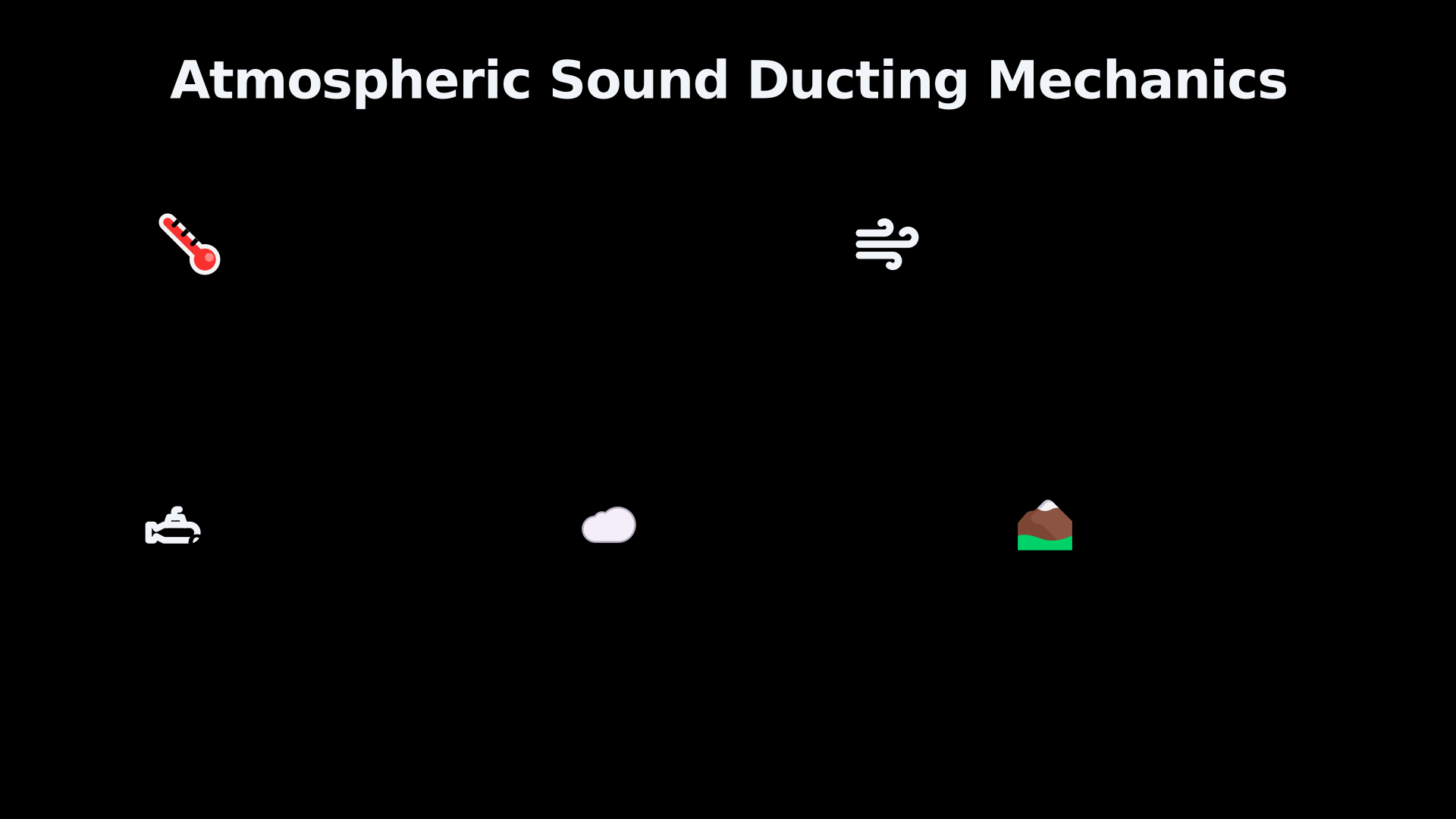
Sound does not travel through the atmosphere in a straight line under all conditions. Its speed changes with temperature, while winds can effectively increase or decrease the speed of sound depending on the direction of travel. When these properties vary with altitude, sound waves are refracted, or gradually bent, rather than simply spreading outward.
Researchers such as geophysicist Maurice Ewing recognised that certain combinations of temperature and wind could create an atmospheric layer where sound repeatedly curved back towards the same altitude instead of escaping upward into thinner air or downward towards the ground. In effect, this layer could behave like an acoustic duct, guiding low-frequency waves across enormous distances. The idea was inspired by the ocean’s SOFAR (Sound Fixing and Ranging) channel, where underwater sound is naturally trapped and carried over thousands of kilometres. Ewing proposed that an atmospheric equivalent might exist in the upper atmosphere and could be exploited for long-range surveillance.[Muller Lab]muller.lbl.govMuller Lab Project MogulMuller Lab Project Mogul
Unlike a rigid pipe, this atmospheric channel was neither permanent nor uniform. Its position and strength changed with the weather, seasonal circulation patterns and high-altitude winds. As a result, predicting when and where long-range propagation would occur became as important as building sensitive listening equipment.
Why low-frequency pressure waves travel farther
Project Mogul concentrated on very low-frequency acoustic waves because they lose energy much more slowly than ordinary audible sounds.
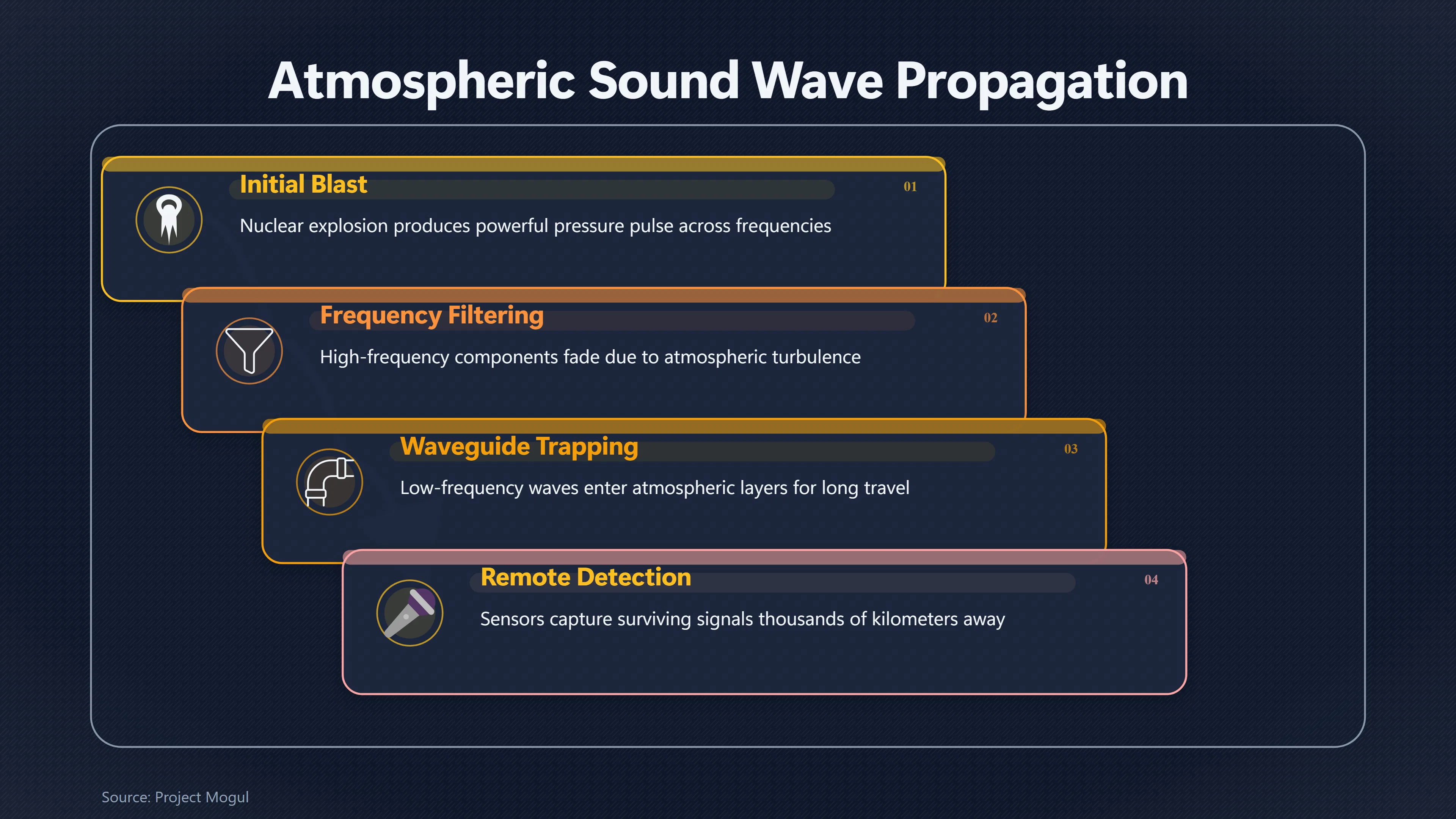
High-frequency sounds are rapidly scattered and absorbed by atmospheric turbulence and molecular interactions. Low-frequency waves, by contrast, have much longer wavelengths that are less affected by small-scale irregularities in the atmosphere. When these waves become trapped within an atmospheric duct, they can propagate over distances that would otherwise be impossible for conventional sound.
For a nuclear explosion, the initial blast produces a powerful pressure pulse spanning a broad range of frequencies. Even after higher-frequency components fade away, the low-frequency portion can continue travelling through favourable atmospheric layers. Detecting that surviving signal was the central scientific objective behind Project Mogul.
Modern atmospheric research has confirmed that elevated acoustic ducts capable of carrying infrasound do exist. Direct balloon observations published in 2023 demonstrated that sensors operating inside such a channel detected signals that ground-based instruments largely missed, providing strong experimental support for the physical principle that Mogul scientists had proposed decades earlier.[AGU Publications]agupubs.onlinelibrary.wiley.comAGU PublicationsThe AtmoSOFAR Channel: First Direct Observations of an Elevated Acoustic Duct - Albert - 2023 - Earth and Space Science…
What Mogul instruments were designed to hear
The balloon trains were intended to carry highly sensitive microphones capable of recording infrasonic pressure fluctuations rather than conventional audible sounds.
The overall system combined several components:
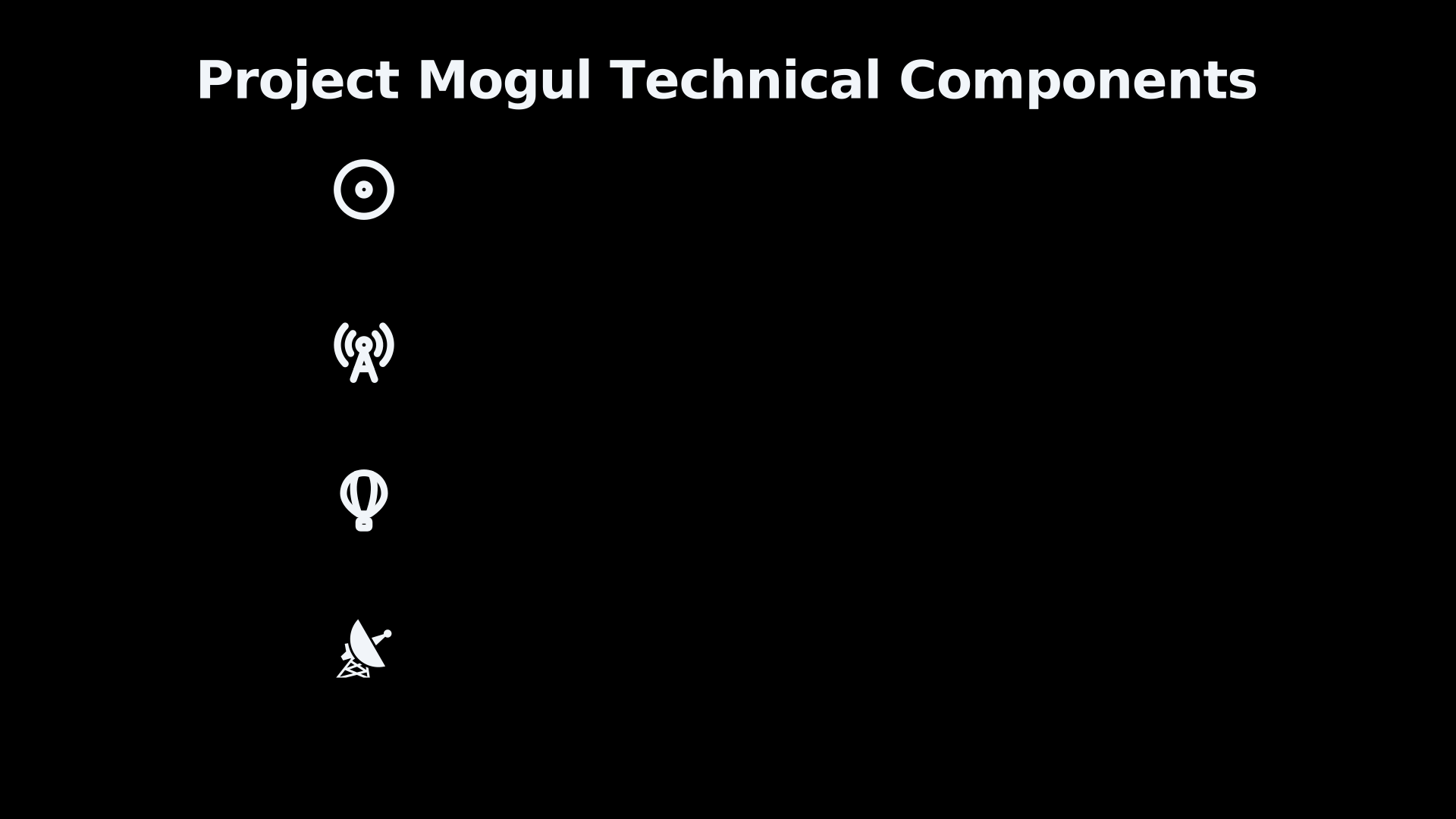
- Disc microphones designed to respond to very low-frequency pressure changes.
- Radio transmitters that relayed measurements to receiving stations without requiring recovery of the equipment.
- Constant-altitude balloon trains intended to keep the sensors within the predicted acoustic layer for extended periods.
Maintaining altitude was critical. If the microphones drifted well above or below the expected sound channel, they might miss the strongest signals altogether. This requirement explains why Project Mogul invested heavily in developing complex balloon arrays and altitude-control techniques rather than relying on ordinary weather balloons, which naturally rise and burst or descend unpredictably.[Wikipedia]WikipediaProject MogulProject Mogul
Why balloon altitude mattered so much
One common misunderstanding is that the balloons were simply raised as high as possible. In reality, the goal was to place the instruments at an altitude where the atmosphere itself favoured long-distance sound propagation.
Scientists expected that sensors operating close to the acoustic duct would receive stronger, clearer signals than instruments located on the ground. Ground-level microphones suffer from interference caused by terrain, surface winds and local weather. By lifting the sensors into the free atmosphere, Mogul attempted to reduce those effects while placing the microphones nearer the anticipated propagation path.
The project therefore represented an early effort to use the atmosphere not merely as the medium through which sound travelled, but as part of the detection system itself.
The strengths and limits of the concept
The underlying physics proved sound, but applying it operationally was far more difficult.
The atmosphere changes continuously, so the precise location and efficiency of acoustic ducts vary from day to day. That variability complicated prediction, tracking and interpretation of received signals. Balloon systems also presented engineering challenges, including maintaining stable altitude, preserving radio communications and recovering equipment after flights.
Although Project Mogul itself remained experimental and was eventually superseded by other nuclear monitoring methods, the broader concept of long-range infrasound detection endured. Atmospheric infrasound is now an established component of international nuclear-test monitoring, with modern systems combining sophisticated propagation models, digital sensors and global networks. Studies of historical Soviet test sites and more recent nuclear events continue to demonstrate that atmospheric channels can transport low-frequency signals over very long distances when atmospheric conditions are favourable.[sciencedirect.com]sciencedirect.comOn simulation of the atmospheric acoustic channel for some nuclear tests in former soviet test site Semipalatinsk - ScienceD…
Why this mechanism matters to the Roswell explanation
Within the Roswell story, the atmospheric sound-channel concept explains why Project Mogul required unusual balloon assemblies instead of ordinary meteorological equipment. The balloons were not simply measuring weather conditions; they were experimental platforms designed to test whether the upper atmosphere could serve as a long-range listening system for distant Soviet nuclear explosions.
Understanding that mechanism helps explain both the secrecy surrounding the programme and why its balloon trains carried an unconventional mixture of balloons, acoustic instruments, radio equipment and radar reflectors. Those technical requirements distinguish Project Mogul from routine weather balloon operations and underpin its role in the official account of the Roswell debris.[Muller Lab]muller.lbl.govMuller Lab Project MogulMuller Lab Project Mogul
Amazon book picks
Further Reading
Books and field guides related to Could the Atmosphere Carry a Nuclear Blast Signal?. Use these as the next step if you want deeper reading beyond the article.
Area 51
The explosive, untold story of the Cold War's biggest secret from the bestselling author of NUCLEAR WAR: A SCENARIO 'An extraordinary boo...
Skunk Works
This classic history of America's high-stakes quest to dominate the skies is "a gripping technothriller in which the technology is real"...
Roswell: Inconvenient Facts and the Will to Believe
For over fifty years an incident near Roswell, New Mexico, has sparked the imaginations of UFO enthusiasts. Did the military recover a cr...
Introduction to Acoustics
No branch of classical physics is older in its origins yet more modern in its applications than acoustics. Courses on acoustics very natu...
eBay marketplace picks
Marketplace Samples
Live-tested eBay searches with available results related to this page.
Selected fromCold War aviation poster oneBay.co.uk.


Endnotes
1.
Source: Wikipedia
Title: Project Mogul
Link:https://en.wikipedia.org/wiki/Project_Mogul
2.
Source: sciencedirect.com
Link:https://www.sciencedirect.com/science/article/abs/pii/S1364682611000411
Source snippet
On simulation of the atmospheric acoustic channel for some nuclear tests in former soviet test site Semipalatinsk - ScienceD...
3.
Source: academic.oup.com
Link:https://academic.oup.com/gji/article/228/1/308/6355443
Source snippet
OUP AcademicIlluminating the North Korean nuclear explosion test in 2017 using remote infrasound observations | Geophysical Journal Inter...
4.
Source: youtube.com
Title: What really happened at Roswell: the sound channel and sky whales
Link:https://www.youtube.com/watch?v=DdSX-7vWyS8
Source snippet
Project Mogul...
5.
Source: youtube.com
Title: Project Mogul
Link:https://www.youtube.com/watch?v=mBcYtSsPIuU
Source snippet
The Top Secret Project That Spawned [the Roswell UFO]({{ 'the-roswell-ufo/' | relative_url }}) Incident...
6.
Source: muller.lbl.gov
Title: Muller Lab Project Mogul
Link:https://muller.lbl.gov/teaching/physics10/Roswell/USMogulReport.html
7.
Source: agupubs.onlinelibrary.wiley.com
Link:https://agupubs.onlinelibrary.wiley.com/doi/10.1029/2023EA003149
Source snippet
AGU PublicationsThe AtmoSOFAR Channel: First Direct Observations of an Elevated Acoustic Duct - Albert - 2023 - Earth and Space Science...
8.
Source: agupubs.onlinelibrary.wiley.com
Link:https://agupubs.onlinelibrary.wiley.com/doi/abs/10.1029/2023EA003149
Source snippet
A. Albert, Corresponding Author S. A. Albert * [email protected] * orcid.org/0000-0002-2369-1997 Sandia National...
9.
Source: muller.lbl.gov
Title: [Roswell Incident]({{ ‘the-1980-book/’ | relative_url }})
Link:https://muller.lbl.gov/teaching/physics10/Roswell/RoswellIncident.html
10.
Source: agupubs.onlinelibrary.wiley.com
Link:https://agupubs.onlinelibrary.wiley.com/doi/pdf/10.1029/JC079i033p05007
11.
Source: agupubs.onlinelibrary.wiley.com
Link:https://agupubs.onlinelibrary.wiley.com/doi/abs/10.1029/JC079i033p05007
12.
Source: agupubs.onlinelibrary.wiley.com
Link:https://agupubs.onlinelibrary.wiley.com/doi/abs/10.1029/JC075i036p07517
13.
Source: military-history.fandom.com
Title: Project Mogul
Link:https://military-history.fandom.com/wiki/Project_Mogul
Additional References
14.
Source: sandia.gov
Link:https://www.sandia.gov/research/publications/details/the-atmosofar-channel-first-direct-observations-of-an-elevated-acoustic-duc-2023-10-01/
Source snippet
The AtmoSOFAR Channel: First Direct Observations of an Elevated Acoustic Duct – Publications – ResearchOctober 1, 2023 — THE ATMOSOFAR CH...
Published: October 1, 2023
15.
Source: dxaudio.com
Title: SOFA R So Good | A Sound Education from Dynamix
Link:https://www.dxaudio.com/news-front-page/sound-ed/files/4264cb4b149ff0c48d6fd7bdb927bc53-116.html
Source snippet
A SOUND EDUCATION SOFAR SO GOOD May 20, 2022 05:43 PM Filed in: Did You Know? | History Image: UFO cloud As terrible as war is, it of...
Published: May 20, 2022
16.
Source: handwiki.org
Title: Unsolved:Project Mogul
Link:https://handwiki.org/wiki/Unsolved%3AProject_Mogul
Source snippet
December 23, 2025 — UNSOLVED:PROJECT MOGUL From HandWiki [Input] Short description: US surveillance project from 1947 to 1949 A P...
Published: December 23, 2025
17.
Source: youtube.com
Title: The [Roswell UFO Crash]({{ ‘roswell-ufo-crash/’ | relative_url }}) (Overview)
Link:https://www.youtube.com/watch?v=ZltLHh_WsZs
Source snippet
What really happened at Roswell: the sound channel and sky whales This video directly focuses on the atmospheric sound channel physics an...
18.
Source: youtube.com
Title: The Top Secret Project That Spawned the Roswell UFO Incident
Link:https://www.youtube.com/watch?v=h54XMccPH-Q
Source snippet
The Roswell Incident Mystery Finally Solved...
19.
Source: youtube.com
Title: The Roswell Incident Mystery Finally Solved
Link:https://www.youtube.com/watch?v=Pz0vYcc4KiI
Source snippet
The Roswell UFO Crash (Overview) - Jimmy Akin's Mysterious World...
20.
Source: researchgate.net
Link:https://www.researchgate.net/publication/374669244_The_AtmoSOFAR_Channel_First_Direct_Observations_of_an_Elevated_Acoustic_Duct
21.
Source: nationalacademies.org
Link:https://www.nationalacademies.org/read/5875/chapter/14
22.
Source: scribd.com
Link:https://www.scribd.com/document/931764073/Waves-Schwartz
23.
Source: nrc-publications.canada.ca
Link:https://nrc-publications.canada.ca/eng/view/object/?id=1feda06a-daf0-4df9-95cb-c79110943703