Within Cold War Technology
Why One Balloon Was Not Enough
Mogul combined many balloons, instruments and control devices because keeping sensors inside a narrow altitude band was exceptionally difficult.
On this page
- The altitude control problem
- Components of a Mogul balloon train
- How long assemblies broke apart
Page outline Jump by section
Introduction
Project Mogul did not use long balloon trains because engineers wanted an elaborate design for its own sake. They used them because the mission depended on solving an unusually difficult technical problem: keeping sensitive acoustic equipment within a narrow layer of the upper atmosphere for long enough to detect the low-frequency sound from distant Soviet nuclear tests. A single weather balloon could rise or fall too quickly as temperature, pressure and sunlight changed. The solution developed in 1947 was an experimental assembly of many balloons, instruments, radar targets and control devices working together as one system. This unusual configuration helps explain why debris from a Mogul flight looked very different from the simple weather balloons that most civilians expected, making the Roswell debris field easier to misunderstand while the programme itself remained classified.[Muller Lab]muller.lbl.govMuller Lab Project MogulMuller Lab Project Mogul
The altitude-control problem
The central engineering challenge for Project Mogul was not simply lifting instruments into the sky. It was keeping them at approximately the right altitude for hours.
Researchers believed that very low-frequency sound from large explosions could travel enormous distances within atmospheric layers where changes in temperature and air density refracted the sound waves instead of allowing them to disperse. If the microphones drifted well above or below that layer, their ability to detect distant signals could fall sharply.[Muller Lab]muller.lbl.govMuller Lab Project MogulMuller Lab Project Mogul
This created a problem that ordinary meteorological balloons were never designed to solve:
- A standard weather balloon climbs continuously until it bursts.
- Wind, solar heating and cooling constantly alter lift.
- Payload weight changes the balloon’s behaviour.
- Small changes in pressure can produce large altitude changes over long flights.
New York University’s contribution to Project Mogul therefore focused heavily on developing “constant-level” balloon systems capable of remaining near a selected altitude instead of following the normal climb-and-burst profile. Early launches relied on clusters of conventional neoprene balloons because the specialised polyethylene balloons intended for the project were not yet available in sufficient numbers.[Muller Lab]muller.lbl.govMuller Lab Project MogulMuller Lab Project Mogul
Why one balloon was not enough
A single balloon offered too little control and too little lifting capacity for an experimental intelligence platform.
Instead, Mogul engineers combined numerous balloons into one long flight train. Each balloon contributed a portion of the total lift. If one balloon failed or gradually lost gas, the entire system could often remain airborne rather than descending immediately. This distributed approach also made it easier to carry increasingly complex payloads while researchers experimented with different configurations.[Muller Lab]muller.lbl.govMuller Lab Project MogulMuller Lab Project Mogul
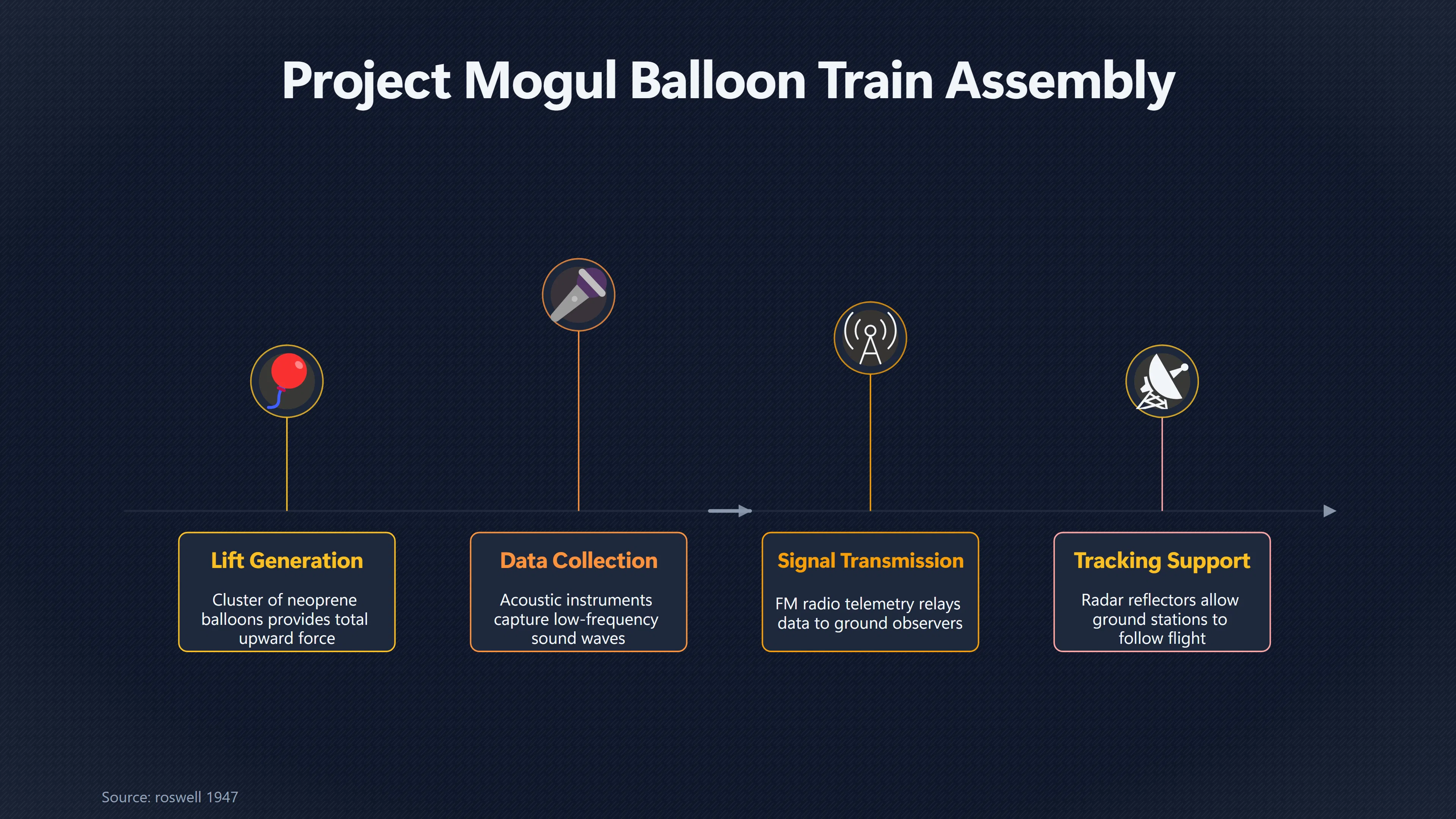
The long train also provided room for equipment that served different purposes simultaneously:
- Balloon clusters generated sufficient lift.
- Acoustic instruments collected low-frequency sound.
- Radio transmitters relayed data to observers.
- Power supplies operated the electronics.
- Radar reflectors allowed tracking aircraft and ground stations to follow the flight.
- Experimental altitude-control devices were tested alongside operational components.
Rather than a single instrument hanging beneath one balloon, Mogul resembled a modular research platform in which each section had its own function. The arrangement changed from flight to flight as engineers evaluated new equipment and operating techniques.[Muller Lab]muller.lbl.govMuller Lab Project MogulMuller Lab Project Mogul
Experimental rather than standardised
One reason Mogul balloon trains appear unusually complicated in photographs and technical descriptions is that the programme was still in development.
Engineers were testing multiple variables at once, including balloon materials, telemetry equipment, ballast systems and payload arrangements. Official reports describe the Alamogordo operations as efforts to perfect the handling of large balloon trains while simultaneously evaluating altitude-control and telemetering devices. In other words, many flights functioned as engineering experiments rather than routine operational missions.[Muller Lab]muller.lbl.govMuller Lab Project MogulMuller Lab Project Mogul
Components of a Mogul balloon train
Although no two early flights were necessarily identical, a typical experimental Mogul assembly could include:
- A cluster of numerous neoprene meteorological balloons.
- Suspension lines connecting successive sections.
- Acoustic sensing equipment, sometimes using adapted sonobuoy components while purpose-built instruments were still under development.
- FM radio telemetry equipment.
- Batteries and supporting electronics.
- Lightweight radar reflector assemblies constructed from balsa wood and reflective foil-covered material.
- Various experimental fittings related to altitude control or payload support.
Because these components were spread over a long vertical assembly, the entire train could extend hundreds of feet from the highest balloon to the lowest instrument package. Contemporary descriptions note that some complete Mogul trains exceeded 600 feet in overall length.[lbl.gov]muller.lbl.govMuller Lab Project MogulMuller Lab Project Mogul
How long assemblies broke apart
The same design that improved experimental performance also made recovery more complicated.
A long balloon train contained numerous attachment points, lightweight structural pieces and separate payload sections. During descent, wind loading, balloon failures or impacts with vegetation and the ground could separate different parts of the assembly. Rubber balloons deteriorated, suspension cords snapped and radar targets fragmented into smaller pieces.
Instead of finding one intact balloon with a single instrument box beneath it, someone encountering the remains might discover scattered rubber fragments, foil-covered reflector material, wooden sticks, cord, adhesive tape and pieces of electronic equipment distributed across a sizeable area. That pattern was entirely consistent with a large experimental balloon train breaking apart rather than a single weather balloon failing.[gutenberg.org]gutenberg.orgOpen source on gutenberg.org.
The lightweight radar reflectors added to the complexity. Built from thin balsa frames covered with reflective material, they were designed to be easily tracked by radar but could also fragment readily when subjected to weather or impact, leaving numerous small pieces instead of one recognisable object.[Project Gutenberg]gutenberg.orgOpen source on gutenberg.org.
Why the design mattered to the Roswell debate
Understanding why Mogul required long balloon trains clarifies one of the most persistent misconceptions surrounding Roswell.
The phrase “weather balloon” evokes a simple picture: one balloon carrying one small instrument. Project Mogul’s experimental flights looked nothing like that. Their length, multiple balloons, radar targets, electronic payloads and changing configurations reflected an attempt to solve a demanding altitude-control problem, not an effort to disguise exotic technology.
This distinction also explains why the debris described in many contemporary accounts included ordinary materials such as rubber, foil, wood, tape and cord. None of those components was individually remarkable. What was unusual was their combination within a large, classified experimental system whose strategic purpose—long-range detection of Soviet nuclear tests—could not be openly discussed in 1947.[lbl.gov]muller.lbl.govMuller Lab Project MogulMuller Lab Project Mogul
Amazon book picks
Further Reading
Books and field guides related to Why One Balloon Was Not Enough. Use these as the next step if you want deeper reading beyond the article.

The Roswell Report: Fact versus Fiction in the New Mexico Desert
First published 1995. Subjects: Unidentified flying objects, Sightings and encounters, Scientific applications, Balloons, Unidentified fl...
The Invention of Clouds: How an Amateur Meteorologist Forged...
An extraordinary yet little-known scientific advance occurred in the opening years of the nineteenth century when a young amateur meteoro...
The Weather Machine: A Journey Inside the Forecast
From the acclaimed author of Tubes, a lively and surprising tour through the global network that predicts our weather, the people behind...
eBay marketplace picks
Marketplace Samples
Live-tested eBay searches with available results related to this page.
Selected fromRoswell UFO collectible oneBay.co.uk.


Endnotes
1.
Source: gutenberg.org
Link:https://www.gutenberg.org/files/63659/old/63659-h/63659-h.htm
2.
Source: wired.com
Link:https://www.wired.com/story/roswell-aliens-fermi-paradox
Source snippet
However, an examination reveals a confluence of secret government projects and Cold War era activities rather than extraterrestrial invol...
3.
Source: altmystery.com
Title: roswell 1947
Link:https://www.altmystery.com/article/roswell-1947/
Source snippet
& Area 51 · AltMysteryMay 26, 2026 — The program's instrumentation consisted of balloon-launched microphone arrays, each suspended on a m...
Published: May 26, 2026
4.
Source: youtube.com
Link:https://www.youtube.com/watch?v=qwgYcnatLm0
Source snippet
Project Mogul...
5.
Source: youtube.com
Title: Project Mogul
Link:https://www.youtube.com/watch?v=mBcYtSsPIuU
Source snippet
The [Roswell Incident]({{ 'the-1980-book/' | relative_url }}) Mystery Finally Solved...
6.
Source: muller.lbl.gov
Title: Muller Lab Project Mogul
Link:https://muller.lbl.gov/teaching/physics10/Roswell/USMogulReport.html
7.
Source: Wikipedia
Title: Project Mogul
Link:https://en.wikipedia.org/wiki/Project_Mogul
8.
Source: muller.lbl.gov
Title: Muller Lab ROSWELL INCIDENT REPORT
Link:https://muller.lbl.gov/teaching/physics10/Roswell/RoswellIncident.html
9.
Source: military-history.fandom.com
Title: Project Mogul
Link:https://military-history.fandom.com/wiki/Project_Mogul
Additional References
10.
Source: kiddofspeed.com
Title: [the roswell ufo]({{ ‘the-roswell-ufo/’ | relative_url }}) incident of 1947 explained
Link:https://www.kiddofspeed.com/the-roswell-ufo-incident-of-1947-explained/
Source snippet
The Air Force concluded that this was the most likely source of the debris Brazel discovered on the Foster ranch. The debris field descri...
11.
Source: handwiki.org
Title: Unsolved:Project Mogul
Link:https://handwiki.org/wiki/Unsolved%3AProject_Mogul
Source snippet
December 23, 2025 — ^{[2]}^{[3]} Relative height of a [Project Mogul balloon]({{ 'project-mogul-balloon/' | relative_url }}) train Project Mogul was conceived by Maurice Ewing wh...
Published: December 23, 2025
12.
Source: common-sense-in-america.com
Title: What is Project Mogul?
Link:https://common-sense-in-america.com/2024/09/03/what-is-project-mogul/
Source snippet
Common Sense and Ramblings In AmericaSeptember 3, 2024 — WHAT IS PROJECT MOGUL? Image Image This is a new series of articles where I ex...
Published: September 3, 2024
13.
Source: youtube.com
Title: The Roswell Incident Mystery Finally Solved
Link:https://www.youtube.com/watch?v=Pz0vYcc4KiI
Source snippet
The [Roswell UFO Crash]({{ 'roswell-ufo-crash/' | relative_url }}) (Overview) - Jimmy Akin's Mysterious World...
14.
Source: en-academic.com
Link:https://en-academic.com/dic.nsf/enwiki/27492
15.
Source: astronomyufo.com
Link:https://www.astronomyufo.com/UFO/flight4.htm
16.
Source: everything.explained.today
Link:https://everything.explained.today/Project_Mogul/
17.
Source: youtube.com
Title: The Roswell UFO Crash (Overview)
Link:https://www.youtube.com/watch?v=ZltLHh_WsZs
Source snippet
The Roswell UFO Crash: Uncovering the Truth Behind the Legend...
18.
Source: theguardian.com
Title: Atmospheric sound channels – good for sleuths but not UFOs | UFOs | The Guardian
Link:https://www.theguardian.com/news/2017/jul/11/atmospheric-sound-channels-good-for-sleuths-but-not-ufos
19.
Source: dchieftain.com
Title: The “Roswell Incident” has a Socorro Connection | Features | dchieftain.com
Link:https://www.dchieftain.com/features/the-roswell-incident-has-a-socorro-connection/124643