Within Roswell
Project Mogul Balloon
Project Mogul was a secret United States Army Air Forces research programme created to detect distant Soviet nuclear tests by listening for low-frequency pressure waves in the upper atmosphere. Its experimental balloon trains, launched from New Mexico in 1947, carried instruments and radar reflectors beneath long strings of weather balloons.
Page outline Jump by section
Introduction
Mogul matters because it explains two features of the Roswell story that the original “weather balloon” announcement did not. First, the recovered object could have been made largely from ordinary foil, rubber, tape and light wooden struts while still belonging to a highly sensitive military operation. Second, officers could have concealed the programme’s real purpose without possessing an alien spacecraft. The identification of a particular launch—usually called New York University Flight 4—is nevertheless a reconstruction rather than a conclusively documented recovery, leaving a narrower historical dispute over which balloon produced the debris.[af.mil]af.milf4a0c3623ce5085676f0426ec242a4ba91786be7Air ForceThe Roswell ReportThe Roswell Report The Roswell Report CASE CLOSED Air Force News Special ReportThe Roswell Report: Case Closed…
What Project Mogul was designed to detect
Project Mogul emerged from an urgent early Cold War problem. The United States wanted to know whether the Soviet Union was testing an atomic weapon, but it could not place monitoring stations inside Soviet territory and had few reliable means of detecting a distant explosion. Researchers therefore investigated whether the immense pressure pulse from a nuclear detonation could travel thousands of miles through atmospheric layers in which temperature and wind conditions channelled sound.
These very-low-frequency pressure waves are commonly described as infrasound: atmospheric vibrations below the range of normal human hearing. The programme’s underlying idea was that microphones positioned within an upper-atmosphere acoustic channel might detect signals from explosions far beyond the reach of conventional listening stations. The scientific principle was considered promising even though the balloon system itself proved difficult to operate reliably.[Muller Lab]muller.lbl.govMuller Lab Project Mogul Air Forces, in conjunction with Project MOGULl0) The NYU "balloon group" was to develop and fly constant-level balloons while simultaneously developing telemetering equipment to tra…
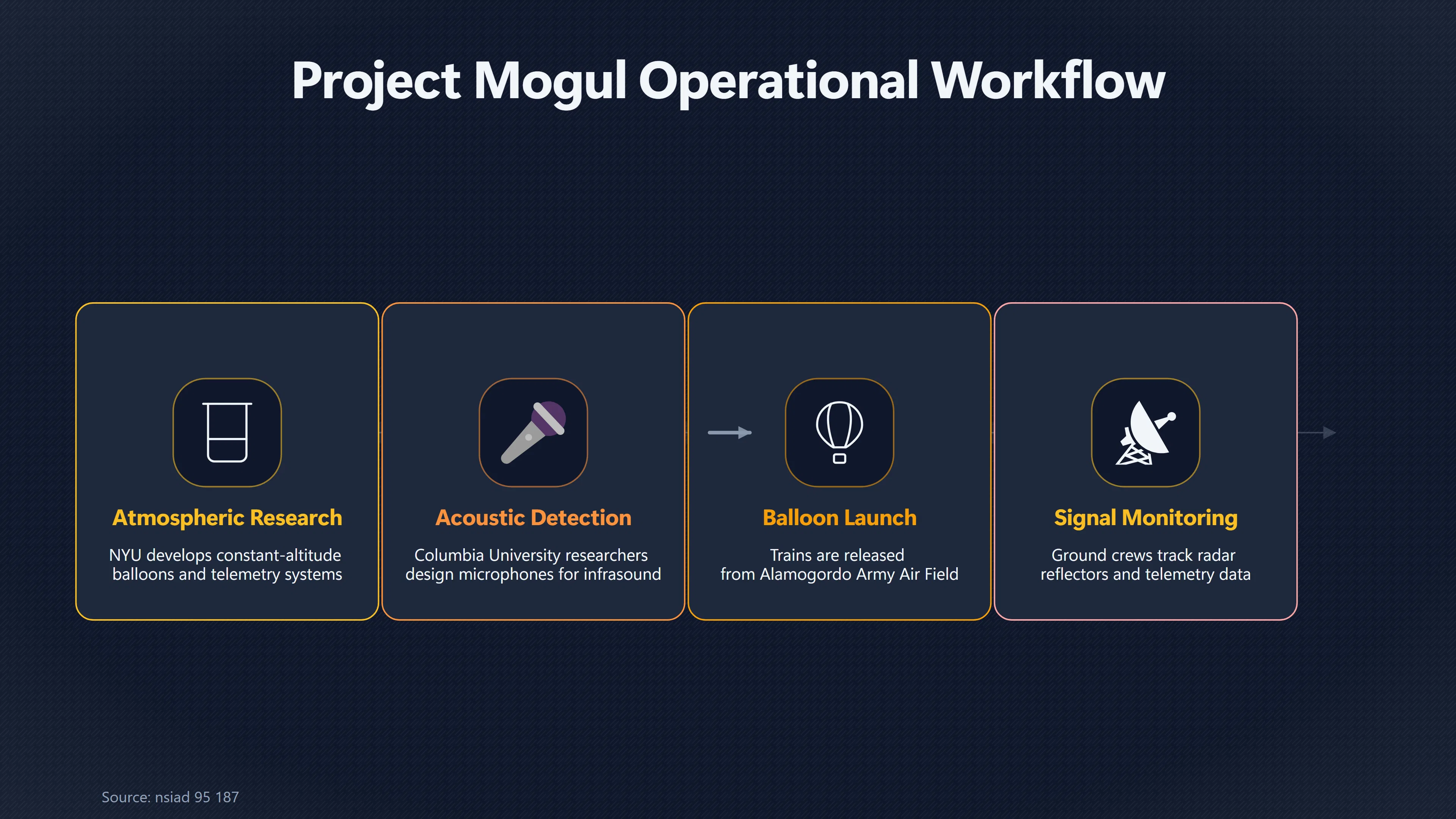
The work combined military direction with university and scientific expertise. New York University’s balloon group was responsible for developing platforms that could remain near a chosen altitude, along with telemetry equipment for transmitting measurements. Researchers associated with Columbia University worked on acoustic detection, while testing and launch activity took place around Alamogordo Army Air Field and the White Sands region of New Mexico. The Air Force later described Mogul as a compartmented programme: participants could know the practical details of balloon research without necessarily being told that the ultimate target was Soviet nuclear activity.[Muller Lab]muller.lbl.govThey handled casual inquiries and/or scientific inquiries/papers in terms of "unclassified meteorological or balloon research."…
The programme’s true intelligence purpose was classified, but much of its physical equipment was not. This distinction is central to understanding Roswell. A civilian or junior officer could encounter recognisable balloon materials while remaining unaware that the flight belonged to a strategically important nuclear-monitoring experiment.
Why the balloon trains looked unusual
Early Mogul flights did not resemble a single small meteorological balloon. To keep an instrument package aloft for long enough, researchers connected numerous neoprene balloons into an extended train. Some experimental configurations stretched for hundreds of feet and carried several separate components suspended at intervals.
A typical early train could include:
- multiple rubber sounding balloons;
- pressure, temperature and altitude instruments;
- acoustic microphones or experimental sensor packages;
- batteries, transmitters and other telemetry equipment;
- parachutes or lines connecting the components;
- radar reflectors used by ground crews to follow the train.
The radar reflectors are particularly important in the Roswell comparison. These lightweight targets were designed to return a strong signal to military radar. Contemporary models used angular frameworks of thin wooden struts covered with reflective foil or foil-backed paper. When intact, they formed conspicuous geometric shapes; when broken, they produced scattered pieces of foil, sticks, string and reinforcing tape.[nmsr.org]nmsr.orgRoswell MogulOne of the NYU tasks was the development of constant-level balloons for placing die acoustic microphones aloft. After some pre…
This material combination resembles the earliest descriptions of debris from the Foster ranch more closely than the later accounts of indestructible metal or sophisticated machinery. Rancher William Brazel and the first newspaper reports referred to rubber, foil or paper-like material, sticks, tape and string. Warrant Officer Irving Newton, who examined material displayed in General Roger Ramey’s office at Fort Worth, identified it as the remains of a radar target attached to a balloon.[nmsr.org]nmsr.orgRoswell MogulOne of the NYU tasks was the development of constant-level balloons for placing die acoustic microphones aloft. After some pre…
One disputed detail concerns reports of coloured or flower-like symbols on some of the tape. The Air Force investigation linked these markings to decorative reinforcing tape used in commercially manufactured radar targets. That explanation is technically plausible, although it relies partly on recollections collected decades later rather than a surviving piece of Roswell debris that can be tested.[Muller Lab]muller.lbl.govMuller Lab Project Mogul Air Forces, in conjunction with Project MOGULl0) The NYU "balloon group" was to develop and fly constant-level balloons while simultaneously developing telemetering equipment to tra…
The Flight 4 reconstruction
The official Roswell explanation centres on an experimental launch generally designated New York University Flight 4. According to the Air Force’s 1994 investigation, a balloon train was released from Alamogordo Army Air Field on 4 June 1947 and subsequently lost. Its projected path could have taken it towards the ranch where Brazel later found wreckage.
Flight 4 was not a fully documented operational mission with a surviving launch record, continuous track and recovery report. The case for it was reconstructed from project papers, the diary of Mogul field director Albert Crary, weather information, the records of nearby flights and interviews with former researchers—most notably atmospheric physicist Charles B. Moore, who had participated in the New Mexico experiments.[Muller Lab]muller.lbl.govMuller Lab Project Mogul Air Forces, in conjunction with Project MOGULl0) The NYU "balloon group" was to develop and fly constant-level balloons while simultaneously developing telemetering equipment to tra…
Crary’s diary recorded that a planned balloon operation was initially cancelled because of cloud conditions on 4 June, followed by the release of a cluster of balloons later that morning. The Air Force and Moore interpreted this entry as evidence that a serviceable experimental train was eventually flown, even if the full acoustic mission had first been scrubbed. Because the surviving project table began formally numbering the better-documented launches with Flight 5, “Flight 4” functions partly as a retrospective label for this earlier operation.
Moore later calculated a possible route using historical upper-air wind data and his recollection that the balloons had been observed north-east of Alamogordo before tracking was lost. His reconstruction placed the train sufficiently close to the Foster ranch area to make it a credible candidate. A contemporary summary of Moore’s work stated that it had been tracked to within roughly 17 miles of the eventual debris location, although the exact figure depends on assumptions about launch time, altitude, wind speed and the point at which the train descended.[nmsr.org]nmsr.orgRoswell MogulOne of the NYU tasks was the development of constant-level balloons for placing die acoustic microphones aloft. After some pre…
The dates do not require Brazel to have found the wreckage immediately after the launch. His 1947 newspaper account suggested that he had encountered the material during an earlier visit and returned to investigate it more carefully after hearing reports of “flying discs”. Neoprene balloons exposed to sunlight and weather could darken, fragment and spread, while surface winds could distribute the lighter parts across a broad area.
The Flight 4 hypothesis is therefore a cumulative argument:
- Mogul balloons were being launched from southern New Mexico at the relevant time.
- One poorly documented train was released and not recovered by the project team.
- Its possible route extended towards the ranch region.
- Its balloons and radar targets could produce the types of material described in early accounts.
- No surviving contemporary record identifies another aircraft or device that better fits the physical debris.
That combination makes Flight 4 the leading documentary explanation, but it is not the equivalent of a serial number recovered at the ranch and matched to an intact launch manifest.
Why the Army called it a weather balloon
The description “weather balloon” was misleading but not wholly fabricated. Mogul used conventional meteorological balloons and operated through outwardly scientific atmospheric research. The sensitive element was the programme’s purpose, configuration and instrumentation—not necessarily every strip of foil or piece of rubber.
The military therefore had a ready cover explanation. Calling the wreckage a weather balloon disclosed nothing about attempts to detect Soviet nuclear tests. The Air Force’s later investigation stated that casual questions could be answered in terms of meteorological or balloon research while the compartmented intelligence objective remained protected.[Muller Lab]muller.lbl.govThey handled casual inquiries and/or scientific inquiries/papers in terms of "unclassified meteorological or balloon research."…
This helps explain the otherwise puzzling sequence of official statements in July 1947. Roswell Army Air Field first announced that it had recovered a “flying disc”, apparently using the popular terminology of the moment without identifying the equipment properly. Higher headquarters then presented portions of a balloon and radar target and substituted the safer weather-research explanation.
Secrecy need not mean that every officer involved knew the truth. Personnel at Roswell Army Air Field were not part of the New York University research group, and even those who recognised balloon equipment might not have known why an unusually elaborate train was being flown. Compartmentalisation allows an organisation to protect a project precisely by limiting how much information reaches people outside the immediate programme.
The first announcement nevertheless caused lasting damage to official credibility. Once the Army had publicly used the phrase “flying disc”, the abrupt reversal looked less like the correction of an error and more like the suppression of an extraordinary discovery. When the Mogul explanation was disclosed decades later, it confirmed that the 1947 weather-balloon statement had omitted material facts, even though it did not confirm an extraterrestrial event.
Where the documentary evidence is strongest
The strongest support for the Mogul explanation comes from the convergence of programme history and physical materials. There is extensive documentation that the Army Air Forces funded constant-altitude balloon experiments in New Mexico during June and July 1947. The project reports describe balloon trains, tracking equipment, telemetry and radar targets matching the general character of the earliest reported Roswell wreckage.[lbl.gov]muller.lbl.govMuller Lab Project Mogul Air Forces, in conjunction with Project MOGULl0) The NYU "balloon group" was to develop and fly constant-level balloons while simultaneously developing telemetering equipment to tra…
The explanation also accounts for why debris that looked mechanically simple could attract military attention. An ordinary weather instrument would have presented little security concern, whereas an experimental platform connected to nuclear intelligence justified recovery and discretion even though its constituent materials were mundane.
The contemporaneous Fort Worth photographs provide another important anchor. They show Brigadier General Ramey, Colonel Thomas Dubose and Major Jesse Marcel with crumpled foil, balloon material and the framework of a radar reflector. Critics argue that the displayed material may have been substituted for whatever was originally recovered. No surviving contemporaneous document demonstrates such a substitution, however, and the photographed components are consistent with equipment used by balloon projects of the period.
A 1995 Government Accountability Office search found no records establishing that an extraterrestrial craft had been recovered. It also reported that some Roswell Army Air Field administrative records for the relevant period had been destroyed without proper documentation of when or under what authority. The missing files prevent a perfectly complete reconstruction, but the GAO found no evidence that their destruction was arranged to conceal an alien recovery.[Government Accountability Office]gao.govnsiadNSIAD-95-187…
What the Flight 4 theory cannot prove
The principal weakness is the absence of a continuous paper trail connecting a specific balloon train to a specific piece of ranch debris. No surviving record states: Flight 4 landed on the Foster ranch and was recovered by Roswell personnel. The official finding is phrased in probabilistic terms because it was assembled nearly half a century after the event.
Critics challenge several parts of the reconstruction. They argue that Crary’s diary indicates the main operation was cancelled; that Flight 4 lacks the detailed data retained for later launches; and that trajectory calculations can be changed significantly by selecting different launch times, altitudes and wind measurements. Even sceptics of an extraterrestrial interpretation acknowledge that precise balloon landing points are difficult to reconstruct from incomplete 1947 weather observations.[newspaceeconomy.ca]newspaceeconomy.caNew Space Economy Challenges to the Project Mogul Explanation for the Roswell Incident | New Space EconomyNew Space Economy Challenges to the Project Mogul Explanation for the Roswell Incident | New Space Economy
These objections demonstrate uncertainty about the exact flight, not positive evidence for an alien vehicle. It is possible that the ranch debris came from an unnumbered test, a service flight associated with Mogul, or another balloon configuration rather than the specific train later designated Flight 4. The broader Mogul interpretation does not depend entirely on Moore’s estimated trajectory, although identifying Flight 4 gives the official account a more precise chronology.
Later witness descriptions also create tension. Beginning in the late 1970s, some witnesses described metal that could not be cut or burned, extensive military cordons, a separate impact site and recovered bodies. Such claims do not match a Mogul balloon. They were generally recorded decades after 1947, however, and are not supported by surviving contemporary photographs, medical records, recovery orders or physical specimens. They should therefore be assessed separately from the much earlier descriptions of foil, rubber, tape, sticks and string.
The absence of preserved wreckage remains decisive. Without material available for laboratory examination, neither the precise balloon-flight identification nor the more extraordinary claims can be tested directly. The historical judgement rests on relative explanatory strength rather than forensic certainty.
What became of Project Mogul
Mogul showed that long-range atmospheric detection was scientifically possible, but the original balloon method was expensive, difficult to control and operationally unreliable. Maintaining a large train at a chosen level was technically demanding, while changing winds complicated tracking and recovery. By late 1948, the military was questioning the project’s cost, security and practicality, and the initial concept was not established as a permanent operational warning system.[Global Security]globalsecurity.orgGlobal Security Project MOGULGlobal Security Project MOGUL
Other approaches proved more useful for detecting nuclear tests, including seismic monitoring, ground-based infrasound stations and the collection of radioactive fallout. The Soviet Union’s first atomic test in August 1949 was ultimately identified through airborne sampling of radioactive debris rather than a Mogul balloon.
The programme nevertheless contributed to the development of constant-altitude balloons, telemetry and high-altitude research platforms. Later scientific and military balloon projects benefited from techniques explored by the New York University team. Mogul therefore occupies an unusual place in technological history: it was not a successful operational nuclear-warning network, but its experimental hardware and secrecy became central to the most famous UFO controversy of the twentieth century.

The most defensible conclusion
Project Mogul offers a coherent explanation for the original Roswell debris and for the military’s contradictory public statements. Its balloon trains contained the right broad mixture of rubber, foil, light struts, tape and tracking equipment; they were operating in New Mexico at the relevant time; and their true purpose provided a genuine reason for secrecy.
The strongest version of the conclusion is not that every detail of NYU Flight 4 has been proven. It is that a lost Mogul-related balloon train is better supported by contemporary materials, programme documents and known military activity than the hypothesis of a recovered extraterrestrial spacecraft. Flight 4 remains the leading candidate, but incomplete logs and uncertain trajectory calculations prevent absolute identification.
That distinction explains both the durability of the official account and the survival of the dispute. The government eventually disclosed a real secret that made the original weather-balloon statement look evasive. Yet the secret it documented was a difficult Cold War nuclear-detection experiment, not evidence of alien technology.
Amazon book picks
Further Reading
Books and field guides related to Project Mogul Balloon. Use these as the next step if you want deeper reading beyond the article.
Roswell: Inconvenient Facts and the Will to Believe
For over fifty years an incident near Roswell, New Mexico, has sparked the imaginations of UFO enthusiasts. Did the military recover a cr...
The Truth About the UFO Crash at Roswell
The true story of the crash of an alien spacecraft--with a crew of five--near Roswell, New Mexico, and the great lengths federal agencies...
The Roswell Report: Case Closed
In "The Roswell Report: Case Closed," James McAndrew meticulously examines one of the most controversial events in UFO history: the alleg...
UFOs and Government: A Historical Inquiry
Governments around the world have had to deal with the UFO phenomenon for a good part of a century. How and why they did so is the subjec...
eBay marketplace picks
Marketplace Samples
Live-tested eBay searches with available results related to this page.
Selected fromweather balloon model oneBay.co.uk.


Endnotes
1.
Source: af.mil
Link:https://www.af.mil/[The-Roswell-Report
Source snippet
Air ForceThe Roswell ReportThe Roswell Report The Roswell Report CASE CLOSED Air Force News Special ReportThe Roswell Report: Case Closed...
2.
Source: gao.gov
Title: nsiad 95 187
Link:https://www.gao.gov/products/nsiad
Source snippet
NSIAD-95-187...
3.
Source: nmsr.org
Title: Roswell Mogul
Link:https://www.nmsr.org/wp-content/uploads/2026/07/RoswellMogul.pdf
Source snippet
One of the NYU tasks was the development of constant-level balloons for placing die acoustic microphones aloft. After some pre...
4.
Source: roswellproof.com
Link:https://www.roswellproof.com/Flight4_Trajectory.html
5.
Source: roswellproof.com
Link:https://www.roswellproof.com/Flight4_Addendums.html
6.
Source: gao.gov
Title: rced 95 212
Link:https://www.gao.gov/products/rced
7.
Source: gao.gov
Title: nsiad 95 113
Link:https://www.gao.gov/products/nsiad
8.
Source: gao.gov
Link:https://www.gao.gov/products/t-osi
9.
Source: gao.gov
Title: nsiad 95 95
Link:https://www.gao.gov/products/nsiad
10.
Source: gao.gov
Link:https://www.gao.gov/products/t-nsiad
11.
Source: gao.gov
Title: rced 95 68
Link:https://www.gao.gov/products/rced
12.
Source: gao.gov
Title: osi 95 10
Link:https://www.gao.gov/products/osi
13.
Source: gao.gov
Title: nsiad 95 78
Link:https://www.gao.gov/products/nsiad
14.
Source: gao.gov
Link:https://www.gao.gov/products/hr
15.
Source: gao.gov
Title: nsiad 95 46
Link:https://www.gao.gov/products/nsiad
16.
Source: gao.gov
Title: rced 95 27
Link:https://www.gao.gov/products/rced
17.
Source: roswellproof.com
Link:https://www.roswellproof.com/Flight4and5_changes.html
18.
Source: roswellproof.com
Link:https://www.roswellproof.com/debris4_tape.html
19.
Source: muller.lbl.gov
Title: Muller Lab Project Mogul Air Forces, in conjunction with Project MOGUL
Link:https://muller.lbl.gov/teaching/physics10/Roswell/USMogulReport.html
Source snippet
(l0) The NYU "balloon group" was to develop and fly constant-level balloons while simultaneously developing telemetering equipment to tra...
20.
Source: muller.lbl.gov
Link:https://muller.lbl.gov/teaching/physics10/Roswell/RoswellIncident.html
Source snippet
They handled casual inquiries and/or scientific inquiries/papers in terms of "unclassified meteorological or balloon research."...
21.
Source: globalsecurity.org
Title: Global Security Project MOGUL
Link:https://www.globalsecurity.org/intell/systems/mogul.htm
22.
Source: media.defense.gov
Title: U.S. Department of War FOREWORD
Link:https://media.defense.gov/2010/Dec/01/2001329893/-1/-1/0/AFD-101201-038.pdf
Source snippet
This report represents a joint effort byThese interviews confirmed that Project MOGUL was a compartmented... The NYU group was responsi...
23.
Source: newspaceeconomy.ca
Link:https://newspaceeconomy.ca/2026/01/04/challenges-to-the-project-mogul-explanation-for-the-[roswell-incident
24.
Source: disclosurearchives.com
Title: project mogul
Link:https://disclosurearchives.com/project-mogul
25.
Source: Wikipedia
Title: Project Mogul
Link:https://en.wikipedia.org/wiki/Project_Mogul
26.
Source: archives.gov
Title: New Mexico | National Archives
Link:https://www.archives.gov/nhprc/projects/states-territories/nm.html
27.
Source: af.mil
Title: public post comment text
Link:https://www.af.mil/The-Roswell-Report/trk/public_post_comment-text/
28.
Source: af.mil
Title: 75th Anniversary
Link:https://www.af.mil/The-Roswell-Report/About-Us/AF-75th-Anniversary/
29.
Source: af.mil
Link:https://www.af.mil/The-Roswell-Report/quot/
30.
Source: af.mil
Title: The Roswell Report
Link:https://www.af.mil/The-Roswell-Report/
Additional References
31.
Source: nsa.gov
Link:https://www.nsa.gov/portals/75/documents/news-features/declassified-documents/ufo/report_af_roswell.pdf
Source snippet
REPORT OF AIR FORCE RESEARCH REGARDING THE ROSWELL INCIDENT EXECUTIVE SUMMARYwhile the audit officially would be reviewing the records...
32.
Source: archives.gov
Link:https://www.archives.gov/research/catalog/catalog-bulk-downloads/uap-bulk-download
33.
Source: archives.gov
Link:https://www.archives.gov/research/topics/uaps/publications
34.
Source: archives.gov
Link:https://www.archives.gov/research/topics/uaps/moving-images-and-sound
35.
Source: archives.gov
Link:https://www.archives.gov/research/topics/uaps/presidential-libraries
36.
Source: archives.gov
Link:https://www.archives.gov/research/topics/uaps/rg-collections
37.
Source: archives.gov
Link:https://www.archives.gov/research/topics/uaps/textual-and-microfilm
38.
Source: youtube.com
Title: The Roswell Incident Balloons, aliens, and loose ends
Link:https://www.youtube.com/watch?v=X9bdAR42_EM
Source snippet
The [Roswell UFO Crash]({{ 'roswell-ufo-crash/' | relative_url }}): Uncovering the Truth Behind the Legend...
39.
Source: youtube.com
Title: The Roswell Incident Mystery Finally Solved
Link:https://www.youtube.com/watch?v=Pz0vYcc4KiI
Source snippet
Roswell UFO: What Really Happened? Conspiracy Theory Section I...
40.
Source: dbpedia.org
Link:https://dbpedia.org/page/Project_Mogul