Within Military Secrecy
Why Cold War Secrecy Left Roswell Records Scattered
Before modern disclosure laws, classified files, restricted sites and scattered record systems made later reconstruction unusually difficult.
On this page
- How records were divided across agencies and programs
- Why unclassified material could still remain inaccessible
- How fragmented archives complicated later investigations
Page outline Jump by section
Introduction
One reason the Roswell incident remains difficult to reconstruct is not simply that some information was classified, but that the relevant records were never kept in one place. In 1947, the United States managed military secrets through a decentralised system in which operational files, intelligence reports, administrative correspondence and technical research were created by different organisations under different security rules. Before the Freedom of Information Act (FOIA) established a general public right to request federal records in 1966, there was no routine mechanism for public access, and many files remained effectively invisible outside government even if they were not formally classified. The result was a documentary trail that became increasingly fragmented over time, complicating later investigations into Roswell and making it difficult to distinguish between records that never existed, records that were destroyed under normal procedures, and records that survived in unexpected archives.[Justia GAO Reports]gao.justia.comGAO Reports Justia GAO ReportsJustia GAO ReportsJustia GAO Reports - NSIAD-95-187 - Government Records - Department of DefenseJuly 28, 1995…
How records became divided across agencies and programmes
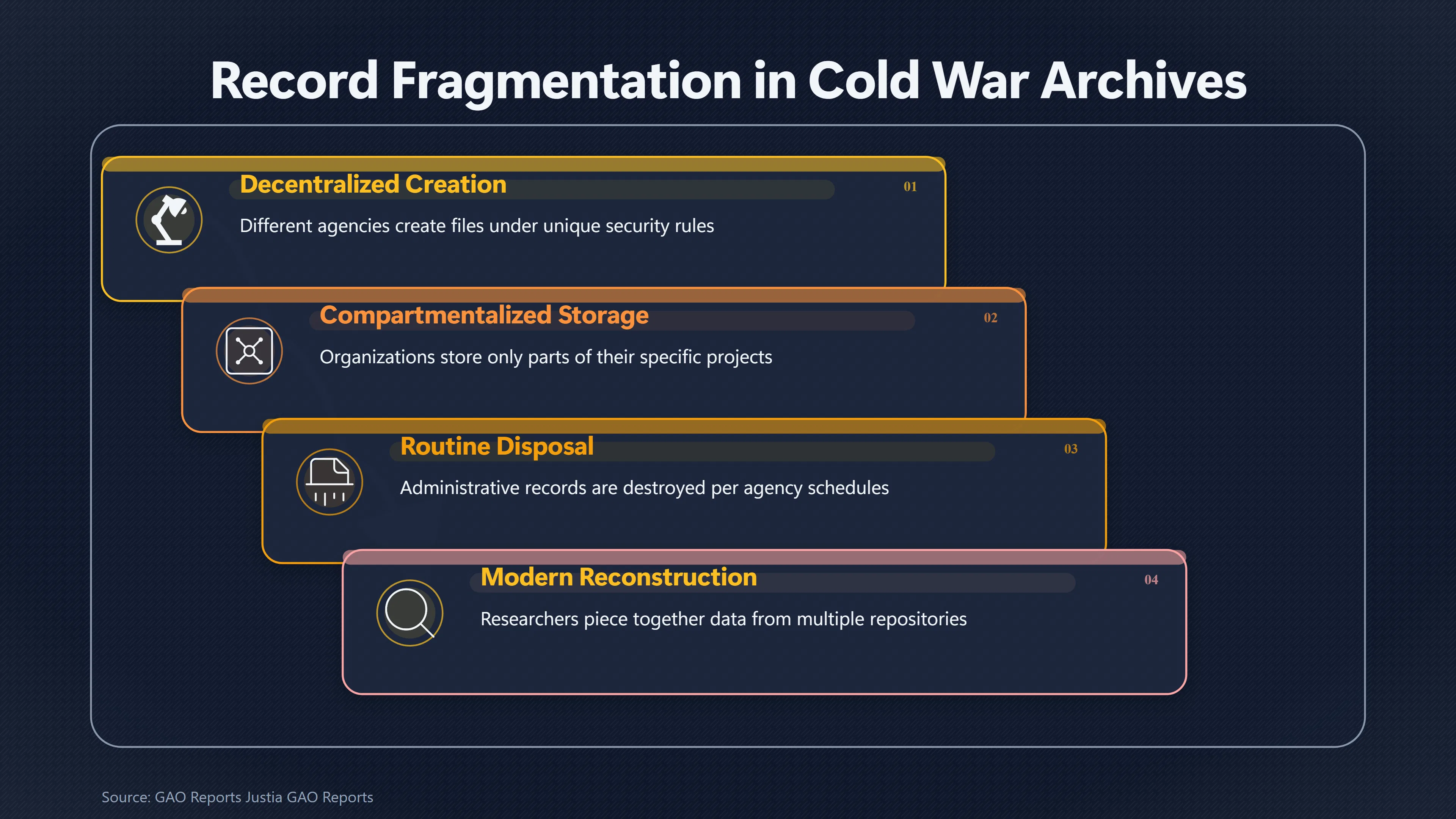
Cold War security depended on compartmentation rather than a single central archive. Different organisations documented only the part of a project for which they were responsible, limiting how much any individual office could see.
For the Roswell period, relevant material could potentially have been generated by:
- Roswell Army Air Field through base operations and administrative correspondence.
- The Army Air Forces chain of command through operational reports.
- Wright Field through technical examination of recovered material.
- Intelligence organisations that handled security-sensitive information.
- Contractors and research institutions working on classified balloon experiments such as Project Mogul.
- The Federal Bureau of Investigation when military information intersected with domestic security reporting.
Each organisation maintained its own filing systems, retention schedules and security procedures. Records were therefore dispersed across multiple record groups rather than assembled into a single “Roswell file”. Modern researchers searching the National Archives must often examine numerous record groups because permanent federal records are organised by creating agency, not by historical event.[National Archives]archives.govNational Archives Alphabetical List of Record Groups | National ArchivesNational Archives Alphabetical List of Record Groups | National Archives
This structure reflected standard government practice rather than an unusual feature of Roswell. Secret programmes were intentionally compartmentalised so that sensitive operational purposes could be concealed even from officials working elsewhere in government.
Why unclassified material could still remain inaccessible
A common misunderstanding is that only classified documents were difficult to obtain. In reality, before FOIA, accessibility depended heavily on internal military procedures rather than public rights of access.
Several factors limited outside scrutiny even for unclassified records:
- Internal distribution lists often restricted circulation to officials with a need to know.
- Operational files remained on military installations rather than in public archives.
- Records were managed according to agency retention schedules instead of public research needs.
- Finding aids and catalogues were limited, making many surviving files difficult to locate.
- Researchers generally required institutional cooperation rather than statutory disclosure rights.
Consequently, later investigators often encountered an absence of accessible documentation that reflected administrative practice rather than proof of deliberate concealment. The distinction matters because “not publicly available” and “classified” were not synonymous in the late 1940s.[National Archives]archives.govNational Archives Alphabetical List of Record Groups | National ArchivesNational Archives Alphabetical List of Record Groups | National Archives
Project Mogul illustrates this complexity. The Air Force later concluded that many individual balloon components were ordinary materials, while the programme’s intelligence mission remained highly sensitive. This meant that some technical records could eventually become publicly available whereas documents revealing operational objectives, deployment or intelligence methods remained protected for much longer.[Project Gutenberg]gutenberg.orgOpen source on gutenberg.org.
Why later investigators encountered incomplete archives
When interest in Roswell revived decades later, investigators expected a coherent documentary trail. Instead, they found records scattered across agencies and interrupted by routine records management practices.
The 1995 investigation by the U.S. General Accounting Office (now the Government Accountability Office) illustrates the problem. Rather than searching one archive, investigators examined material held by the Department of Defense, FBI, CIA, National Security Council and other organisations. They found that some Roswell Army Air Field administrative records and outgoing message files covering the relevant period had been destroyed, while other records survived elsewhere. Only two contemporaneous 1947 government documents directly mentioning the incident were located during the search.[Justia GAO Reports]gao.justia.comGAO Reports Justia GAO ReportsJustia GAO ReportsJustia GAO Reports - NSIAD-95-187 - Government Records - Department of DefenseJuly 28, 1995…
The GAO did not conclude that the missing files proved a cover-up of extraterrestrial material. Instead, it reported that some records had been destroyed without documentation identifying precisely when, by whom or under what disposal authority, leaving genuine gaps in the surviving archive. Those gaps continue to fuel competing interpretations because missing records cannot conclusively support either the official explanation or extraordinary claims.[Justia GAO Reports]gao.justia.comGAO Reports Justia GAO ReportsJustia GAO ReportsJustia GAO Reports - NSIAD-95-187 - Government Records - Department of DefenseJuly 28, 1995…
Fragmentation does not automatically imply concealment
An important historical distinction is that fragmented archives are common for Cold War programmes, especially those involving intelligence, military research and rapidly evolving organisations.
Several mechanisms produced incomplete documentary trails without requiring a coordinated effort to erase evidence:
- Routine records disposal. Many administrative records were never intended for permanent preservation.
- Agency reorganisation. The post-war transition from the Army Air Forces to the independent U.S. Air Force changed administrative structures and records custody.
- Separate security systems. Technical, operational and intelligence records frequently followed different retention policies.
- Compartmentation. Officials documented only the information required within their own organisational responsibilities.
These mechanisms make historical reconstruction more difficult, but they do not by themselves establish that documents were intentionally destroyed to conceal a particular explanation for Roswell. Historians therefore distinguish between documentary absence and affirmative evidence of a cover-up.[Justia GAO Reports]gao.justia.comGAO Reports Justia GAO ReportsJustia GAO ReportsJustia GAO Reports - NSIAD-95-187 - Government Records - Department of DefenseJuly 28, 1995…
How fragmented records shaped the Roswell debate
The scattered nature of the surviving documentation had lasting consequences for public understanding of Roswell.
Because relatively few contemporary records survived in one accessible location, later debates relied heavily on retrospective witness testimony, partial documentary discoveries and declassified files released decades apart. Each newly released document was interpreted against an already incomplete archival record, making it difficult to establish a continuous chronology.
The Air Force’s investigations in the 1990s attempted to reconstruct Project Mogul using surviving technical papers, flight records and research documentation gathered from multiple repositories rather than from a single operational file. That reconstruction demonstrated how dispersed records could still support a historically plausible explanation, but it also highlighted the limits imposed by missing administrative files and incomplete archival preservation.[Project Gutenberg]gutenberg.orgOpen source on gutenberg.org.
The enduring lesson is broader than Roswell itself. Cold War secrecy operated through dispersed administration as much as through formal classification. Records were divided across agencies, governed by different retention rules and often inaccessible long before public disclosure laws existed. Those institutional practices help explain why reconstructing events such as Roswell remains far more difficult than simply opening a single classified file.
Amazon book picks
Further Reading
Books and field guides related to Why Cold War Secrecy Left Roswell Records Scattered. Use these as the next step if you want deeper reading beyond the article.
Area 51: An Uncensored History of America's Top Secret Milita...
The explosive, untold story of the Cold War's biggest secret from the bestselling author of NUCLEAR WAR: A SCENARIO 'An extraordinary boo...
Command and Control
The Oscar-shortlisted documentary Command and Control, directed by Robert Kenner, finds its origins in Eric Schlosser's book and continue...
The Puzzle Palace
In this remarkable tour de force of investigative reporting, James Bamford exposes the inner workings of America's largest, most secretiv...
The Making of the Atomic Bomb
Details the making of the atomic bomb. Includes diagrams and pictures documenting people and places.
eBay marketplace picks
Marketplace Samples
Live-tested eBay searches with available results related to this page.
Selected fromRoswell UFO poster oneBay.co.uk.

Endnotes
1.
Source: gao.justia.com
Title: GAO Reports Justia GAO Reports
Link:https://gao.justia.com/department-of-defense/1995/7/government-records-nsiad-95-187/
Source snippet
Justia GAO ReportsJustia GAO Reports - NSIAD-95-187 - Government Records - Department of DefenseJuly 28, 1995...
Published: July 28, 1995
2.
Source: archives.gov
Title: National Archives Alphabetical List of Record Groups | National Archives
Link:https://www.archives.gov/research/catalog/lcdrg/record-groups/alphabetical-list
3.
Source: archives.gov
Title: National Archives Record Group Explorer | National Archives
Link:https://www.archives.gov/findingaid/record-group-explorer
4.
Source: archives.gov
Title: National Archives All Record Groups | National Archives
Link:https://www.archives.gov/records-mgmt/rcs/schedules/list-all-record-groups
5.
Source: gutenberg.org
Link:https://gutenberg.org/files/63659/63659-h/63659-h.htm
6.
Source: archives.gov
Link:https://www.archives.gov/research/topics/uaps/rg-collections
Source snippet
ecord Group or Collection | National ArchivesDecember 12, 2025 — Series: [Roswell Report]({{ 'the-roswell-report/' | relative_url }}) Source Files, 1987–1996 (National Archives Identi...
Published: December 12, 2025
7.
Source: prologue.blogs.archives.gov
Title: the origins of the record group
Link:https://prologue.blogs.archives.gov/2024/10/23/the-origins-of-the-record-group/
Source snippet
These registrations were intended to serve as an administrative control over, and as a general guide...
8.
Source: archives.gov
Title: Project BLUE BOOK
Link:https://www.archives.gov/research/military/air-force/ufos
9.
Source: archives.gov
Title: Declassified Records | National Archives
Link:https://www.archives.gov/research/declassification.html
10.
Source: archives.gov
Title: Record Group Clusters and Locations | National Archives
Link:https://www.archives.gov/research/alic/tools/record-group-clusters.html
11.
Source: gao.gov
Link:https://www.gao.gov/assets/a250690.html
12.
Source: gao.gov
Title: nsiad 95 187
Link:https://www.gao.gov/products/nsiad
13.
Source: gao.gov
Link:https://www.gao.gov/products/154832
14.
Source: gao.gov
Title: ggd 89 91
Link:https://www.gao.gov/products/ggd
15.
Source: gao.gov
Title: plrd 81 2
Link:https://www.gao.gov/products/plrd
16.
Source: gao.gov
Link:https://www.gao.gov/products/110508
17.
Source: sgp.fas.org
Link:https://sgp.fas.org/othergov/roswell.html
18.
Source: decur.org
Title: Roswell Incident
Link:https://decur.org/cases/roswell-1947
Additional References
19.
Source: youtube.com
Link:https://www.youtube.com/watch?v=cB4TtrXoaT4
Source snippet
This video is relevant because it discusses the historical government investigations, declassified files, and missing or fragmented recor...
20.
Source: ufouap.com
Title: The GAO said the records were des
Link:https://www.ufouap.com/articles/roswell-series-government-investigations/
Source snippet
Roswell, Part 3: Project Mogul, Destroyed Records, and the Questions Nobody Has Answered — UFOUAPFebruary 26, 2026 — February 26, 2026 ·...
Published: February 26, 2026
21.
Source: curiolink.net
Title: roswell incident 1947 cover up explained
Link:https://www.curiolink.net/2026/06/roswell-incident-1947-cover-up-explained.html
Source snippet
government went looking for an entirely different set of records. In response to a 1994 Congressional inquiry from th...
22.
Source: youtube.com
Title: The Roswell Incident Explained: Crash, Cover-Up, Witnesses & What We Know
Link:https://www.youtube.com/watch?v=vRnOUO7TMJo
Source snippet
Reel America: "The Roswell Reports" - 1997 U.S. Air Force Film...
23.
Source: youtube.com
Title: Area 51, Roswell & the Pentagon Files | Full Documentary
Link:https://www.youtube.com/watch?v=Ml0zF_dNJ1g
Source snippet
The 1973 Fire at National Personnel Records Center | Military Records Burned...
24.
Source: nsa.gov
Link:https://www.nsa.gov/Helpful-Links/NSA-FOIA/Declassification-Transparency-Initiatives/FOIA-Reports-and-Releases/FOIA-Reports-and-Releases-List/igphoto/2002761373/
25.
Source: af.mil
Link:https://www.af.mil/The-Roswell-Report/trk/public_post_comment-text/
26.
Source: ufotransparency.com
Title: 1995 07 28 gao roswell report nsiad 95 187 gao nsiad 95 187 roswell 1995
Link:https://ufotransparency.com/files/1995-07-28-gao-roswell-report-nsiad-95-187-gao-nsiad-95-187-roswell-1995
27.
Source: youtube.com
Title: Roswell Reports, Vol. 1
Link:https://www.youtube.com/watch?v=WY5YN1SNaS8
Source snippet
Area 51, Roswell & the Pentagon Files | Full Documentary...
28.
Source: ufoexplorations.com
Title: roswell crash records destroyed methods and culprits revealed
Link:https://www.ufoexplorations.com/roswell-crash-records-destroyed-methods-and-culprits-revealed