Within Modern Unidentified
Why Pilots Hesitate to Report UAP
Pilots may face stigma, unclear procedures and classification barriers even when an encounter raises legitimate safety concerns.
On this page
- How stigma shaped military reporting
- What pilots told Congress about safety
- Which reporting reforms could improve the evidence
Page outline Jump by section
Introduction
Military and civilian pilots are trained to report anything that could affect flight safety, yet many have historically been reluctant to report unidentified anomalous phenomena (UAP). The hesitation is not necessarily because they believe they have seen something extraordinary, but because they may be uncertain what they observed, unsure how to report it, or concerned that colleagues could dismiss the report as evidence of poor judgement. In recent years, Congress, NASA and the US Department of Defense have increasingly framed this as an aviation safety and national security problem rather than a debate about extraterrestrial visitors. That shift has prompted reforms, but reporting barriers remain an important implementation challenge within the broader modern UAP debate.
How stigma shaped military reporting
For decades, the term “UFO” carried strong cultural associations with conspiracy theories and alien spacecraft. Many aviators have argued that this cultural baggage discouraged reporting even when an encounter involved a legitimate operational hazard.
Former US Navy pilot Ryan Graves, who testified before the House Oversight Committee in July 2023, described repeated encounters by military aircrews operating near training areas off the US East Coast. His central argument was not that the objects were extraterrestrial, but that pilots lacked confidence that reporting unusual observations would be treated as routine aviation safety information rather than sensational claims. His testimony emphasised that unreported hazards create risks regardless of what ultimately caused them.[Vanity Fair]vanityfair.comThe hearing featured testimonies from former Navy pilots Ryan Graves and David Fravor, as well as whistleblower and former intelligence o…
Several factors reinforced this reluctance:
- Professional reputation. Pilots depend heavily on credibility. Being associated with unexplained sightings was widely perceived as carrying reputational risk.
- Operational uncertainty. Aircrew often could not distinguish between foreign surveillance systems, classified domestic programmes, sensor artefacts or genuinely unidentified objects.
- Classification barriers. Military encounters frequently occur in restricted airspace or involve classified sensors, making open discussion difficult even when the object itself is not classified.
- Lack of standard procedures. Until recently, many aviators reported uncertainty about where unusual observations should be submitted or whether reporting served any practical purpose.
These concerns created a reporting bias: unusual encounters could remain undocumented because the institutional costs of reporting appeared greater than the expected benefits.
Why reporting is difficult even when safety is the priority
An unidentified object does not have to be extraordinary to create an aviation hazard. A drone, balloon, foreign surveillance platform or sensor malfunction may all require investigation if they affect military operations or create collision risks.
However, identifying an object after the event is often difficult because pilots rarely have complete information. High-speed manoeuvres, changing weather, limited viewing angles and rapidly evolving tactical situations may leave only fragmented observations. NASA’s independent UAP study concluded that many reports remain unresolved because available observations lack sufficient calibrated data rather than because they demonstrate unknown technology. The study recommended better sensor integration, improved metadata and more systematic reporting rather than relying primarily on eyewitness testimony.[NASA Science]science.nasa.govScience UAPNASA ScienceUAP - NASA Science…
This creates an implementation challenge. Pilots may know they encountered something unusual but still be unable to provide enough evidence for investigators to determine whether the object was:
- a conventional aircraft;
- a drone;
- atmospheric or astronomical phenomena;
- a sensor or processing artefact; or
- genuinely unidentified because available evidence is incomplete.
The result is that some reports remain unresolved without implying an extraordinary explanation.
What pilots told Congress about safety
Congressional hearings shifted attention from sensational claims towards operational reporting.
Ryan Graves argued that UAP reporting should resemble established aviation hazard reporting rather than becoming a debate about extraordinary theories. He stated that pilots should feel able to report unidentified objects without fearing ridicule or career consequences because unidentified traffic itself represents a potential safety concern.[Vanity Fair]vanityfair.comThe hearing featured testimonies from former Navy pilots Ryan Graves and David Fravor, as well as whistleblower and former intelligence o…
Former Navy commander David Fravor similarly described encounters that he believed deserved careful investigation because trained military crews observed unexpected objects using multiple systems. While interpretations of individual incidents remain disputed, both pilots emphasised improving reporting mechanisms rather than drawing conclusions about the nature of the objects.
The hearings also highlighted another practical concern: under-reporting limits the ability of defence agencies to identify trends. If multiple crews independently observe similar objects but only a fraction submit formal reports, investigators lose opportunities to compare locations, weather, radar data and sensor recordings.
Which reporting reforms could improve the evidence
Recent reforms have attempted to reduce institutional barriers while improving evidence quality.
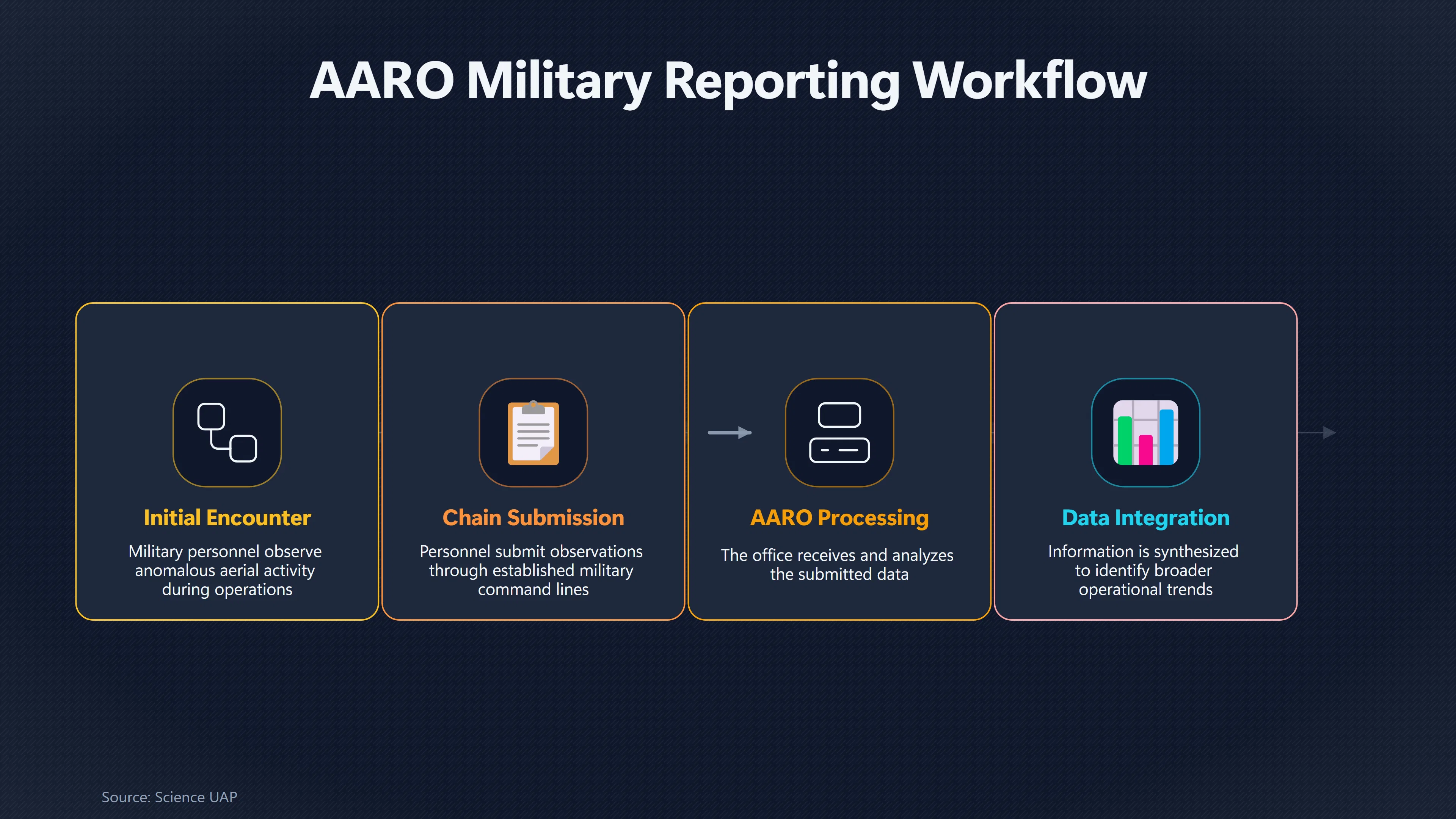
The Pentagon’s All-domain Anomaly Resolution Office (AARO) has established clearer reporting channels for military personnel and federal employees. Current guidance directs military personnel to report operational UAP through their chain of command under updated Joint Staff procedures, while civilian pilots are encouraged to report sightings through air traffic control, allowing relevant reports to reach AARO via the Federal Aviation Administration. AARO also accepts historical reports from eligible current and former government personnel with direct knowledge relevant to its historical review.[AARO]aaro.milSubmit A ReportAARO Submit A Report…
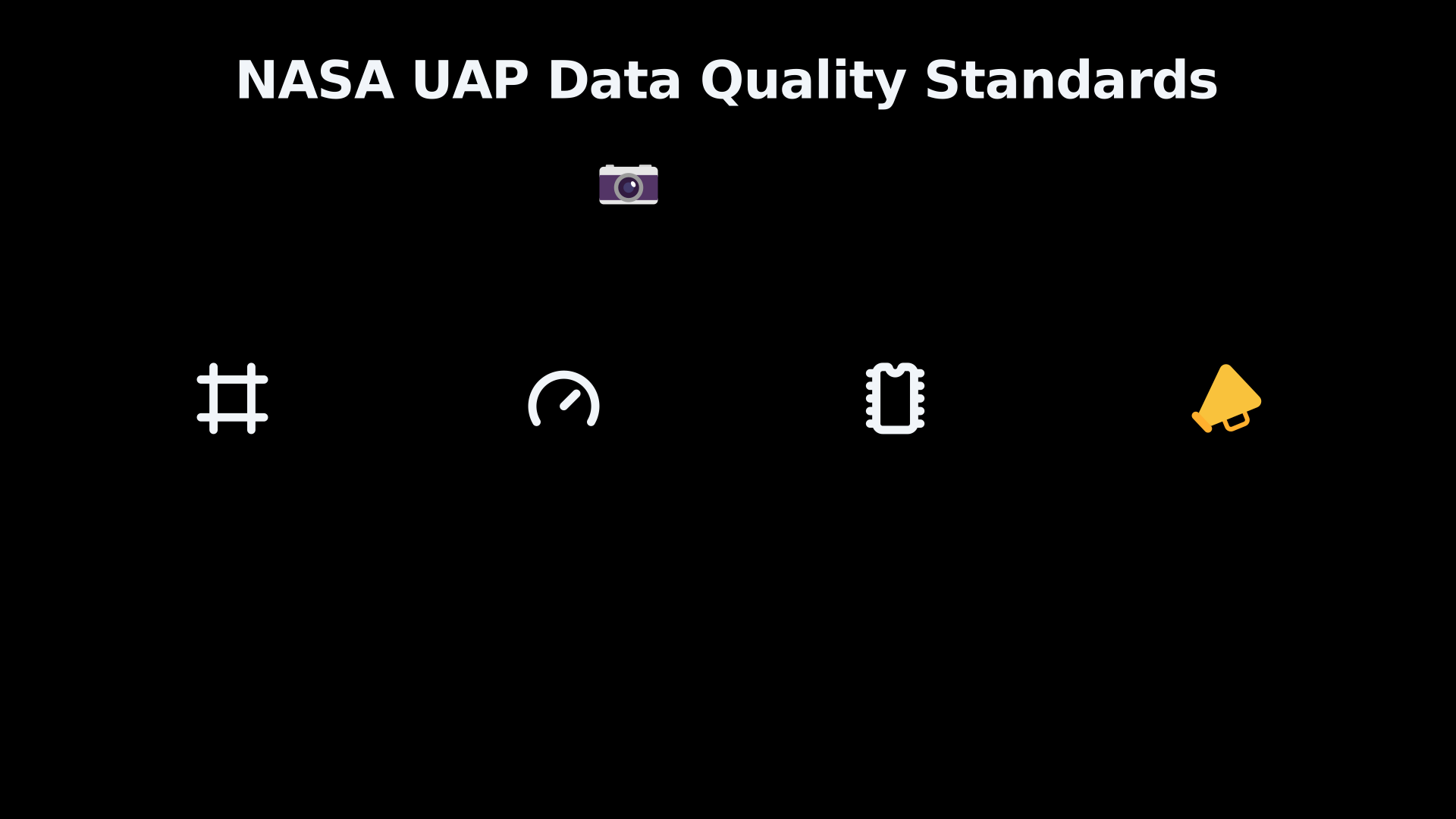
NASA’s recommendations complement this approach by focusing on scientific data quality rather than witness credibility alone. Its study proposed:
- better integration of civilian and military sensor data where possible;
- improved collection of calibrated imagery and flight metadata;
- consistent reporting standards;
- use of artificial intelligence to identify patterns in large datasets; and
- reducing stigma so pilots report observations promptly instead of remaining silent.[NASA Science]science.nasa.govScience UAPNASA ScienceUAP - NASA Science…
These reforms aim to improve evidence regardless of whether individual reports ultimately prove mundane or remain unresolved.
The continuing role of classification
Even with improved reporting systems, classification continues to complicate investigation.
Military aircraft often operate using sensors, tactics and intelligence capabilities that cannot be publicly disclosed. Investigators may therefore possess more information than can be released, while external researchers may lack access to the data needed to independently evaluate specific cases.
Conversely, classification can also delay or limit reporting within government if personnel are uncertain which details can safely be shared. AARO has stated that it is authorised to receive classified information relating to UAP investigations, an attempt to reduce this barrier by providing an official destination for sensitive reporting.[AARO]aaro.milSubmit A ReportAARO Submit A Report…
This does not eliminate disputes over transparency, but it addresses one practical obstacle identified by pilots and lawmakers.
Why pilot reporting matters to the wider UAP debate
Within the broader debate surrounding modern UAP—and by extension continuing public interest rooted in cases such as Roswell—the reporting issue illustrates a more practical question than whether any particular sighting represents alien technology. The central policy challenge is ensuring that trained observers can document unusual aerial encounters without unnecessary stigma while generating evidence that investigators can meaningfully analyse.
Better reporting systems cannot determine the origin of every unidentified observation. They can, however, improve aviation safety, strengthen intelligence awareness and increase the likelihood that future cases are supported by multiple independent sources of evidence rather than isolated eyewitness accounts. That implementation-focused approach increasingly defines official UAP policy, regardless of the conclusions ultimately reached about individual incidents.
Amazon book picks
Further Reading
Books and field guides related to Why Pilots Hesitate to Report UAP. Use these as the next step if you want deeper reading beyond the article.
The UFO Experience: A Scientific Inquiry
Cited by the New York Review of Books as "the best brief for visitation," this classic study presents an analysis of UFO reports and conc...
UFOs: Generals, Pilots, and Government Officials Go on the Re...
NEW YORK TIMES BESTSELLER • Impeccably researched, this riveting journalistic investigation separates fact from fiction, and documents th...
The Checklist Manifesto
THE GAME-CHANGING BOOK FROM THE BESTSELLING AUTHOR OF BEING MORTAL Today we find ourselves in possession of stupendous know-how, which we...
Skunk Works
This classic history of America's high-stakes quest to dominate the skies is "a gripping technothriller in which the technology is real"...
eBay marketplace picks
Marketplace Samples
Live-tested eBay searches with available results related to this page.
Selected frompilot patch oneBay.co.uk.

Endnotes
1.
Source: science.nasa.gov
Title: Science UAP
Link:https://science.nasa.gov/uap/
Source snippet
NASA ScienceUAP - NASA Science...
2.
Source: nasa.gov
Title: UPDATE: NASA Shares UAP Independent Study Report; Names Director
Link:https://www.nasa.gov/news-release/update-nasa-shares-uap-independent-study-report-names-director/
Source snippet
UPDATE: NASA Shares UAP Independent Study Report; Names Director - NASA...
3.
Source: aaro.mil
Title: Submit A Report
Link:https://www.aaro.mil/Next-AARO-Home-redesign/Next-Parent/Next-Submit-a-Report-dup/
Source snippet
AARO Submit A Report...
4.
Source: aaro.mil
Link:https://www.aaro.mil/FAQ/
Source snippet
AARO FAQ...
5.
Source: nasa.gov
Title: ASA P Historical Reports
Link:https://www.nasa.gov/history/asap-historical-reports/
Source snippet
ASAP Historical Reports - NASAFebruary 25, 2026 — NASA History * Explore NASA’s History * NASA History Office * Publications and Resource...
Published: February 25, 2026
6.
Source: congress.gov
Link:https://www.congress.gov/bill/119th-congress/house-bill/5231/text
Source snippet
H.R.5231 - 119th Congress (2025-2026): Safe Airspace for Americans Act | Congress.gov | Library of CongressSeptember 9, 2025 — H.R.5231...
Published: September 9, 2025
7.
Source: congress.gov
Link:https://www.congress.gov/bill/119th-congress/house-bill/5231/text/ih?format=txt
Source snippet
Garcia of California (for himself, Mr. Grothman, Mr. Moskowitz, and Mr. Ogles) introduced the following bill; which was referred to the C...
8.
Source: defense.gov
Link:https://www.defense.gov/News/News-Stories/Article/Article/3965403/dod-examining-unidentified-anomalous-phenomena/
9.
Source: congress.gov
Link:https://www.congress.gov/bill/118th-congress/house-bill/6967/text
10.
Source: defense.gov
Link:https://www.defense.gov/News/News-Stories/Article/Article/3575511/dod-unidentified-anomalous-phenomena-office-launches-new-reporting-tool/
11.
Source: defense.gov
Link:https://www.defense.gov/News/Transcripts/Transcript/Article/3575588/aaro-director-dr-sean-kirkpatrick-holds-an-off-camera-media-roundtable/
12.
Source: defense.gov
Link:https://www.defense.gov/News/Releases/Release/Article/3513171/the-department-of-defense-launches-the-all-domain-anomaly-resolution-office-web/
13.
Source: aaro.mil
Link:https://www.aaro.mil/Submit-A-Report/
14.
Source: aaro.mil
Link:https://www.aaro.mil/
15.
Source: aaro.mil
Link:https://www.aaro.mil/UAP-Records/-1/
16.
Source: vanityfair.com
Link:https://www.vanityfair.com/news/2023/07/ufo-hearing-congress
Source snippet
The hearing featured testimonies from former Navy pilots Ryan Graves and David Fravor, as well as whistleblower and former intelligence o...
Additional References
17.
Source: youtube.com
Link:https://www.youtube.com/watch?v=lTGJt7Gho0w
Source snippet
Why Pilots Struggle to Report UAP Encounters Ryan Graves The Final Warning: Why the Military Grounded This Pilot After His UAP Sighting...
18.
Source: atlantisassociation.com
Title: UAP Current State Research Source Pack | Atlantis Association
Link:https://atlantisassociation.com/library/bibliographies/uap-current-state-research-source-pack/
Source snippet
April 9, 2026 — Curated Bibliography UAP CURRENT STATE RESEARCH SOURCE PACK An evidence-first bibliography covering NASA's 2023 UAP study...
Published: April 9, 2026
19.
Source: youtube.com
Title: Pilots claim to witness UFOs on a near-daily basis | Morning in America
Link:https://www.youtube.com/watch?v=1gCYSsvYQPY
Source snippet
Inside the Data: What 1,000+ Pilot Reports Reveal About UAP | iConnections Webinar with Ryan Graves...
20.
Source: youtube.com
Title: UFO Hearing: Former Navy pilot says sightings were ‘routine’ | News Nation
Link:https://www.youtube.com/watch?v=ti1RxDYx20E
Source snippet
Pilots claim to witness UFOs on a near-daily basis | Morning in America...
21.
Source: youtube.com
Link:https://www.youtube.com/watch?v=wjFHqzrnUhA
Source snippet
Navy pilots describe encounters with UFOs...
22.
Source: faa.gov
Link:https://www.faa.gov/air_traffic/publications/atpubs/foa_html/chap4_section_7.html
23.
Source: youtube.com
Title: Navy pilots describe encounters with UFOs
Link:https://www.youtube.com/watch?v=ZBtMbBPzqHY
Source snippet
UFO Hearing: Former Navy pilot says sightings were 'routine' | NewsNation...
24.
Source: uap-archive.org
Link:https://uap-archive.org/uap/records/aaro-historical-record-report-vol1/
25.
Source: uap-archive.org
Link:https://uap-archive.org/uap/compare/nasa-study-vs-aaro-historical-scope/
26.
Source: uaparchive.com
Link:https://uaparchive.com/documents.html