Within Cold War Technology
Could the Atmosphere Carry a Nuclear Blast?
Project Mogul tested whether low-frequency sound trapped in atmospheric layers could reveal distant Soviet nuclear explosions.
On this page
- How atmospheric sound channels work
- Why nuclear tests produce detectable signals
- What Mogul needed to prove
Page outline Jump by section
Introduction
One of the least-known ideas behind Project Mogul was not the balloon itself but the atmosphere. During the early Cold War, US scientists investigated whether the upper atmosphere could act as a natural waveguide, allowing extremely low-frequency sound from a distant nuclear explosion to travel thousands of kilometres. If this worked, the United States might detect a secret Soviet atomic test without crossing Soviet airspace or relying solely on spies. Project Mogul therefore combined atmospheric physics, acoustics and high-altitude balloon engineering into an ambitious intelligence experiment. Although later technologies overtook it, the research established important principles that would eventually contribute to modern infrasound monitoring used for nuclear-test verification.[Muller Lab]muller.lbl.govMuller Lab Project MogulMuller Lab Project Mogul
How atmospheric sound channels work
Ordinarily, sound spreads outward and weakens rapidly as it travels through the atmosphere. The upper atmosphere, however, is not uniform. Temperature changes and powerful high-altitude winds alter the speed of sound at different altitudes. Under favourable conditions, these variations bend—or refract—low-frequency sound waves back towards a narrow layer rather than allowing them to disperse into space.
This phenomenon creates an atmospheric acoustic duct, often described as an atmospheric sound channel. Much like an optical fibre guides light or the ocean’s SOFAR (Sound Fixing and Ranging) channel guides underwater sound, the atmosphere can trap infrasonic waves and carry them over enormous distances with comparatively little energy loss. These frequencies, generally below 20 hertz, are largely inaudible to humans but propagate far more efficiently than ordinary audible sound.[Annual Reviews]annualreviews.orgAnnual ReviewsInfrasound: Connecting the Solid Earth, Oceans, and Atmosphere | Annual ReviewsMay 30, 2012…
Scientists recognised that the exact position and strength of these channels constantly changed with:
- Temperature structure in the stratosphere.
- Seasonal and daily wind patterns.
- Atmospheric turbulence.
- Changes in air density with altitude.
Rather than providing a permanent “highway” for sound, the atmosphere created shifting propagation paths that could enhance or prevent long-range detection depending on weather conditions hundreds of kilometres away.[Annual Reviews]annualreviews.orgAnnual ReviewsInfrasound: Connecting the Solid Earth, Oceans, and Atmosphere | Annual ReviewsMay 30, 2012…
Why nuclear tests produce detectable signals
A nuclear explosion releases energy extremely rapidly, generating a powerful shock wave. While much of the blast energy remains at higher frequencies near the explosion, part of it extends into the infrasonic range. These long-wavelength pressure waves can survive long-distance propagation far better than ordinary sound.
Large atmospheric nuclear detonations therefore produce distinctive infrasonic signatures that can travel across continents when atmospheric conditions are favourable. Researchers hoped these signals would reveal several useful characteristics:
- That an explosion had occurred.
- The approximate direction of the source.
- An estimate of the explosion’s size.
- In some circumstances, the probable location when observations from multiple sensors were combined.
This offered an attractive intelligence capability before satellites routinely monitored nuclear activities. Instead of observing the explosion directly, analysts could infer its occurrence from the pressure waves travelling through the atmosphere.[OSTI]osti.govInfrasound and the infrasonic monitoring of atmospheric nuclear explosions: A literature review. Final report, 7 September 1995-28 Fe…
The same physical principles also apply to volcanic eruptions, large meteors, rocket launches and other energetic events, which is why modern infrasound stations detect a wide variety of natural and human-made phenomena.[Annual Reviews]annualreviews.orgAnnual ReviewsInfrasound: Connecting the Solid Earth, Oceans, and Atmosphere | Annual ReviewsMay 30, 2012…

What Mogul needed to prove
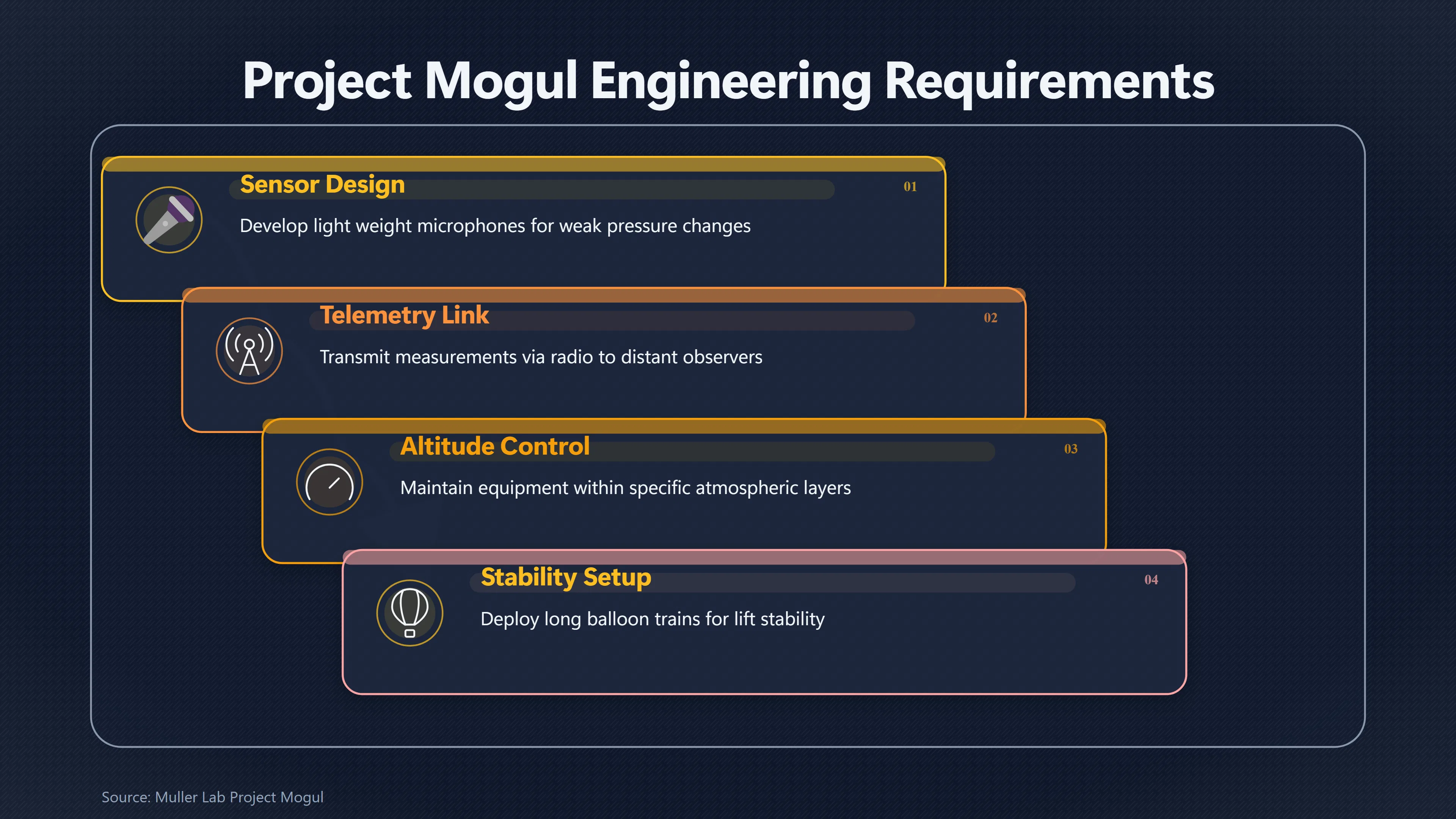
The scientific theory alone was insufficient. Project Mogul needed to demonstrate that practical instruments could remain inside the appropriate atmospheric layer long enough to record useful signals.
This required solving three interconnected engineering problems.
First, researchers needed lightweight microphones sensitive enough to detect extremely weak infrasonic pressure changes after thousands of kilometres of travel.
Second, the instruments had to transmit their measurements back to observers through radio telemetry rather than storing data aboard a balloon that might never be recovered.
Third—and perhaps most difficult—the equipment had to stay within the desired altitude band despite changing winds and balloon expansion. A drifting instrument outside the acoustic channel could miss signals entirely.[Muller Lab]muller.lbl.govMuller Lab Project MogulMuller Lab Project Mogul
These requirements explain why Mogul used long balloon trains rather than simple weather balloons. Multiple balloons provided greater lift stability, while attached equipment included microphones, batteries, transmitters, radar reflectors and altitude-control components intended to maximise time within the target atmospheric region.[Muller Lab]muller.lbl.govMuller Lab Project MogulMuller Lab Project Mogul
Why atmospheric physics made the project difficult
The greatest uncertainty was not the balloons themselves but the atmosphere.
Unlike a laboratory experiment, atmospheric sound propagation depends upon conditions extending across thousands of kilometres. Winds that were impossible to measure accurately in the late 1940s could redirect, weaken or entirely block infrasonic signals. Even if a nuclear explosion generated detectable sound, researchers first had to determine whether the absence of a signal meant:
- no explosion had occurred;
- the signal had travelled along an unexpected path;
- the balloon was outside the optimal altitude;
- atmospheric conditions had prevented propagation; or
- instrument noise had masked the event.
These uncertainties made interpretation difficult and required extensive experimentation before operational monitoring could become reliable.[Annual Reviews]annualreviews.orgAnnual ReviewsInfrasound: Connecting the Solid Earth, Oceans, and Atmosphere | Annual ReviewsMay 30, 2012…

From experimental balloons to global monitoring
Project Mogul itself remained experimental, and later Cold War surveillance increasingly relied on complementary technologies such as seismic monitoring, radionuclide detection, satellites and other intelligence methods. Nevertheless, atmospheric acoustics never disappeared.
As international nuclear-test monitoring expanded, infrasound became one of the four verification technologies incorporated into the International Monitoring System supporting the Comprehensive Nuclear-Test-Ban Treaty. Modern arrays of sensitive microbarometers can detect atmospheric explosions over vast distances using sophisticated atmospheric models and digital signal processing unavailable to Mogul’s designers.[De Gruyter Brill]degruyterbrill.comDe Gruyter Brill Detection of atmospheric nuclear explosions: the infrasouDe Gruyter Brill Detection of atmospheric nuclear explosions: the infrasou
Recent research has also strengthened understanding of elevated atmospheric acoustic ducts. Direct balloon-borne observations have provided evidence for an atmospheric channel resembling the oceanic SOFAR channel, demonstrating that balloon-mounted sensors can detect infrasonic signals in ways that ground stations sometimes cannot. These findings validate ideas first explored during the early Cold War, although with vastly improved instruments and atmospheric models.[AGU Publications]agupubs.onlinelibrary.wiley.comAGU PublicationsThe AtmoSOFAR Channel: First Direct Observations of an Elevated Acoustic Duct - Albert - 2023 - Earth and Space Science…
Why this mechanism matters to the Roswell story
Within the Roswell context, atmospheric sound channels explain why Project Mogul existed in the first place. The project’s objective was not to develop unusual balloon materials but to test whether the atmosphere itself could become a strategic sensor for detecting distant Soviet nuclear activity.
Because the mission depended on maintaining instruments at precise altitudes inside a poorly understood atmospheric layer, Mogul required unusually complex balloon assemblies and repeated experimental flights. Those specialised flight trains, rather than any extraterrestrial technology, formed the classified element of the programme. Understanding the atmospheric detection mechanism therefore clarifies why an apparently ordinary collection of balloons, reflectors and scientific equipment could nevertheless belong to one of the United States’ most sensitive early Cold War intelligence experiments.
Amazon book picks
Further Reading
Books and field guides related to Could the Atmosphere Carry a Nuclear Blast?. Use these as the next step if you want deeper reading beyond the article.
Dark Sun: The Making of the Hydrogen Bomb
Here, for the first time, in a brilliant, panoramic portrait by the Pulitzer Prize-winning author of The Making of the Atomic Bomb, is th...
The Making of the Atomic Bomb
Details the making of the atomic bomb. Includes diagrams and pictures documenting people and places.
Physics of the Atmosphere and Climate
Murry Salby's textbook provides an integrated treatment of processes controlling the Earth-atmosphere system for students and researchers.
An Introduction to Atmospheric Physics
Contributor biographical information for An introduction to atmospheric physics / David G. Andrews. Bibliographic record and links to rel...
eBay marketplace picks
Marketplace Samples
Live-tested eBay searches with available results related to this page.
Selected fromCold War aviation poster oneBay.co.uk.


Endnotes
1.
Source: muller.lbl.gov
Title: Muller Lab Project Mogul
Link:https://muller.lbl.gov/teaching/physics10/Roswell/USMogulReport.html
2.
Source: osti.gov
Link:https://www.osti.gov/biblio/621445
Source snippet
Infrasound and the infrasonic monitoring of atmospheric nuclear explosions: A literature review. Final report, 7 September 1995-28 Fe...
Published: September 1995
3.
Source: annualreviews.org
Link:https://www.annualreviews.org/content/journals/10.1146/annurev-earth-042711-105508
Source snippet
Annual ReviewsInfrasound: Connecting the Solid Earth, Oceans, and Atmosphere | Annual ReviewsMay 30, 2012...
Published: May 30, 2012
4.
Source: agupubs.onlinelibrary.wiley.com
Link:https://agupubs.onlinelibrary.wiley.com/doi/10.1029/2023EA003149
Source snippet
AGU PublicationsThe AtmoSOFAR Channel: First Direct Observations of an Elevated Acoustic Duct - Albert - 2023 - Earth and Space Science...
5.
Source: degruyterbrill.com
Title: De Gruyter Brill Detection of atmospheric nuclear explosions: the infrasou
Link:https://www.degruyterbrill.com/document/doi/10.1515/kern-2001-0058/html?lang=en
6.
Source: agupubs.onlinelibrary.wiley.com
Link:https://agupubs.onlinelibrary.wiley.com/doi/abs/10.1029/2023EA003149
Source snippet
A. Albert, Corresponding Author S. A. Albert * [email protected] * orcid.org/0000-0002-2369-1997 Sandia National...
7.
Source: degruyterbrill.com
Title: Detection of atmospheric nuclear explosions: the infrasou
Link:https://www.degruyterbrill.com/de/document/doi/10.1515/kern-2001-0058/html
8.
Source: agupubs.onlinelibrary.wiley.com
Link:https://agupubs.onlinelibrary.wiley.com/doi/10.1029/2021GL096326
9.
Source: agupubs.onlinelibrary.wiley.com
Link:https://agupubs.onlinelibrary.wiley.com/doi/full/10.1029/2017RG000594
10.
Source: agupubs.onlinelibrary.wiley.com
Link:https://agupubs.onlinelibrary.wiley.com/doi/10.1029/2017RG000594
11.
Source: dfat.gov.au
Link:https://www.dfat.gov.au/about-us/publications/corporate/annual-reports/asno-annual-report-2000-2001/Pages/infrasound-the-ctbts-international-monitoring-system
12.
Source: agupubs.onlinelibrary.wiley.com
Link:https://agupubs.onlinelibrary.wiley.com/doi/abs/10.1029/2010rg000335
13.
Source: history.com
Link:https://www.history.com/articles/roswell
14.
Source: muller.lbl.gov
Title: [Roswell Incident]({{ ‘the-1980-book/’ | relative_url }})
Link:https://muller.lbl.gov/teaching/physics10/Roswell/RoswellIncident.html
15.
Source: youtube.com
Title: Project Mogul
Link:https://www.youtube.com/watch?v=mBcYtSsPIuU
Source snippet
Roswell UFO: What Really Happened? Conspiracy Theory Section I...
Additional References
16.
Source: sandia.gov
Link:https://www.sandia.gov/research/publications/details/the-atmosofar-channel-first-direct-observations-of-an-elevated-acoustic-duc-2023-10-01/
Source snippet
The AtmoSOFAR Channel: First Direct Observations of an Elevated Acoustic Duct – Publications – ResearchOctober 1, 2023 — THE ATMOSOFAR CH...
Published: October 1, 2023
17.
Source: researchgate.net
Link:https://www.researchgate.net/publication/375337220_AtmoSOFAR_Verifying_the_Presence_of_an_Acoustic_Duct_with_Balloon-borne_Infrasound
Source snippet
(PDF) AtmoSOFAR: Verifying the Presence of an Acoustic Duct with Balloon-borne Infrasound.April 1, 2022 — Conference Paper PDF Available...
Published: April 1, 2022
18.
Source: youtube.com
Title: Roswell UFO: What Really Happened? Conspiracy Theory Section I
Link:https://www.youtube.com/watch?v=8ua33uwRTMM
Source snippet
The Roswell Incident Mystery Finally Solved...
19.
Source: researchgate.net
Link:https://www.researchgate.net/publication/374669244_The_AtmoSOFAR_Channel_First_Direct_Observations_of_an_Elevated_Acoustic_Duct
20.
Source: researchgate.net
Link:https://www.researchgate.net/publication/281322566_Detection_of_atmospheric_nuclear_explosions_The_infrasound_component_of_the_International_Monitoring_System
21.
Source: researchgate.net
Link:https://www.researchgate.net/publication/252447170_Monitoring_of_atmospheric_nuclear_explosions_with_infrasonic_microphone_arrays
22.
Source: sciencedirect.com
Link:https://www.sciencedirect.com/science/article/abs/pii/S1364682611000411
23.
Source: sciencedirect.com
Title: ScienceDirect Infrasound
Link:https://www.sciencedirect.com/topics/physics-and-astronomy/infrasound
Source snippet
Infrasound - an overview | ScienceDirect Topics...
24.
Source: youtube.com
Title: What Nuclear Bombs Taught Us About Whales
Link:https://www.youtube.com/watch?v=x_QJ3KxkjtE
Source snippet
ANU Science on Location Warramunga Seismic Station...
25.
Source: govinfo.gov
Title: [The Roswell Report]({{ ‘the-roswell-report/’ | relative_url }}): Fact Versus Fiction in the New Mexico Desert
Link:https://www.govinfo.gov/app/details/GOVPUB-D301-PURL-LPS71655