Within Military Secrecy
Why Nuclear Secrets Were Classified From the Start
Postwar nuclear rules made sensitive information secret from creation, shaping how Roswell-era military programs were protected.
On this page
- The Atomic Energy Act and automatic secrecy
- How wartime security practices carried into 1947
- Why nuclear intelligence received exceptional protection
Page outline Jump by section
Introduction
The extraordinary secrecy surrounding the Roswell incident did not emerge in isolation. It coincided with a profound change in how the United States treated nuclear information after the Second World War. Rather than relying solely on ordinary military classification, Congress created a legal framework in which many categories of atomic knowledge were considered secret from the moment they came into existence. This principle—later widely described as information being “born secret”—was unlike almost any other area of American law. It reflected the belief that nuclear weapons were so strategically important that even seemingly ordinary technical details could help a hostile power.

Understanding this framework helps explain why military programmes connected with nuclear intelligence in 1947, including efforts to detect Soviet atomic testing, were protected with exceptional care. The secrecy surrounding projects of the Roswell era was not simply a matter of hiding individual documents; it was part of a broader governance system designed to prevent adversaries from piecing together America’s nuclear capabilities.
The Atomic Energy Act and Automatic Secrecy
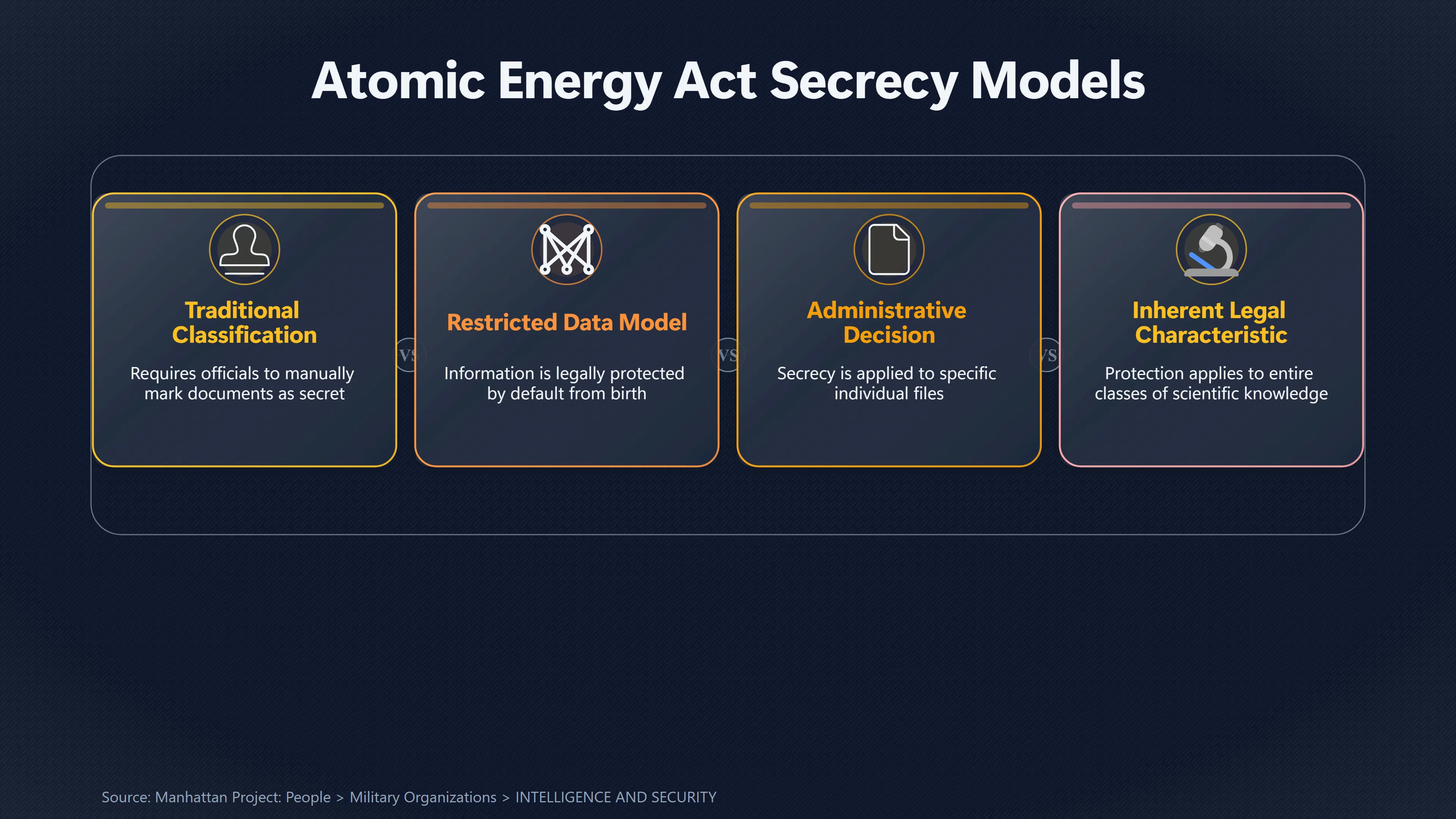
The legal foundation for post-war nuclear secrecy was the Atomic Energy Act of 1946, often called the McMahon Act. Unlike conventional classification systems, which normally require officials to decide that a document should be marked Confidential, Secret or Top Secret, the Act created a category called Restricted Data. Information falling within that category was legally protected by default until the government deliberately removed it from protection. This became known as the “born secret” doctrine.[EHSS Energy]ehss.energy.govOpen source on energy.gov.
The legislation covered three broad areas:
- the design and manufacture of atomic weapons;
- the production of special nuclear material;
- the use of such material in producing energy.
Congress deliberately defined these categories broadly because officials feared that isolated technical facts, harmless in isolation, could become valuable when combined with other intelligence. The law therefore assumed that nuclear information should begin life as protected information rather than requiring officials to classify each new discovery individually.[EHSS Energy]ehss.energy.govOpen source on energy.gov.
This represented an important shift in governance. Instead of treating secrecy as an administrative decision applied to particular documents, the law made secrecy an inherent legal characteristic of entire classes of scientific knowledge.
How Wartime Security Practices Carried Into 1947
The Atomic Energy Act did not appear in a vacuum. It formalised security practices that had already developed during the Manhattan Project.
General Leslie Groves managed the wartime atomic programme through strict compartmentalisation. Scientists, engineers and military personnel typically knew only the portion of the project necessary for their work. Entire research facilities were isolated behind security checkpoints, employees underwent extensive background investigations, and communication between project sites was tightly controlled. Even many senior government officials lacked access unless they demonstrated a specific operational need.[OSTI]osti.govManhattan Project: People > Military Organizations > INTELLIGENCE AND SECURITYManhattan Project: People > Military Organizations > INTELLIGENCE AND SECURITY…
These methods proved highly effective at preventing large-scale disclosure despite the enormous size of the Manhattan Project. When the war ended, policymakers concluded that such extraordinary controls should not disappear simply because the fighting had ended. Instead, the emerging Cold War seemed to justify making exceptional secrecy permanent.
The transition from wartime emergency measures to statutory law therefore represented continuity rather than abrupt change. The habits of compartmentation, restricted access and “need to know” survived into the institutions that managed America’s nuclear programme after 1945.[OSTI]osti.govManhattan Project: People > Military Organizations > INTELLIGENCE AND SECURITYManhattan Project: People > Military Organizations > INTELLIGENCE AND SECURITY…
Why Nuclear Intelligence Received Exceptional Protection
The protection extended beyond bomb design itself. American leaders regarded intelligence about foreign nuclear programmes as nearly as sensitive as the weapons.
In 1947, the United States possessed the world’s only operational nuclear arsenal, but officials had limited knowledge of Soviet progress. Intelligence analysts attempted to estimate Soviet uranium production, industrial capacity, scientific expertise and likely testing schedules, often from fragmentary evidence. Errors in these assessments could have major strategic consequences.
Programmes intended to detect a future Soviet nuclear explosion therefore became national priorities. Revealing how the United States collected that intelligence could expose:
- the existence of long-range detection programmes;
- the physical principles being exploited;
- the locations and capabilities of monitoring systems;
- weaknesses that an adversary might evade.
For that reason, even equipment that appeared ordinary could acquire exceptional sensitivity when viewed as part of an intelligence system. The intelligence mission—not necessarily every individual component—was what demanded protection.
This distinction is particularly important for understanding the Roswell period. The secrecy surrounding projects associated with nuclear intelligence often concerned operational purpose rather than unusual physical materials.
Why “Born Secret” Was Different From Ordinary Military Classification
Traditional military classification generally depends on official judgement. A document is reviewed, assigned a classification level and later may be downgraded or declassified through administrative procedures.
The nuclear system differed in several important respects.
- Legal rather than administrative authority. Protection arose directly from federal statute rather than only executive classification rules.
- Automatic application. Relevant information entered the Restricted Data category immediately instead of waiting for an official marking.
- Broader scope. Protection applied to categories of knowledge, not merely specific government documents.
- Controlled release. Information remained protected until formally removed through statutory declassification procedures rather than ordinary document review.[EHSS Energy]ehss.energy.govOpen source on energy.gov.
This framework reflected policymakers’ belief that atomic knowledge could not safely be managed through conventional secrecy rules because scientific information spreads rapidly once published.
Why This Matters for Roswell-Era Military Secrecy
The Roswell incident occurred only months after the Atomic Energy Act became law and during the same period that the United States was reorganising its national security institutions around Cold War priorities.
Whether or not particular Roswell materials themselves fell under Restricted Data rules, the broader security culture surrounding military projects had already been transformed. Programmes connected to nuclear intelligence inherited:
- rigorous compartmentalisation;
- limited distribution of operational knowledge;
- reluctance to provide public explanations that might reveal intelligence objectives;
- acceptance that misleading public impressions could sometimes be preferable to exposing sensitive capabilities.
Seen in that context, the secrecy surrounding projects such as those intended to monitor Soviet nuclear activity reflected established policy rather than an improvised response to a single incident. The government had created a system in which protecting nuclear intelligence was considered a strategic necessity from the moment such information—or even the means of acquiring it—came into existence.
Amazon book picks
Further Reading
Books and field guides related to Why Nuclear Secrets Were Classified From the Start. Use these as the next step if you want deeper reading beyond the article.
Restricted Data: The History of Nuclear Secrecy in the United...
"Nuclear weapons, since their conception, have been the subject of secrecy. In the months after the dropping of the atomic bombs on Hiros...
The Making of the Atomic Bomb
Details the making of the atomic bomb. Includes diagrams and pictures documenting people and places.
The Bomb: Presidents, Generals, and the Secret History of Nuc...
From the author of the classic The Wizards of Armageddon and Pulitzer Prize finalist comes the definitive history of American policy on n...
Command and Control: Nuclear Weapons, the Damascus Accident,...
From famed investigative journalist Eric Schlosser, author of Fast Food Nation, comes Command and Control a ground-breaking account of th...
eBay marketplace picks
Marketplace Samples
Live-tested eBay searches with available results related to this page.
Selected fromatomic age poster oneBay.co.uk.




Endnotes
1.
Source: ehss.energy.gov
Link:https://ehss.energy.gov/ohre/roadmap/achre/chap13_2.html
2.
Source: osti.gov
Title: Manhattan Project: People > Military Organizations > INTELLIGENCE AND SECURITY
Link:https://www.osti.gov/opennet/manhattan-project-history/People/MilitaryOrgs/cic.html
Source snippet
Manhattan Project: People > Military Organizations > INTELLIGENCE AND SECURITY...
3.
Source: ehss.energy.gov
Title: chap13 3
Link:https://ehss.energy.gov/ohre/roadmap/achre/chap13_3.html
4.
Source: osti.gov
Link:https://www.osti.gov/opennet/manhattan-project-history/Events/1942-1945/espionage.htm
5.
Source: osti.gov
Link:https://www.osti.gov/opennet/manhattan-project-history/Resources/openness.htm
6.
Source: osti.gov
Link:https://www.osti.gov/opennet/manhattan-project-history/Places/LosAlamos/la-security.html
7.
Source: Wikipedia
Title: Restricted Data
Link:https://en.wikipedia.org/wiki/Restricted_Data
8.
Source: cia.gov
Link:https://www.cia.gov/readingroom/document/0000629617
9.
Source: military-history.fandom.com
Title: Atomic Energy Act of 1946
Link:https://military-history.fandom.com/wiki/Atomic_Energy_Act_of_1946
10.
Source: atomicarchive.com
Title: atomic energy act
Link:https://www.atomicarchive.com/resources/documents/postwar/atomic-energy-act.html
11.
Source: everything.explained.today
Title: Atomic Energy Act of 1946
Link:https://everything.explained.today/Atomic_Energy_Act_of_1946/
12.
Source: nature.com
Title: The Atomic Energy Act | Nature
Link:https://www.nature.com/articles/158807a0
Additional References
13.
Source: nrc.gov
Title: Information Security | Nuclear Regulatory Commission
Link:https://www.nrc.gov/security/info-security
Source snippet
Nuclear Regulatory Commission (NRC) must protect classified and sensitive unclassified non-safeguards information (SUNSI) related to U.S...
14.
Source: archives.gov
Title: Each redaction will be associated with a re
Link:https://www.archives.gov/declassification/iscap/redaction-codes.html
Source snippet
Redaction Codes | National ArchivesMay 13, 2025 — REDACTION CODES The declassified documents will usually contain redactions, which indic...
Published: May 13, 2025
15.
Source: legalclarity.org
Title: What Is Restricted Data Under the Atomic Energy Act?
Link:https://legalclarity.org/what-is-restricted-data-under-the-atomic-energy-act-2/
Source snippet
June 1, 2026 — THE BORN CLASSIFIED DOCTRINE The phrase “born classified” does not appear in the statute, but it accurately de...
Published: June 1, 2026
16.
Source: acquisition.gov
Title: 952.204-2 Security requirements
Link:https://www.acquisition.gov/dears/952.204-2-security-requirements
Source snippet
1, 2024 — DEAR Part Number: 952 * * * * ## Department of Energy Acquisition Regulation <?xml encoding="UTF-8"?...
Published: December 1, 2024
17.
Source: youtube.com
Title: Bulletin Virtual Program—Restricted Data: The History of Nuclear Secrecy
Link:https://www.youtube.com/watch?v=I3OttUdrkJE
Source snippet
Restricted Data The History of Nuclear Secrecy in the United States with Alex Wellerstein...
18.
Source: youtube.com
Link:https://www.youtube.com/watch?v=dKSY-i2AsvY
Source snippet
Alex Wellerstein, Historian of Science, Stevens Institute...
19.
Source: youtube.com
Title: More Secret Than Roswell UFO
Link:https://www.youtube.com/watch?v=QhMwPz9esjk
Source snippet
Why Nuclear Intelligence Was Born Secret Atomic Energy Act 1946 Restricted Data AEA v FOIA: HOW THE Department of Energy Suppresses UAP T...
20.
Source: youtube.com
Title: Restricted Data: The History of Nuclear Secrecy in the United States
Link:https://www.youtube.com/watch?v=Ey5n9PS3ybE
Source snippet
Bulletin Virtual Program—Restricted Data: The History of Nuclear Secrecy...
21.
Source: uscode.house.gov
Link:https://uscode.house.gov/view.xhtml?edition=prelim&f=treesort&jumpTo=true&num=0&req=%28title%3A42+section%3A2276+edition%3Aprelim%29+OR+%28granuleid%3AUSC-prelim-title42-section2276%29
Source snippet
23, 2026 — 42 USC 2276: Tampering with Restricted Data 42 USC 2276: Tampering with Restricted Data Text contains those laws in effect on...
22.
Source: uscode.house.gov
Link:https://uscode.house.gov/view.xhtml?edition=prelim&path=%2Fprelim%40title42%2Fchapter23%2FdivisionA%2Fsubchapter11