Within The Role
What Makes a Roswell Memory Credible?
Delayed testimony becomes stronger when it matches early documents, stable timelines and physical evidence that were not shaped by later publicity.
On this page
- The hierarchy of memory support
- Comparing late claims with early records
- A practical test for Roswell testimony
Page outline Jump by section
Introduction
The strongest Roswell memories are not necessarily the most detailed or the most dramatic. Because many of the best-known witness accounts emerged thirty to fifty years after 1947, historians judge them primarily by whether they can be independently tested against records created at the time. A late recollection becomes more persuasive when it matches contemporary documents, photographs, military paperwork, newspaper reports or physical evidence that existed before later publicity could influence the story. Conversely, memories that introduce entirely new events without contemporary support require greater caution. This approach does not assume that delayed witnesses were dishonest. Rather, it recognises that human memory changes over time and that historical claims gain credibility when they converge with independent evidence instead of standing alone.
The hierarchy of memory support
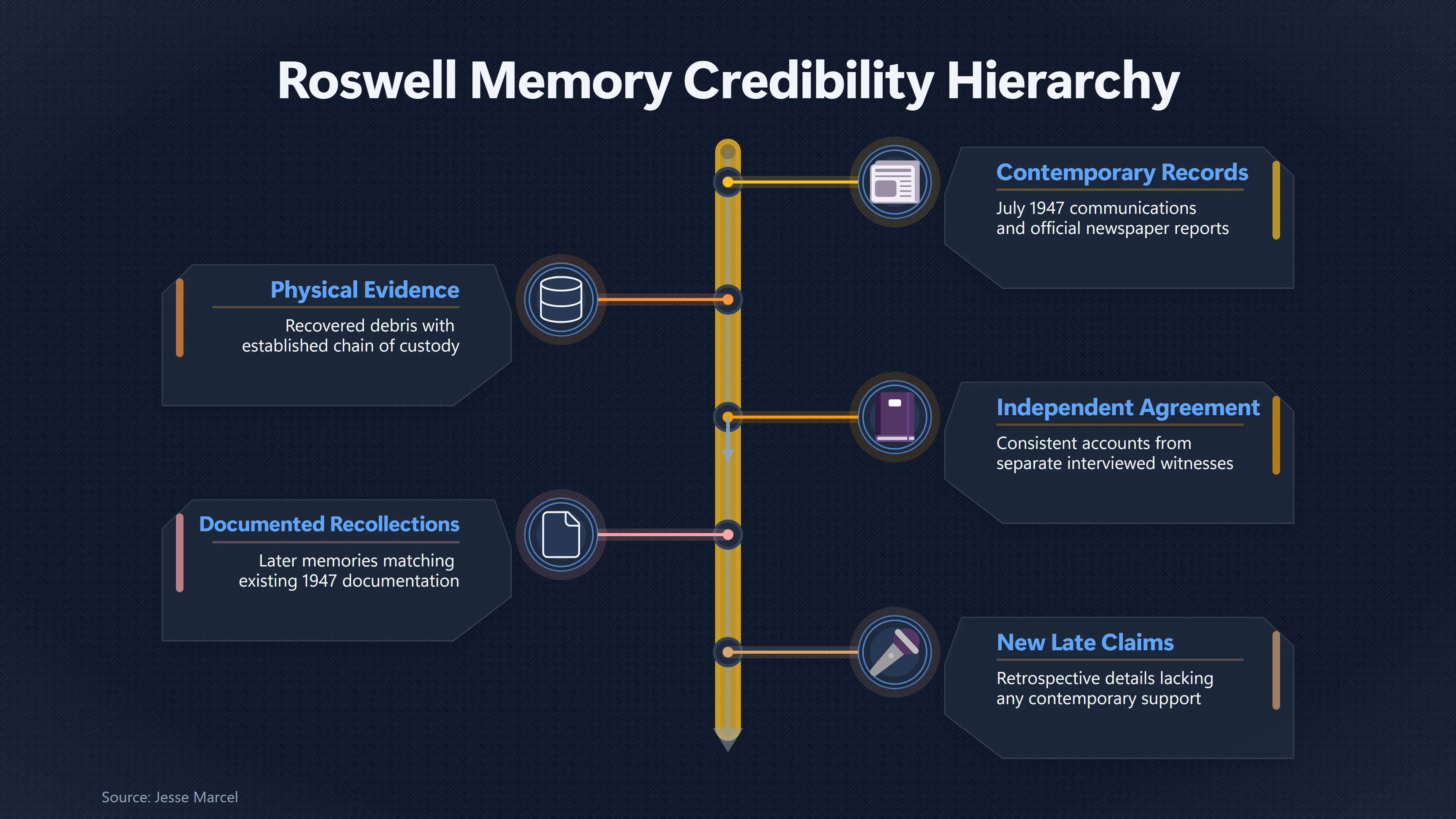
Not all witness testimony carries the same historical weight. Historians typically rank Roswell memories according to how well they can be checked against independent evidence.
From strongest to weakest, the hierarchy is generally:
- Contemporary records created in July 1947, such as military communications, newspaper reports, official correspondence and photographs.
- Physical evidence whose origin and chain of custody can be established.
- Independent witness agreement, where people interviewed separately provide consistent accounts without obvious opportunities for mutual influence.
- Later recollections that accurately describe details already documented in contemporary records.
- Late claims introducing new events that have no supporting documentary or physical evidence.
This hierarchy does not automatically invalidate late testimony. Instead, it reflects a basic historical principle: evidence created closest to an event is generally less vulnerable to memory distortion than recollections formed decades later.
Comparing late claims with early records
The Roswell case contains several examples where later memories can be directly compared with surviving 1947 evidence.
Jesse Marcel and the recovered debris
Former intelligence officer Jesse Marcel became the central Roswell witness after interviews conducted in the late 1970s. He argued that the recovered material was unlike anything he had previously encountered and later suggested that the debris photographed in Fort Worth had been substituted for the real wreckage. His testimony fundamentally reshaped public understanding of the incident.[Wikipedia]WikipediaJesse MarcelJesse Marcel
The test against contemporary records is mixed.
On one hand:
- Marcel unquestionably participated in the original recovery.
- Contemporary newspapers and military records confirm the brief “flying disc” announcement before it was withdrawn.
- The Fort Worth photographs clearly establish that Marcel handled debris presented to the press on 8 July 1947.[U.S. Air Force]af.milU.S. Air Force The Roswell ReportU.S. Air Force The Roswell Report
On the other hand:
- The surviving photographs consistently show lightweight foil, wooden components and balloon-related material rather than obviously exotic objects.
- No surviving contemporary document describes extraordinary metals, unusual symbols or impossible physical properties that became prominent in Marcel’s later interviews.
- No authenticated sample of the alleged unusual debris has ever been produced for independent examination.[af.mil]af.milU.S. Air Force The Roswell ReportU.S. Air Force The Roswell Report
This does not prove Marcel’s later memories were false. It does mean historians must explain the discrepancy between his retrospective description and the surviving 1947 record.
William Brazel’s changing statements
Rancher William Brazel reported finding the debris field in July 1947.
His earliest published descriptions referred to scattered pieces of foil, rubber, sticks and other lightweight materials. Later accounts sometimes suggested that Brazel had privately described something far more unusual before allegedly being pressured by the military.
Testing these claims is difficult because the contemporary record contains Brazel’s published statements but relatively little verifiable documentation of his private conversations. Historians therefore give greater evidential weight to the statements recorded closest to the event while recognising that they may themselves have been influenced by military involvement.[U.S. Air Force]af.milU.S. Air Force The Roswell ReportU.S. Air Force The Roswell Report
When memories add details absent from the historical record
Many famous Roswell claims—including alien bodies, multiple crash sites, military cordons and secret autopsies—did not appear in publicly documented form until decades after 1947.
When evaluating such testimony, historians ask several practical questions:
- Does any contemporary document mention the event?
- Did the witness previously describe the same event before Roswell became famous?
- Can independent witnesses corroborate the claim without obvious cross-influence?
- Does the claim fit established timelines?
- Would the alleged event reasonably be expected to leave documentary traces?
The more extraordinary the claim, the greater the need for independent corroboration.
For example, allegations involving recovered bodies would likely require transportation records, medical documentation, security orders or multiple contemporaneous witnesses whose accounts align independently. Such supporting records have not been found despite extensive searches by investigators and later government reviews.[U.S. Air Force]af.milU.S. Air Force The Roswell ReportU.S. Air Force The Roswell Report

Stable timelines are often more informative than vivid memories
One useful way to evaluate Roswell testimony is to compare chronology rather than dramatic detail.
Researchers ask whether a witness consistently places events at the correct point in the documented sequence:
- Brazel discovers debris.[theoriesofanything.com]theoriesofanything.comRoswell Incident: Historical Analysis | Theories of AnythingVERIFIED CLAIMS (TIER 1 — PEER-REVIEWED / SCHOLARLY CONSENSUS) 1.1 THE CORE EVENTS * Mack Brazel discovered debris on the J.B. Foster ran…
- Roswell Army Air Field issues the “flying disc” press release.
- General Roger Ramey announces the balloon explanation in Fort Worth.
- Contemporary newspapers publish photographs of the displayed debris.
Witnesses whose recollections repeatedly fit this independently established sequence generally receive greater historical confidence than witnesses whose timelines conflict with documented events or evolve substantially across later interviews.[U.S. Air Force]af.milU.S. Air Force The Roswell ReportU.S. Air Force The Roswell Report
Chronological consistency does not prove every remembered detail is accurate, but it provides an objective test that is less vulnerable to subjective interpretation.
Project Mogul as an external check
The discovery and declassification of records relating to Project Mogul significantly changed how Roswell memories are evaluated.
The U.S. Air Force’s 1994 investigation concluded that the recovered debris most likely originated from a then-classified balloon project designed to detect Soviet nuclear tests. Rather than relying solely on witness testimony, investigators compared recollections with engineering documents, launch records, procurement information and surviving project files.[U.S. Air Force]af.milU.S. Air Force The Roswell ReportU.S. Air Force The Roswell Report
Supporters and critics of this explanation continue to debate whether specific Mogul launch records perfectly match the Roswell debris field. Nevertheless, the availability of contemporaneous project documentation provides an objective benchmark against which later witness memories can be tested instead of evaluated in isolation.[U.S. Air Force]af.milU.S. Air Force The Roswell ReportU.S. Air Force The Roswell Report
A practical test for Roswell testimony
A straightforward framework helps distinguish stronger memories from weaker ones.
High credibility indicators
- Supported by documents created in 1947.
- Consistent across multiple interviews over time.
- Confirmed independently by witnesses with limited contact.
- Compatible with established chronology.
- Consistent with surviving physical evidence.
Lower credibility indicators
- First reported decades after the event.
- Adds dramatic new elements absent from earlier accounts.
- Changes substantially between interviews.
- Depends mainly on second-hand recollections.
- Conflicts with well-established contemporary documentation without providing independent corroboration.
Applying this framework does not settle the Roswell debate. Instead, it separates the historical reliability of individual memories from the broader question of what happened in July 1947.

Why this method matters
Roswell illustrates a broader principle used throughout historical research. Memories remain valuable sources, especially when official records are incomplete or secrecy may have existed. However, memories become substantially more persuasive when they converge with evidence that predates later publicity, cultural narratives and repeated retellings.
For that reason, the central question is not whether a witness sincerely believed what they remembered. It is whether that memory can withstand comparison with contemporary records, stable timelines, surviving photographs and independently verifiable evidence. In the Roswell case, this comparative approach explains why some witness recollections continue to be treated as historically significant while others remain intriguing but insufficiently supported.
Amazon book picks
Further Reading
Books and field guides related to What Makes a Roswell Memory Credible?. Use these as the next step if you want deeper reading beyond the article.
Roswell: Inconvenient Facts and the Will to Believe
For over fifty years an incident near Roswell, New Mexico, has sparked the imaginations of UFO enthusiasts. Did the military recover a cr...
The Seven Sins of Memory
Rating: 3.5/5 from 5 Google Books ratings
A New York Times Notable Book: A psychologist's "gripping and thought-provoking" look at how and why our brains sometimes fail us (Steven...
Eyewitness Testimony
Every year hundreds of defendants are convicted on little more than the say-so of a fellow citizen. Although psychologists have suspected...
The Seven Sins of Memory: How the Mind Forgets and Remembers
Rating: 3.5/5 from 5 Google Books ratings
A New York Times Notable Book: A psychologist's "gripping and thought-provoking" look at how and why our brains sometimes fail us (Steven...
eBay marketplace picks
Marketplace Samples
Live-tested eBay searches with available results related to this page.
Selected fromUFO poster oneBay.co.uk.
Current eBay listing
FS02 VINTAGE UFO FLYING SAUCERS COMIC ADVERTISING A4 POSTER PRINT
Current eBay listing
VINTAGE UFO FLYING SAUCERS COMIC ADVERTISING A2 POSTER PRINT
Endnotes
1.
Source: Wikipedia
Title: Jesse Marcel
Link:https://en.wikipedia.org/wiki/Jesse_Marcel
2.
Source: wired.com
Link:https://www.wired.com/story/roswell-aliens-fermi-paradox
Source snippet
However, an examination reveals a confluence of secret government projects and Cold War era activities rather than extraterrestrial invol...
3.
Source: af.mil
Title: U.S. Air Force [The Roswell Report]({{ ‘the-roswell-report/’ | relative_url }})
Link:https://www.af.mil/The-Roswell-Report/trk/public_post_comment-text/
4.
Source: openuap.space
Link:https://openuap.space/topic/roswell
Additional References
5.
Source: gutenberg.org
Title: The Roswell Report: Case Closed, by James Mc Andrew—A Project Gutenberg e Book
Link:https://www.gutenberg.org/cache/epub/63659/pg63659-images.html
Source snippet
The Roswell Report: Case Closed, by James McAndrew—A Project Gutenberg eBookNovember 7, 2020 — SECTION ONE Flying Saucer Crashes and Alie...
Published: November 7, 2020
6.
Source: theoriesofanything.com
Title: [Roswell Incident]({{ ‘the-1980-book/’ | relative_url }}): Historical Analysis | Theories of Anything
Link:https://theoriesofanything.com/research/roswell-incident-historical-analysis
Source snippet
VERIFIED CLAIMS (TIER 1 — PEER-REVIEWED / SCHOLARLY CONSENSUS) 1.1 THE CORE EVENTS * Mack Brazel discovered debris on the J.B. Foster ran...
7.
Source: youtube.com
Link:http://www.youtube.com/watch?v=cZYqa98rJHw
Source snippet
UFO Roswell Incident (Full Episode) | Undercover History Updates | National Geographic...
8.
Source: youtube.com
Title: “Roswell: The First Witness” on the HISTORY channel
Link:http://www.youtube.com/watch?v=FqB0BKOdm_E
Source snippet
Roswell UFO contemporary records documents FBI military report 1947 Roswell Revisited: Uncovering What 1947 Army Air Forces Documents Rev...
9.
Source: ufouap.com
Title: The GAO said the records were des
Link:https://www.ufouap.com/articles/roswell-series-government-investigations/
Source snippet
Roswell, Part 3: Project Mogul, Destroyed Records, and the Questions Nobody Has Answered — UFOUAPFebruary 26, 2026 — February 26, 2026 ·...
Published: February 26, 2026
10.
Source: archives.gov
Title: National Archives Project BLUE BOOK
Link:https://www.archives.gov/research/military/air-force/ufos
Source snippet
National ArchivesProject BLUE BOOK - [Unidentified]({{ 'unidentified/' | relative_url }}) Flying Objects | National Archives...
11.
Source: youtube.com
Link:http://www.youtube.com/watch?v=H4AxRTzASxE
Source snippet
1997-06-24: ABC Reports USAF's Roswell Explanation...
12.
Source: youtube.com
Title: Roswell Reports, Vol. 1
Link:http://www.youtube.com/watch?v=WY5YN1SNaS8
Source snippet
Roswell Revisited: Uncovering What 1947 Army Air Forces Documents Reveal About Flying Saucers...
13.
Source: youtube.com
Link:http://www.youtube.com/watch?v=00vWcl4UBto
Source snippet
"Roswell: The First Witness" on the HISTORY channel...
14.
Source: history.co.uk
Link:https://www.history.co.uk/shows/roswell-the-first-witness/articles/does-an-army-officer-s-secret-diary-reveal-new-clues-to-roswell?page=1