Within Cold War Technology
How Could America Detect a Secret Atomic Test?
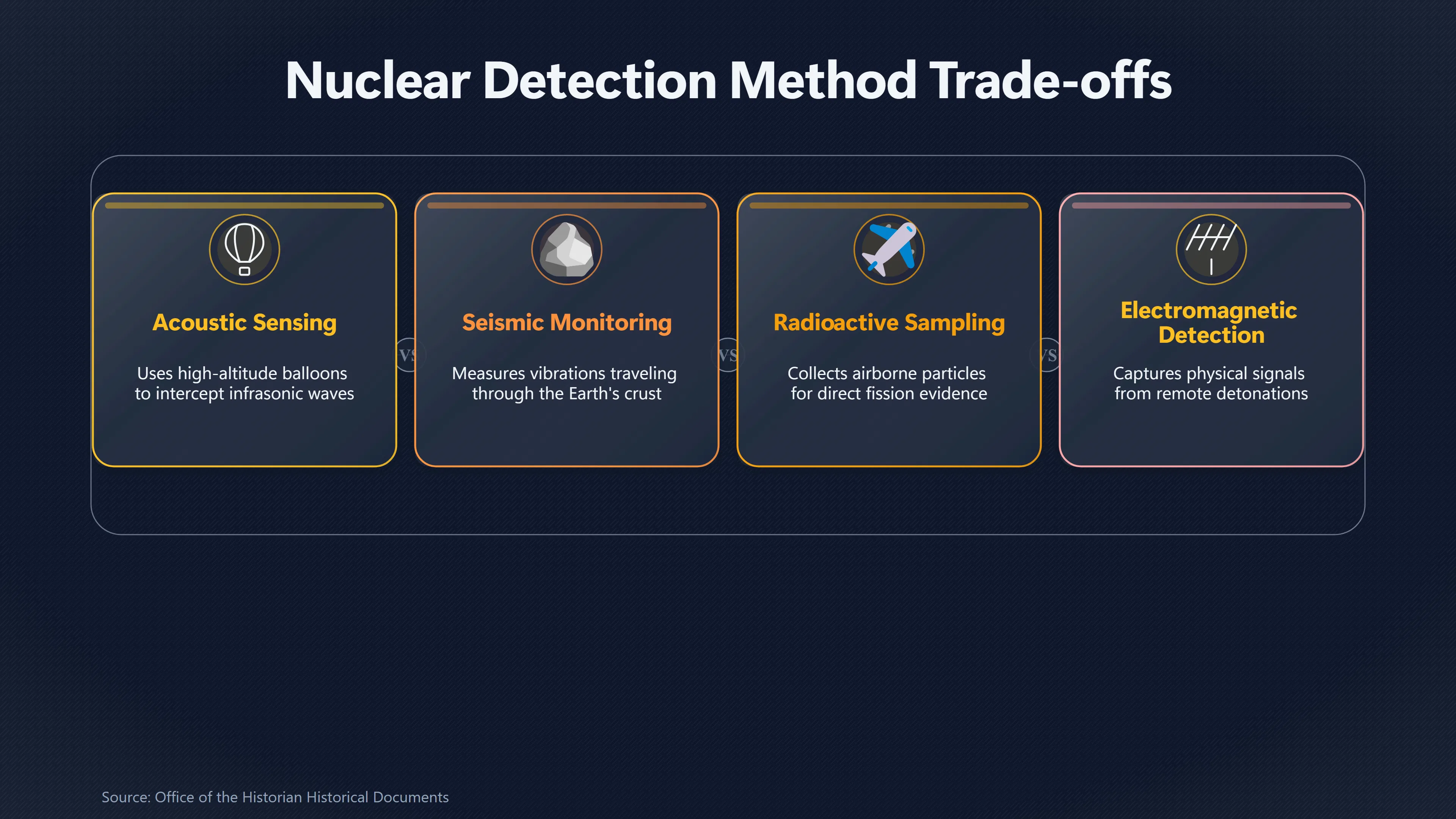
Acoustic balloons were one of several early methods considered alongside seismic monitoring, radioactive sampling and electromagnetic detection.
On this page
- The limits of spies and reconnaissance aircraft
- Acoustic, seismic and radioactive methods compared
- Why no single system was sufficient
Page outline Jump by section
Introduction
The search for evidence of a Soviet atomic test was one of the defining technical intelligence challenges of the early Cold War. Long before satellites could routinely observe remote military sites, the United States explored multiple ways to detect a nuclear explosion from thousands of kilometres away without crossing Soviet borders. Project Mogul’s high-altitude acoustic balloons became the best-known experiment because of their later association with the Roswell incident, but they were only one element in a much broader effort. Military planners compared acoustic sensing with seismic monitoring, airborne radioactive sampling and electromagnetic detection, recognising that each method offered distinct strengths while suffering important limitations. The resulting lesson was clear: no single technology could provide reliable warning or definitive proof. Instead, American planners gradually built an integrated surveillance system in which different techniques corroborated one another and compensated for individual weaknesses.[Office of the Historian]history.state.govOffice of the Historian Historical DocumentsOffice of the HistorianHistorical Documents - Office of the HistorianMarch 28, 1958…

Why Spies and Aircraft Were Not Enough
Human intelligence remained valuable, but it was uncertain and incomplete. Although espionage revealed aspects of the Soviet nuclear programme, it could not guarantee timely knowledge of when a weapon would actually be tested. Reconnaissance aircraft also faced severe political and operational constraints because routine overflights of Soviet territory before specialised Cold War reconnaissance programmes were impractical and risked international escalation. These realities encouraged investment in “national technical means”—remote sensing systems capable of gathering evidence without direct access to the test site.[National Security Archive]nsarchive.gwu.edudetection first soviet nuclear test september 1949National Security ArchiveDetection of the First Soviet Nuclear Test, September 1949 | National Security Archive…
The goal was not simply to detect an explosion but also to answer several practical questions: Had a nuclear test occurred? Where had it taken place? How powerful was it? Could it be distinguished from an earthquake, industrial explosion or other natural phenomenon? Different technologies answered different parts of that puzzle.
Acoustic, Seismic and Radioactive Methods Compared
Acoustic detection: listening across the atmosphere
Project Mogul was based on the idea that very low-frequency sound from a nuclear explosion might travel enormous distances through favourable atmospheric layers. Scientists believed that microphones suspended at carefully chosen altitudes could intercept these infrasonic waves after they had propagated across continents.
The concept was scientifically plausible but operationally difficult. Balloon trains had to remain within narrow atmospheric layers despite changing winds, making flights complex and expensive. Atmospheric conditions also varied considerably, reducing reliability from one mission to the next. Although Mogul demonstrated important atmospheric research, acoustic balloons never became the primary operational means of detecting Soviet nuclear tests.[Wikipedia]WikipediaProject MogulProject Mogul
Seismic monitoring: detecting underground shock waves
Seismic monitoring approached the problem from an entirely different direction. Instead of listening through the atmosphere, sensitive seismometers measured vibrations travelling through the Earth’s crust.
Seismic methods proved particularly valuable once nuclear testing increasingly moved underground. Networks of stations could detect explosions occurring thousands of kilometres away by analysing characteristic wave patterns. However, early systems often struggled to distinguish smaller nuclear explosions from naturally occurring earthquakes or large chemical blasts, especially when station coverage was sparse. Determining precise yield and confirming that an event was definitely nuclear rather than geological remained challenging.[National Academies]nationalacademies.orgOpen source on nationalacademies.org.
Radioactive sampling: direct physical evidence
Airborne radiological sampling ultimately became one of the most persuasive detection techniques because it searched for radioactive debris rather than indirect physical effects.
Specially equipped aircraft collected airborne particles and gases that could escape into the atmosphere after an above-ground nuclear detonation. Laboratory analysis could identify radioactive isotopes characteristic of nuclear fission, providing direct evidence that a nuclear weapon had exploded.
This approach famously confirmed the Soviet Union’s first atomic test in 1949. Aircraft detected radioactive material several days after the explosion, allowing scientists to establish that a nuclear detonation had occurred even before many details of the event were known. The drawback, however, was timing and weather: radioactive debris had to reach accessible airspace, and underground tests released little or no detectable fallout if successfully contained.[National Security Archive]nsarchive.gwu.edudetection first soviet nuclear test september 1949National Security ArchiveDetection of the First Soviet Nuclear Test, September 1949 | National Security Archive…
Electromagnetic detection: capturing the physical signatures
American planners also investigated electromagnetic effects associated with nuclear explosions. Depending on altitude and circumstances, a nuclear detonation could generate electromagnetic disturbances or other measurable signals that specialised instruments might detect remotely.
These methods added another independent stream of information but were generally insufficient on their own. Atmospheric conditions, test geometry and the characteristics of individual explosions all affected detection performance. Consequently, electromagnetic sensors were viewed as complementary rather than standalone solutions.[Office of the Historian]history.state.govOffice of the Historian Historical DocumentsOffice of the HistorianHistorical Documents - Office of the HistorianMarch 28, 1958…
Why No Single System Was Sufficient
Experience quickly demonstrated that every detection technology possessed blind spots.
- Acoustic systems depended heavily on atmospheric conditions and balloon operations.
- Seismic networks excelled at detecting underground disturbances but could not always identify whether the source was nuclear.
- Radioactive sampling offered direct confirmation but only when radioactive debris escaped into the atmosphere and could be intercepted.
- Electromagnetic sensors contributed additional evidence but were sensitive to the characteristics of individual explosions.
Rather than selecting a single “best” technology, American planners increasingly favaged combining independent methods. An event detected simultaneously by seismic instruments, supported by atmospheric sampling and consistent with acoustic or electromagnetic observations, inspired far greater confidence than any individual sensor alone. This philosophy became central to Cold War nuclear monitoring.[state.gov]history.state.govOffice of the Historian Historical DocumentsOffice of the HistorianHistorical Documents - Office of the HistorianMarch 28, 1958…
From Experimental Projects to an Integrated Detection Network
By the late 1940s and into the 1950s, the United States expanded these separate research efforts into what became the Atomic Energy Detection System. Responsibility eventually fell to the Air Force organisation known as AFOAT-1, which coordinated acoustic, seismic, radiological and other technical intelligence capabilities.
Government assessments from the late 1950s and early 1960s explicitly described nuclear detection as a system composed of seismic, acoustic, electromagnetic and nuclear sampling components rather than any single technology. The objective was to maximise detection probability while recognising the limitations inherent in every individual sensor.[state.gov]history.state.govOffice of the Historian Historical DocumentsOffice of the HistorianHistorical Documents - Office of the HistorianMarch 28, 1958…
This integrated philosophy anticipated later international verification systems. Modern nuclear-test monitoring under the Comprehensive Nuclear-Test-Ban Treaty similarly combines seismic, radionuclide, hydroacoustic and infrasound observations because independent technologies provide mutually reinforcing evidence.[National Academies]nationalacademies.orgOpen source on nationalacademies.org.
Why This Matters for Understanding Roswell
Within the broader story of Roswell, Project Mogul occupies an outsized place because its balloon equipment may explain the recovered debris. Historically, however, Mogul was only one experimental branch of a much wider search for ways to detect Soviet nuclear weapons development.
Recognising the competing technologies changes the perspective. Acoustic balloons were not a unique or futuristic intelligence concept but one candidate among several approaches being evaluated to solve the same strategic problem. As evidence accumulated, seismic monitoring and radioactive sampling proved more dependable for routine surveillance, while acoustic research contributed valuable scientific knowledge but never became the dominant operational solution. Understanding that broader technological competition helps place Mogul—and therefore one of the principal conventional explanations for the Roswell debris—within its genuine Cold War intelligence context rather than treating it as an isolated or mysterious project.[wikipedia.org]WikipediaProject MogulProject Mogul
Amazon book picks
Further Reading
Books and field guides related to How Could America Detect a Secret Atomic Test?. Use these as the next step if you want deeper reading beyond the article.
Spying on the Bomb: American Nuclear Intelligence from Nazi G...
'Spying on the Bomb' focuses on the past & present nuclear activities of various countries, intermingling what the US believed was happen...
The Making of the Atomic Bomb
Details the making of the atomic bomb. Includes diagrams and pictures documenting people and places.
Dark Sun: The Making of the Hydrogen Bomb
Here, for the first time, in a brilliant, panoramic portrait by the Pulitzer Prize-winning author of The Making of the Atomic Bomb, is th...
Command and Control: Nuclear Weapons, the Damascus Accident,...
From famed investigative journalist Eric Schlosser, author of Fast Food Nation, comes Command and Control a ground-breaking account of th...
eBay marketplace picks
Marketplace Samples
Live-tested eBay searches with available results related to this page.
Selected fromCold War poster oneBay.co.uk.


Endnotes
1.
Source: history.state.gov
Title: Office of the Historian Historical Documents
Link:https://history.state.gov/historicaldocuments/frus1958-60v03mSupp/d304
Source snippet
Office of the HistorianHistorical Documents - Office of the HistorianMarch 28, 1958...
Published: March 28, 1958
2.
Source: nsarchive.gwu.edu
Title: detection first soviet nuclear test september 1949
Link:https://nsarchive.gwu.edu/briefing-book/nuclear-vault/2019-09-09/detection-first-soviet-nuclear-test-september-1949
Source snippet
National Security ArchiveDetection of the First Soviet Nuclear Test, September 1949 | National Security Archive...
Published: september 1949
3.
Source: Wikipedia
Title: Project Mogul
Link:https://en.wikipedia.org/wiki/Project_Mogul
4.
Source: nsarchive2.gwu.edu
Link:https://nsarchive2.gwu.edu/NSAEBB/NSAEBB7/nsaebb7.htm
5.
Source: nationalacademies.org
Link:https://www.nationalacademies.org/read/12849/chapter/5
6.
Source: history.state.gov
Title: Office of the Historian Historical Documents
Link:https://history.state.gov/historicaldocuments/frus1961-63v07-09mSupp/d3
Source snippet
Office of the HistorianHistorical Documents - Office of the Historian...
7.
Source: nsarchive2.gwu.edu
Link:https://nsarchive2.gwu.edu/nukevault/ebb286/index.htm
Source snippet
Intelligence and the Detection of the First Soviet Nuclear Test, September 1949September 22, 2009 — U.S. INTELLIGENCE AND THE DETECTION O...
Published: September 22, 2009
8.
Source: history.state.gov
Link:https://history.state.gov//historicaldocuments/frus1958-60v03/d147fn1
9.
Source: history.state.gov
Link:https://history.state.gov//historicaldocuments/frus1961-63v07-09mSupp/d3
Additional References
10.
Source: af.mil
Title: Sensor network detects nuclear blasts worldwide > Air Force > Article Display
Link:https://www.af.mil/News/Article-Display/Article/112821/sensor-network-detects-nuclear-blasts-worldwide/
Source snippet
The collection suite allows the mission crew to detect radioactive “clouds” in real time...
11.
Source: youtube.com
Title: A World Full of Sounds
Link:https://www.youtube.com/watch?v=m7EC8adZhtg
Source snippet
Project Mogul Soviet nuclear test detection Cold War 🛸 Roswell: The 24-Hour Lie That Built a $100 Million Alien Empire...
12.
Source: youtube.com
Title: Seismic Detection of Underground Explosions: A Geophysical Monitoring System
Link:https://www.youtube.com/watch?v=0sN2p_K74IM
Source snippet
A World Full of Sounds - CTBTO's Technologies...
13.
Source: youtube.com
Title: The International Monitoring System. How it works
Link:https://www.youtube.com/watch?v=nUNNLsv274A
Source snippet
Seismic Detection of Underground Explosions: A Geophysical Monitoring System...
14.
Source: stratocat.com.ar
Title: MOGU L PROJECT
Link:https://stratocat.com.ar/fichas-e/1947/BET-19470508.htm
Source snippet
MOGUL PROJECT - 5/8/1947May 31, 2026 — PURPOSE OF THE FLIGHT AND PAYLOAD DESCRIPTION Project Mogul was a top secret project carried out b...
Published: May 31, 2026
15.
Source: agupubs.onlinelibrary.wiley.com
Link:https://agupubs.onlinelibrary.wiley.com/doi/full/10.1029/2017RG000594
Source snippet
78-105 Review Article Free Access IONOSPHERIC DETECTION OF EXPLOSIVE EVENTS C. Y. Huang, Corresponding Author C. Y. Huang * afrl.rvborgma...
16.
Source: sandia.gov
Title: Infrasound records from U.S. atmospheric tests – Publications – Research
Link:https://www.sandia.gov/research/publications/details/infrasound-records-from-u-s-atmospheric-tests-1998-07-01/
17.
Source: darpa.mil
Link:https://www.darpa.mil/about/innovation-timeline/vela-nuclear-explosion-detection
18.
Source: everything.explained.today
Link:https://everything.explained.today/Project_Mogul/
19.
Source: youtube.com
Title: Julian Dorey
Link:https://www.youtube.com/watch?v=2PUs7l2jW9c
Source snippet
Detecting nuclear explosions seismic acoustic radionuclide monitoring Seismic Detection of Underground Explosions: A Geophysical Monitori...