Within Project Mogul Balloon
Why Radar Targets Looked Like Roswell Wreckage
Broken radar targets could leave foil, thin wooden sticks, paper backing, tape and string resembling the earliest Roswell debris reports.
On this page
- How corner radar reflectors were built
- What the materials looked like when broken
- Comparing reflector debris with early descriptions
Page outline Jump by section
Introduction
One of the strongest links between Project Mogul and the Roswell debris is not the balloons themselves but the lightweight radar reflectors suspended beneath them. These devices were designed to give a strong radar return while adding very little weight to an experimental balloon train. When they broke apart after landing or being dragged across the ground, they produced a scatter of metallic foil, thin wooden sticks, paper backing, tape, string and rubber fragments that closely resemble the earliest descriptions of the Roswell wreckage recorded in July 1947. The comparison does not settle every debate surrounding Roswell, but it explains why witnesses unfamiliar with specialised military equipment could describe the debris as both ordinary in its materials and unusual in its appearance. The radar reflectors therefore occupy a central place in the historical explanation offered by the US Air Force and later investigators.[lbl.gov]muller.lbl.govMuller Lab Project MogulMuller Lab Project Mogul

How corner radar reflectors were built
The radar targets used on early Project Mogul flights were versions of the military ML-307 radar reflector, often called RAWIN (Radar Wind) targets because similar devices were used in upper-air meteorological work. Their purpose was simple: a weather radar could easily detect the reflector, allowing crews on the ground to track the balloon train’s movement.
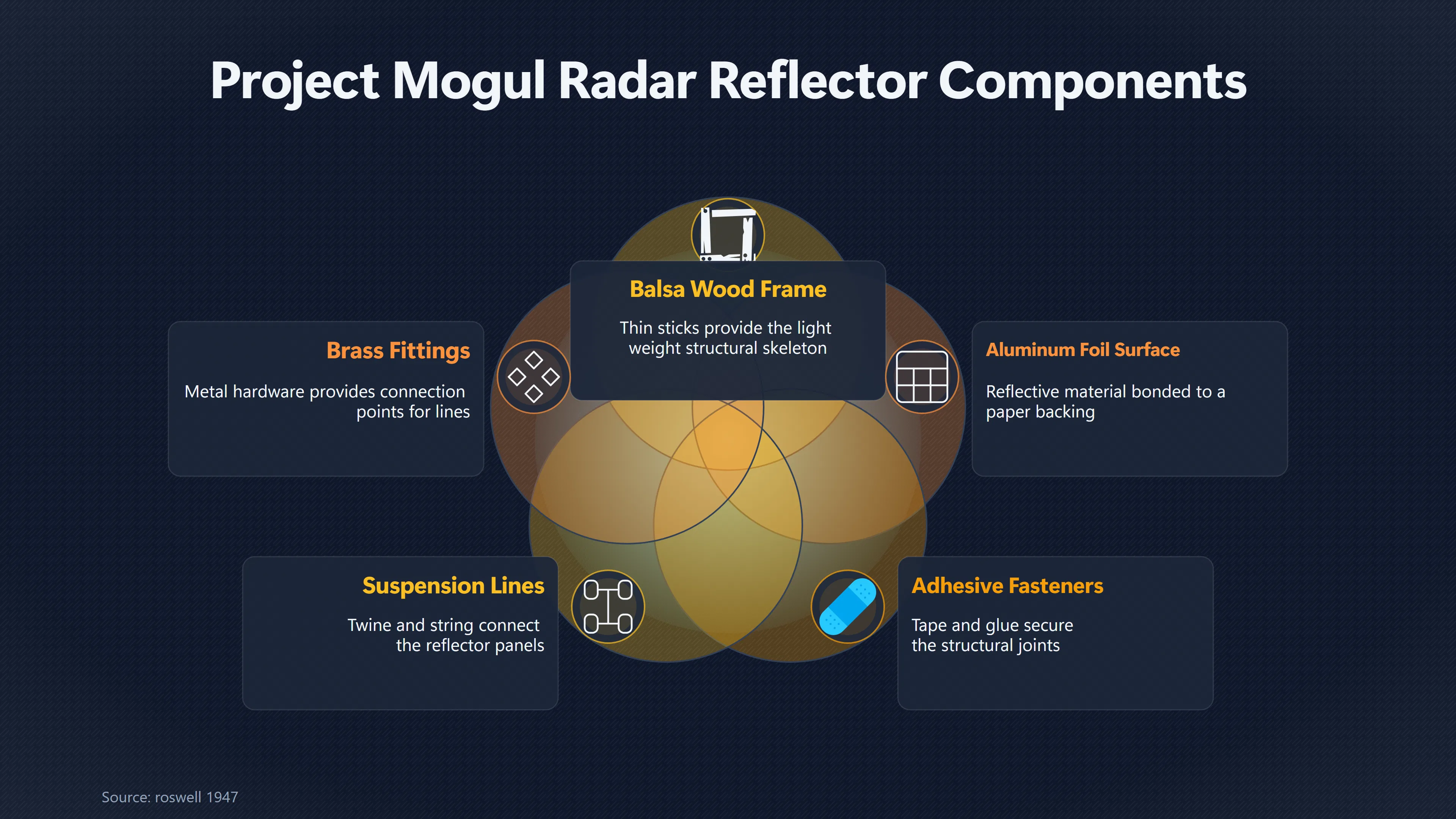
Rather than being solid metal objects, these reflectors were extremely light structures assembled from everyday-looking materials:
- thin balsa wood sticks formed the frame;
- reflective aluminium foil bonded to a paper backing created the radar-reflecting surfaces;
- tape and glue secured the joints;
- eyelets, twine and string connected the reflector panels and suspension lines.
When assembled, the reflector resembled a three-dimensional geometric kite or open box rather than a flat sheet of foil. Several reflectors could be attached to a single Mogul balloon train to improve radar visibility, creating a surprisingly large collection of lightweight structural material beneath dozens of balloons.[globalnet.co.uk]users.globalnet.co.ukAir Force Roswell Report…
Unlike conventional aircraft wreckage, nothing about these reflectors was intended to survive impact. Their effectiveness depended on being as light as possible, making them inherently fragile.
What the materials looked like when broken
The appearance of a damaged radar reflector is one of the most important pieces of the historical comparison.
Once the balloon train descended, wind, dragging forces or impact could quickly reduce the reflector into disconnected fragments. The foil peeled away from its paper backing, the balsa sticks snapped easily, and tape, glue and string remained attached to irregular pieces. Instead of one recognisable object, searchers encountered a field of scattered debris.
The Air Force’s 1994 investigation obtained original blueprints and surviving examples of the reflector assemblies. Its examination described them as consisting of aluminium-coloured foil-like material laminated to stronger paper, attached to balsa wood with tape, glue and twine—precisely the sort of lightweight construction expected from radar targets designed for balloon use.[Globalnet]users.globalnet.co.ukAir Force Roswell Report…
Charles Moore, the New York University engineer who helped conduct Mogul launches, also explained that the early reflector designs incorporated foil-backed paper, balsa beams, reinforced tape, nylon twine and brass fittings. Some experimental reflectors even used decorative adhesive tape obtained through a toy manufacturer because it met the programme’s lightweight material requirements.[Muller Lab]muller.lbl.govMuller Lab ROSWELL INCIDENT REPORTMuller Lab ROSWELL INCIDENT REPORT
These details matter because they account for why observers could describe the debris as simultaneously flimsy, unfamiliar and difficult to identify without invoking advanced or exotic materials.

Comparing reflector debris with early Roswell descriptions
The earliest newspaper reports and witness descriptions focused on remarkably ordinary materials.
Accounts published immediately after the recovery referred to:
- foil or “tinfoil”;
- paper-like material;
- thin sticks;
- tape;
- rubber from balloons.
These descriptions appeared before later claims involving exotic alloys or alien technology became widely associated with Roswell decades afterwards.[Project Gutenberg]dev.gutenberg.orgOpen source on gutenberg.org.
The similarity is especially notable because the recovered reflector components would not necessarily remain recognisable as a radar device. Someone encountering only broken fragments would not see a complete corner reflector. Instead, they would find disconnected foil panels, snapped wooden members and lengths of string spread over a large area.
The Air Force argued that this pattern closely matched the debris field expected after a Mogul balloon train landed and partially disintegrated. Since several reflectors were often carried together, the quantity of foil and wooden fragments could appear much greater than that produced by an ordinary weather balloon equipped with only a single radar target.[Muller Lab]muller.lbl.govMuller Lab Project MogulMuller Lab Project Mogul
The decorative tape and the “strange symbols”
Among the most discussed aspects of the Roswell debris are later recollections of tape carrying unusual coloured markings or “symbols.”
Project Mogul researchers provided a prosaic explanation for this feature. According to interviews conducted during the Air Force investigation, some early radar targets were assembled using commercially available decorative tape supplied through a toy manufacturer. Participants recalled pink or purplish tape printed with floral or geometric designs, an unusual choice that resulted from wartime shortages and the search for lightweight materials rather than any secret technology.[Muller Lab]muller.lbl.govMuller Lab Project MogulMuller Lab Project Mogul
Supporters of the Mogul explanation argue that witnesses recalling unfamiliar patterned tape decades later could naturally reinterpret childish decorative motifs as mysterious writing or symbols. Critics respond that memory after many decades is unreliable in either direction, making the tape evidence suggestive rather than conclusive.
The significance of this issue lies less in proving one interpretation than in demonstrating that apparently unusual details reported by witnesses may have had mundane counterparts in authentic Mogul hardware.
Why the reflector explanation remains persuasive but not definitive
The radar reflector comparison is one of the strongest material links between Project Mogul and the original Roswell debris because it explains multiple independent features at once:
- why the wreckage consisted largely of lightweight everyday materials;
- why the debris covered a broad area after breaking apart;
- why military personnel unfamiliar with the classified project might not immediately recognise it;
- why witnesses described foil, sticks, paper, tape and string rather than heavy aircraft components.
Even so, historians distinguish between explaining the nature of the debris and proving the precise origin of every recovered fragment. The broader Mogul hypothesis depends on reconstructing which balloon train came down near the Foster Ranch and whether the recovered material came specifically from one of those launches. That reconstruction remains debated, but the physical characteristics of Mogul radar reflectors themselves closely correspond to the earliest documented descriptions of the Roswell wreckage.[lbl.gov]muller.lbl.govMuller Lab Project MogulMuller Lab Project Mogul
Amazon book picks
Further Reading
Books and field guides related to Why Radar Targets Looked Like Roswell Wreckage. Use these as the next step if you want deeper reading beyond the article.
Roswell: Inconvenient Facts and the Will to Believe
For over fifty years an incident near Roswell, New Mexico, has sparked the imaginations of UFO enthusiasts. Did the military recover a cr...
The Roswell Report: Case Closed
In "The Roswell Report: Case Closed," James McAndrew meticulously examines one of the most controversial events in UFO history: the alleg...
Stuff Matters: Exploring the Marvelous Materials That Shape O...
An eye-opening adventure deep inside the everyday materials that surround us, from concrete and steel to denim and chocolate, packed with...
The Radar War: Germany's Pioneering Achievement
Beskriver radar'ens udviklingshistorie herunder navnlig de tyske resultater og anvendelsen af radar under 2. verdenskrig.
eBay marketplace picks
Marketplace Samples
Live-tested eBay searches with available results related to this page.
Selected fromweather balloon model oneBay.co.uk.

Endnotes
1.
Source: dev.gutenberg.org
Link:https://dev.gutenberg.org/files/63659/63659-h/63659-h.htm
2.
Source: altmystery.com
Title: roswell 1947
Link:https://www.altmystery.com/article/roswell-1947/
Source snippet
& Area 51 · AltMysteryMay 26, 2026 — The program's instrumentation consisted of balloon-launched microphone arrays, each suspended on a m...
Published: May 26, 2026
3.
Source: gutenberg.org
Title: [The Roswell Report]({{ ‘the-roswell-report/’ | relative_url }}): Case Closed, by James Mc Andrew—A Project Gutenberg e Book
Link:https://www.gutenberg.org/files/63659/old/63659-h/63659-h.htm
4.
Source: muller.lbl.gov
Title: Muller Lab Project Mogul
Link:https://muller.lbl.gov/teaching/physics10/Roswell/USMogulReport.html
5.
Source: history.com
Link:https://www.history.com/articles/roswell
Source snippet
Roswell - New Mexico, Alien & UFOs | HISTORY...
6.
Source: users.globalnet.co.uk
Link:https://www.users.globalnet.co.uk/~hex/ufo/text/pages026-050/page33.html
Source snippet
Air Force Roswell Report...
7.
Source: muller.lbl.gov
Title: Muller Lab [ROSWELL INCIDENT]({{ ‘the-1980-book/’ | relative_url }}) REPORT
Link:https://muller.lbl.gov/teaching/physics10/Roswell/RoswellIncident.html
Additional References
8.
Source: theoriesofanything.com
Title: Roswell Incident: Historical Analysis | Theories of Anything
Link:https://theoriesofanything.com/research/roswell-incident-historical-analysis
Source snippet
VERIFIED CLAIMS (TIER 1 — PEER-REVIEWED / SCHOLARLY CONSENSUS) 1.1 THE CORE EVENTS * Mack Brazel discovered debris on the J.B. Foster ran...
9.
Source: kiddofspeed.com
Title: [the roswell ufo]({{ ‘the-roswell-ufo/’ | relative_url }}) incident of 1947 explained
Link:https://www.kiddofspeed.com/the-roswell-ufo-incident-of-1947-explained/
Source snippet
The Air Force concluded that this was the most likely source of the debris Brazel discovered on the Foster ranch. The debris field descri...
10.
Source: apeirron.com
Title: The Roswell Incident — Apeirron
Link:https://www.apeirron.com/node/roswell
Source snippet
The central physical question at Roswell is deceptively simple: what was the material that Mac Brazel found on the Foster Ranch? The answ...
11.
Source: wikidisc.org
Title: Roswell incident | Wiki Disc
Link:https://www.wikidisc.org/wiki/Roswell_incident
Source snippet
Roswell incident | WikiDiscJuly 2, 2026 — ANALYSIS AND EXPLANATIONS[EDIT | EDIT SOURCE] OFFICIAL GOVERNMENT POSITION[EDIT | EDIT SOURCE]...
Published: July 2, 2026
12.
Source: youtube.com
Link:https://www.youtube.com/watch?v=TV0Xm9ZgiKQ
Source snippet
The Roswell Incident Mystery Finally Solved...
Published: July 1947
13.
Source: youtube.com
Title: Roswell UFO: What Really Happened? Conspiracy Theory Section I
Link:https://www.youtube.com/watch?v=8ua33uwRTMM
Source snippet
What Actually Happened at Roswell (And Why It Doesn't Matter) | Sidequests...
14.
Source: youtube.com
Title: The Roswell Incident as Told by Thomas Snégaroff
Link:https://www.youtube.com/watch?v=s1FsS-dPc0w
Source snippet
8th July 1947: First flying saucer as [Roswell Army Air]({{ 'roswell-army-air/' | relative_url }}) Base reports debris of a 'flying disc'...
Published: July 1947
15.
Source: youtube.com
Title: What Actually Happened at Roswell (And Why It Doesn’t Matter) | Sidequests
Link:https://www.youtube.com/watch?v=XLQB1MGMjB0
Source snippet
The Roswell Incident as Told by Thomas Snégaroff...
16.
Source: youtube.com
Title: The Roswell Incident Mystery Finally Solved
Link:https://www.youtube.com/watch?v=Pz0vYcc4KiI
Source snippet
Roswell UFO: What Really Happened? Conspiracy Theory Section I...
17.
Source: astronomyufo.com
Link:https://www.astronomyufo.com/UFO/Mogul.htm