Within Witness Testimonies
Which Roswell Claims Were Truly Eyewitness Accounts?
Roswell testimony becomes clearer when direct observation, inference and second-hand reporting are treated as different kinds of evidence.
On this page
- Direct Observation, Inference and Hearsay Defined
- How Later Retellings Blurred the Categories
- A Practical Test for Evaluating Witness Claims
Page outline Jump by section
Introduction
Roswell witness testimony is easier to evaluate when each claim is placed into the correct evidential category. The central question is not simply whether a witness was credible, but whether they were describing something they personally observed, something they inferred from what they saw, or something another person allegedly told them. These categories are often merged in books, documentaries and popular retellings, giving very different kinds of evidence the same apparent weight.
For the Roswell incident, this distinction matters because many of the most dramatic elements of the story—including recovered alien bodies, multiple crash sites and extensive military cover-ups—rest primarily on second-hand or third-hand accounts rather than documented first-hand observation. Separating direct observation from interpretation and hearsay does not resolve the Roswell debate, but it provides a more reliable framework for weighing competing claims.[whs.mil]esd.whs.milROSWELL REPORT Fact versus Fiction in theFebruary 12, 2026…
Direct Observation, Inference and Hearsay Defined
The simplest way to assess any Roswell testimony is to ask what the witness could actually know from personal experience.
Direct observation consists of events or objects the witness personally saw, handled or experienced.
Examples include:
- Jesse Marcel stating that he recovered debris from the Foster Ranch.
- Rancher William “Mac” Brazel describing finding scattered debris on his property.
- Walter Haut confirming that he issued the original Roswell Army Air Field press release announcing recovery of a “flying disc.”
These statements can still be mistaken or affected by memory, but they describe experiences the speaker claims to have witnessed personally.[Wikipedia]WikipediaRoswell incidentRoswell incident
Inference begins when witnesses move beyond describing what they observed.
For example, Marcel later argued that the recovered material could not have been a weather balloon and concluded it must have represented something extraordinary. Whether that conclusion is correct is a separate question from his description of the debris itself. Likewise, a witness who saw heavy military security may infer that officials were hiding an alien craft, but security alone does not establish what was being protected.
Separating observation from interpretation prevents conclusions from becoming confused with evidence.
Hearsay consists of information received from another person.
Typical Roswell examples include statements such as:
- “Someone at the base told me they recovered bodies.”
- “A friend who worked in the hospital described alien corpses.”
- “My relative was present and later told me what happened.”
Such claims may preserve genuine historical information, but they cannot independently establish what occurred because the original observer is absent or unidentified, and each retelling introduces opportunities for misunderstanding, embellishment or memory change.[Annual Reviews]annualreviews.orgAnnual Reviews Eavesdropping on Memory | Annual ReviewsAnnual Reviews Eavesdropping on Memory | Annual Reviews
How Later Retellings Blurred the Categories
The Roswell story changed substantially after its revival in the late 1970s. As researchers interviewed hundreds of military veterans, local residents and relatives, many narratives accumulated details from conversations that had occurred decades earlier rather than from first-hand experience.
A common pattern appears repeatedly:
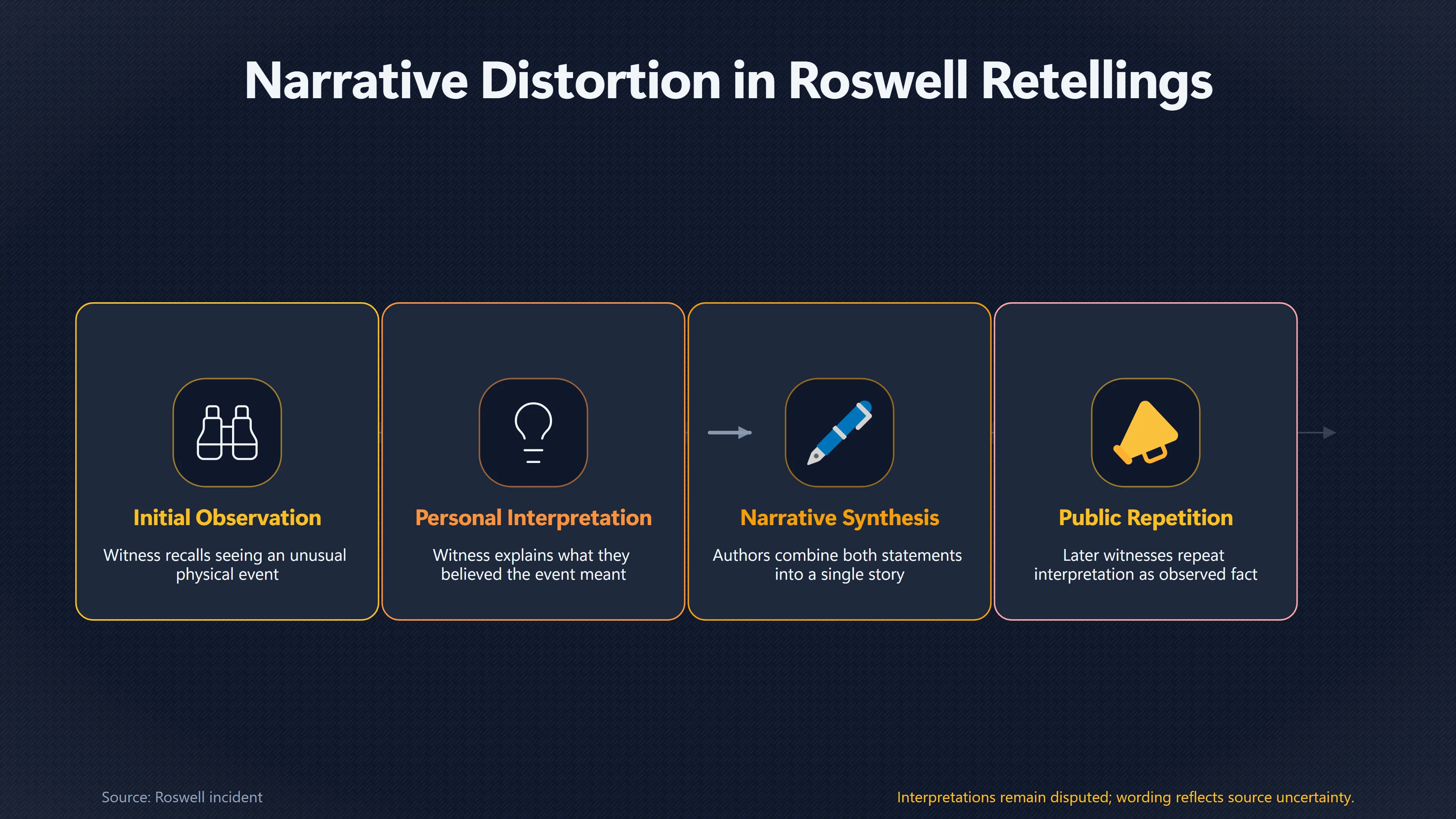
- A witness recalls seeing an unusual event.
- The witness later explains what they believed it meant.
- Authors combine both statements into a single narrative.
- Later witnesses repeat the interpretation as though it were an observed fact.
Over time, this process can make independent stories appear to corroborate one another even when they ultimately derive from the same original rumour.
Memory research helps explain why this occurs. Decades of psychological experiments have shown that post-event information, repeated interviews and conversations with others can become incorporated into sincere recollections without deliberate deception. Confidence in a memory is therefore not a reliable indicator that every remembered detail originated in direct experience.[sciencedirect.com]sciencedirect.comScienceDirect Leading questions and the eyewitness reportLeading questions and the eyewitness report - ScienceDirect…
The long gap between the 1947 incident and many of the major interviews—often thirty to fifty years—makes this distinction particularly important. Witnesses were recalling events after extensive media attention, numerous books and repeated questioning had already established an expected Roswell narrative containing unusual debris, military secrecy and alien bodies.[Wikipedia]WikipediaRoswell incidentRoswell incident
Examples of Why the Distinction Matters
Several well-known Roswell witnesses illustrate why categorisation produces a clearer picture than treating every statement equally.
Jesse Marcel is a documented participant in the debris recovery. His presence at the ranch and later transport of recovered material are supported by contemporary records. His description of the debris therefore deserves serious consideration as first-hand testimony. His later belief that the material was extraterrestrial, however, is an interpretation rather than a direct observation.[Wikipedia]WikipediaRoswell incidentRoswell incident
Sheridan Cavitt also participated in the recovery but later described debris that he considered consistent with balloon material. His testimony directly contradicts Marcel on several factual details, including the appearance and extent of the debris field. The disagreement is significant precisely because both men claimed first-hand knowledge, forcing researchers to compare competing eyewitness accounts rather than assuming one represents objective fact.[ESD]esd.whs.milROSWELL REPORT Fact versus Fiction in theFebruary 12, 2026…
Walter Haut presents a different evidential problem. His documented role was preparing and releasing the famous July 1947 press announcement. Later in life he signed an affidavit describing events beyond those official duties. Historians therefore distinguish between what Haut certainly knew as the base public information officer and what he later stated he had learned or observed. Those categories should not automatically be merged.[ESD]esd.whs.milROSWELL REPORT Fact versus Fiction in theFebruary 12, 2026…
By contrast, many famous Roswell body stories originate with individuals reporting what someone else allegedly witnessed. Even when sincerely related, these accounts remain hearsay unless supported by independent first-hand evidence.
A Practical Test for Evaluating Witness Claims
A useful method is to ask the same sequence of questions for every testimony.
QuestionWhy it mattersDid the witness personally observe the event?Establishes whether the account is first-hand.What exactly was observed?Separates description from interpretation.Which parts are conclusions rather than observations?Prevents inference becoming evidence.Does the witness identify another source?Reveals hearsay within the account.When was the testimony first recorded?Contemporary accounts generally reduce the influence of later publicity.Has the account changed over time?Consistency can be evaluated against earlier statements and documents.Is there independent corroboration?Multiple genuinely independent witnesses strengthen reliability more than repeated retellings of the same story.
Applying this framework often reveals that a single interview contains several evidential levels. A witness may accurately describe seeing military vehicles, speculate they were transporting alien technology and repeat rumours about recovered bodies—all within one narrative. Treating every sentence as equal evidence obscures these important distinctions.
Why This Approach Produces a Clearer Historical Record
Separating eyewitness evidence from hearsay does not require accepting or rejecting extraordinary explanations in advance. Instead, it applies the same historical standards used in investigations of accidents, military operations and criminal cases.
The strongest Roswell evidence generally comes from documented participants describing actions they personally performed or objects they personally encountered. Claims become progressively less reliable as they move from observation to interpretation, from interpretation to rumour, and from rumour to repeated retelling across decades.
Using these categories does not eliminate uncertainty. It does, however, make clear which parts of the Roswell narrative rest on documented first-hand experience and which depend primarily on chains of memory and second-hand reporting. That distinction is essential for any balanced assessment of the witness record.
Amazon book picks
Further Reading
Books and field guides related to Which Roswell Claims Were Truly Eyewitness Accounts?. Use these as the next step if you want deeper reading beyond the article.
Roswell: Inconvenient Facts and the Will to Believe
For over fifty years an incident near Roswell, New Mexico, has sparked the imaginations of UFO enthusiasts. Did the military recover a cr...
Eyewitness Testimony
Every year hundreds of defendants are convicted on little more than the say-so of a fellow citizen. Although psychologists have suspected...
The Seven Sins of Memory: How the Mind Forgets and Remembers
Rating: 3.5/5 from 5 Google Books ratings
A New York Times Notable Book: A psychologist's "gripping and thought-provoking" look at how and why our brains sometimes fail us (Steven...
The Psychology of Eyewitness Identification
This volume provides a tutorial review and evaluation of scientific research on the accuracy and reliability of eyewitness identification...
eBay marketplace picks
Marketplace Samples
Live-tested eBay searches with available results related to this page.
Selected fromalien conspiracy poster oneBay.co.uk.

Endnotes
1.
Source: Wikipedia
Title: Roswell incident
Link:https://en.wikipedia.org/wiki/Roswell_incident
2.
Source: sciencedirect.com
Link:https://www.sciencedirect.com/science/article/pii/S0001691813002278
Source snippet
Comparing the influence of directly vs. indirectly encountered post-event misinformation on eyewitness remembering - Science...
3.
Source: sciencedirect.com
Title: ScienceDirect [Leading questions]({{ ‘leading-questions/’ | relative_url }}) and the eyewitness report
Link:https://www.sciencedirect.com/science/article/pii/0010028575900237
Source snippet
Leading questions and the eyewitness report - ScienceDirect...
4.
Source: sciencedirect.com
Title: Leading questions and the eyewitness report
Link:https://www.sciencedirect.com/science/article/abs/pii/0010028575900237
5.
Source: esd.whs.mil
Link:https://www.esd.whs.mil/Portals/54/Documents/FOID/Reading%20Room/UFOsandUAPs/roswell.pdf?ver=2017-05-22-113531-807
Source snippet
ROSWELL REPORT Fact versus Fiction in theFebruary 12, 2026...
Published: February 12, 2026
6.
Source: annualreviews.org
Title: Annual Reviews Eavesdropping on Memory | Annual Reviews
Link:https://www.annualreviews.org/content/journals/10.1146/annurev-psych-010416-044138
Additional References
7.
Source: tandfonline.com
Link:https://www.tandfonline.com/doi/abs/10.1080/09658219308258229
Source snippet
25, 2007 — Image: Publication Cover Memory Volume 1, 1993 - Issue 2 Submit an article Journal homepage 425 Views 33 CrossRef citations to...
8.
Source: ufotransparency.com
Title: decade 1990s roswell report fact vs fiction 1994 dtic ada326148
Link:https://ufotransparency.com/files/decade-1990s-roswell-report-fact-vs-fiction-1994-dtic-ada326148
Source snippet
Air Force Headquarters (Office of Air Force History) · 1994 · UFO TransparencySeptember 8, 1994 — * Page 131 vision OCR CONTINUATION SHEE...
Published: September 8, 1994
9.
Source: uapinvestigations.com
Title: the roswell incident what actually happened in 1947
Link:https://uapinvestigations.com/the-roswell-incident-what-actually-happened-in-1947/
Source snippet
The Roswell Incident: What Actually Happened in 1947 -April 3, 2026 — WITNESS TESTIMONY The witness testimony in the Roswell case spans d...
Published: April 3, 2026
10.
Source: ojp.gov
Title: Office of Justice Programs EYEWITNESS TESTIMONY
Link:https://www.ojp.gov/ncjrs/virtual-library/abstracts/eyewitness-testimony-final-report-september-1975
Source snippet
Office of Justice ProgramsEYEWITNESS TESTIMONY - FINAL REPORT, SEPTEMBER 1975 | Office of Justice Programs...
Published: SEPTEMBER 1975
11.
Source: youtube.com
Title: History’s Greatest Mysteries: Military Cleanup at Roswell Crash?! (S1, E6)
Link:https://www.youtube.com/watch?v=TywPwJSosgc
Source snippet
History's Greatest Mysteries: ROSWELL SECRETS Revealed in Eyewitness Journal (Part 1)...
12.
Source: youtube.com
Link:https://www.youtube.com/watch?v=BZpHEALNozw
Source snippet
Roswell UFO: What Really Happened? Conspiracy Theory Section I...
13.
Source: ojp.gov
Link:https://www.ojp.gov/ncjrs/virtual-library/abstracts/distortions-eyewitness-memory-postevent-information-part-3
14.
Source: youtube.com
Title: Roswell UFO: What Really Happened? Conspiracy Theory Section I
Link:https://www.youtube.com/watch?v=8ua33uwRTMM
Source snippet
Area 51, Roswell & the Pentagon Files | Full Documentary...
15.
Source: youtube.com
Title: Area 51, Roswell & the Pentagon Files | Full Documentary
Link:https://www.youtube.com/watch?v=Ml0zF_dNJ1g
Source snippet
The [Roswell UFO Crash]({{ 'roswell-ufo-crash/' | relative_url }}): Uncovering the Truth Behind the Legend...
16.
Source: af.mil
Link:https://www.af.mil/The-Roswell-Report/quot/