Within The Role
How Roswell Stories Grew More Definite
Repeated interviews can preserve a story's core while making uncertain details more vivid, definite and dramatic over time.
On this page
- Why repeated recall changes narratives
- Comparing tentative and later Roswell accounts
- When consistency can mislead
Page outline Jump by section
Introduction
One of the most important features of the Roswell story is not simply what witnesses said, but how often they said it. Many of the best-known accounts were developed through repeated interviews over years or even decades, appearing in books, documentaries, lectures and media appearances rather than being recorded once immediately after the events of 1947. Modern memory research shows that repeated recall can preserve the broad outline of an experience while simultaneously making uncertain details feel clearer, more coherent and more convincing than they originally were. This creates a challenge for historians: a witness may become increasingly confident and internally consistent without becoming more historically accurate.[Criminal Justice]criminal-justice.iresearchnet.comCriminal Justice Repeated RecallCriminal JusticeRepeated Recall - Forensic Psychology - iResearchNet…
For Roswell, this distinction matters because the case relies heavily on retrospective testimony gathered long after the physical evidence had largely disappeared. The mechanism is not that repeated retelling automatically creates false memories. Rather, each retelling offers an opportunity to reorganise, simplify and strengthen a narrative, especially when interviews occur within an active community discussing the same event.
Why repeated recall changes narratives
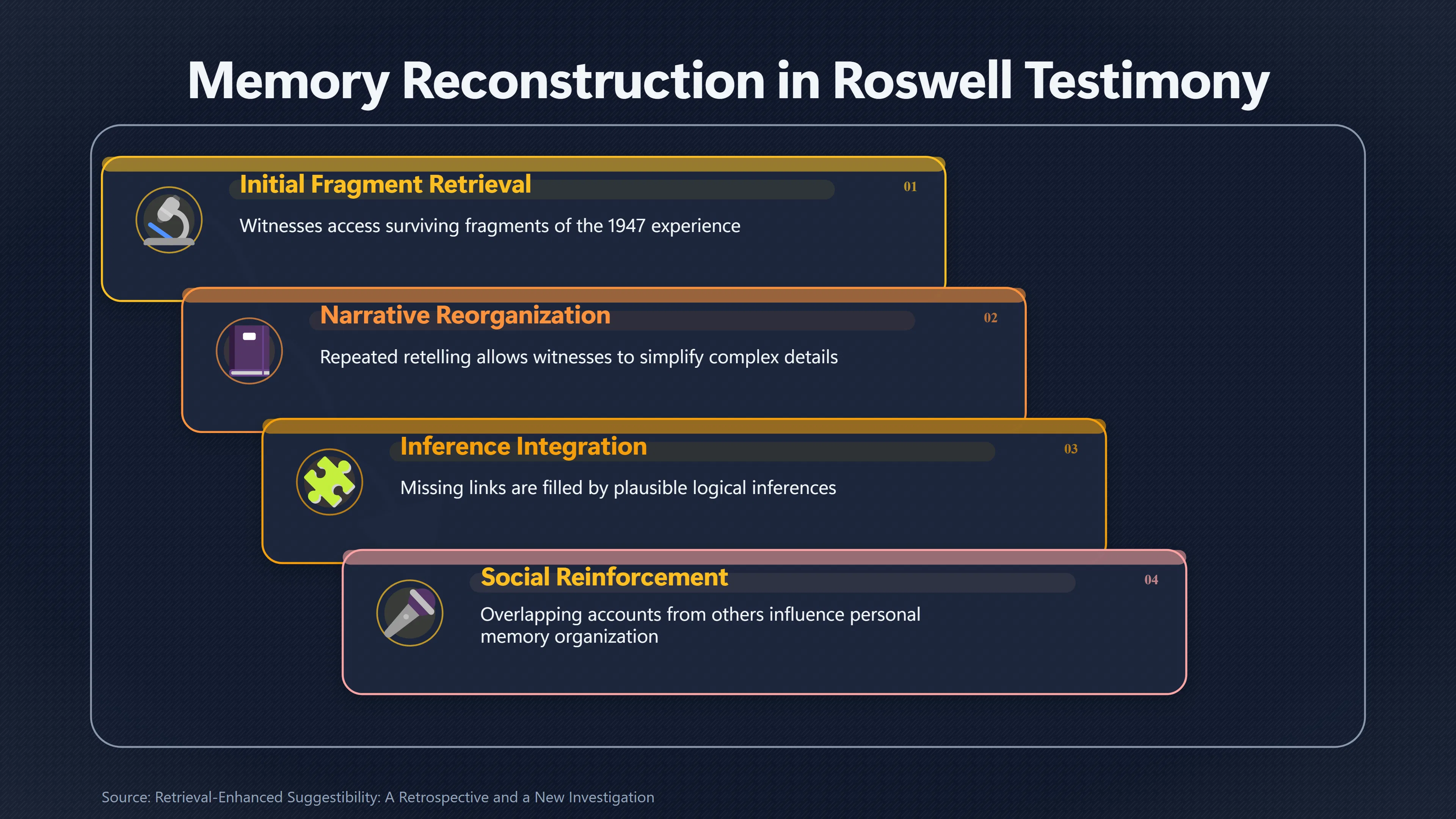
Psychologists describe memory as reconstructive rather than reproductive. People do not retrieve an untouched recording of the past. Instead, they rebuild a memory from surviving fragments, expectations and later knowledge each time they remember an event.
Repeated recall has several effects that are particularly relevant to Roswell:[criminal-justice.iresearchnet.com]criminal-justice.iresearchnet.comCriminal Justice Repeated RecallCriminal JusticeRepeated Recall - Forensic Psychology - iResearchNet…
- Core events become more stable. Frequently recalled elements become easier to retrieve and less likely to be forgotten.
- Peripheral uncertainty tends to shrink. Details that were originally vague may gradually become filled in by inference or later information.
- Confidence often increases. People typically become more certain about memories they have rehearsed repeatedly, even when objective accuracy has not improved.
- The story becomes more coherent. Contradictions or loose ends are naturally reduced as the narrative is told repeatedly to different audiences.[wiley.com]onlinelibrary.wiley.comWiley Online LibraryRepeated partial eyewitness questioning causes confidence inflation but not retrieval‐induced forgetting - Odinot - 2…
Laboratory studies of eyewitness testimony consistently find that repeated questioning can increase confidence without guaranteeing greater accuracy. Witnesses often remember practised details more fluently, and that fluency itself can be mistaken—by both the witness and listeners—for evidence of reliability.[Wiley Online Library]onlinelibrary.wiley.comWiley Online LibraryRepeated partial eyewitness questioning causes confidence inflation but not retrieval‐induced forgetting - Odinot - 2…
Comparing tentative and later Roswell accounts
Roswell researchers frequently interviewed witnesses multiple times across many years. Early interviews sometimes contained uncertainty, qualifications or admissions of incomplete memory. Later versions often presented the same central story with greater precision.
The most widely discussed example is former intelligence officer Jesse Marcel. Beginning with interviews in the late 1970s, Marcel consistently maintained that the recovered debris was unlike an ordinary weather balloon. Across later interviews and publications, his descriptions became one of the central pillars of the Roswell narrative. Whether one accepts his conclusions or not, historians must distinguish between the persistence of his core claim and the possibility that repeated recollection strengthened surrounding details over time.[Criminal Justice]criminal-justice.iresearchnet.comCriminal Justice Repeated RecallCriminal JusticeRepeated Recall - Forensic Psychology - iResearchNet…
The broader Roswell literature shows a similar pattern. As investigators returned to witnesses repeatedly, stories often became:
- more chronological,
- more descriptive,
- less hesitant,
- easier to tell as complete narratives.
This is not necessarily evidence of fabrication. People naturally become better storytellers through repetition. The difficulty is that polished narratives can appear more historically reliable than fragmented first recollections, even though memory science offers no such guarantee.
Storytelling gradually removes uncertainty
Most everyday memories contain gaps. During repeated interviews, those gaps are uncomfortable for both interviewer and witness.
Over time, several processes can sharpen a story:
Missing links become inferred
If someone clearly remembers the beginning and end of an episode but not every intermediate detail, repeated explanation encourages plausible inferences that eventually feel like genuine recollection. Once integrated into the story, these inferred details may no longer feel distinguishable from directly remembered ones.
This process is especially important in Roswell because interviews often occurred more than thirty years after the original events, leaving many opportunities for reconstruction.
Narratives become socially reinforced
Roswell witnesses rarely spoke in isolation. Books, conferences, documentaries and discussions among investigators exposed many participants to overlapping accounts.
Even without deliberate collaboration, repeated exposure to similar narratives can influence how individuals organise their own memories. Memory researchers refer to this as a source-monitoring problem: people may accurately remember a detail while gradually losing track of whether it came from personal observation, another witness or later reading. Repetition increases the familiarity of information, and familiar information often feels more credible.[ScienceDirect]sciencedirect.comRepetition, not number of sources, increases both susceptibility to misinformation and confidence in the accuracy of eyewitn…
Interview practice improves delivery
Someone recounting an unusual experience for the tenth time is usually more fluent than during the first interview. Hesitations disappear, chronology becomes cleaner and key moments receive greater emphasis.
Listeners often interpret this polished delivery as evidence of authenticity. Yet fluency reflects practice as much as memory quality.
When consistency can mislead
A common intuition is that if someone tells essentially the same story for decades, the account must be true. Cognitive psychology suggests a more cautious conclusion.
Repeated recall generally makes the practised version of events easier to access. Consequently:
- genuine memories can remain remarkably stable;
- mistaken memories can also become remarkably stable;
- confidence may increase for both accurate and inaccurate details.
Experimental work has shown that repeated questioning inflates confidence even when objective accuracy changes little. Likewise, repetition alone can increase the perceived truthfulness of claims because familiar information is processed more easily.[Wiley Online Library]onlinelibrary.wiley.comWiley Online LibraryRepeated partial eyewitness questioning causes confidence inflation but not retrieval‐induced forgetting - Odinot - 2…
Therefore, long-term consistency should not be treated as decisive evidence either for or against extraordinary Roswell claims. It is one factor among many, to be weighed alongside contemporaneous documents, physical evidence and independent corroboration.
The historical lesson for Roswell
The Roswell case illustrates why historians and psychologists evaluate testimony differently from casual audiences. Historians ask not only whether witnesses remained consistent, but also when memories were first recorded, how many times they were retold and under what circumstances.
Repeated retelling can genuinely preserve important experiences. It can also sharpen uncertain memories into narratives that feel increasingly vivid, complete and certain. The result is a paradox at the heart of Roswell: some of its most influential testimony may owe part of its persuasive power to decades of rehearsal rather than to an unchanged mental record preserved since 1947. Recognising that distinction neither disproves nor confirms the witnesses’ claims. Instead, it provides a framework for understanding why sincere recollections can become more definite over time while remaining difficult to verify independently.[nih.gov]pmc.ncbi.nlm.nih.govFebruary 19, 2015…
Amazon book picks
Further Reading
Books and field guides related to How Roswell Stories Grew More Definite. Use these as the next step if you want deeper reading beyond the article.
The Seven Sins of Memory
Rating: 3.5/5 from 5 Google Books ratings
A New York Times Notable Book: A psychologist's "gripping and thought-provoking" look at how and why our brains sometimes fail us (Steven...
The Memory Illusion: Remembering, Forgetting, and the Science...
THE INTERNATIONAL BESTSELLER 'Truly fascinating.' Steve Wright, BBC Radio 2 - Have you ever forgotten the name of someone you’ve met doze...
The Seven Sins of Memory: How the Mind Forgets and Remembers
Rating: 3.5/5 from 5 Google Books ratings
A New York Times Notable Book: A psychologist's "gripping and thought-provoking" look at how and why our brains sometimes fail us (Steven...
Memory Lane: The Perfectly Imperfect Ways We Remember
"Making Memories describes the science of how memories are constructed and reconstructed, revealing how this process of making (and remak...
eBay marketplace picks
Marketplace Samples
Live-tested eBay searches with available results related to this page.
Selected fromUFO memorabilia oneBay.co.uk.

Endnotes
1.
Source: onlinelibrary.wiley.com
Link:https://onlinelibrary.wiley.com/doi/abs/10.1002/acp.1443
Source snippet
Wiley Online LibraryRepeated partial eyewitness questioning causes confidence inflation but not retrieval‐induced forgetting - Odinot - 2...
2.
Source: sciencedirect.com
Link:https://www.sciencedirect.com/science/article/pii/S000169181100223X
Source snippet
Repetition, not number of sources, increases both susceptibility to misinformation and confidence in the accuracy of eyewitn...
3.
Source: onlinelibrary.wiley.com
Link:https://onlinelibrary.wiley.com/doi/abs/10.1002/1099-0720%28200009%2914%3A5%3C397%3A%3AAID-ACP658%3E3.0.CO%3B2-M
Source snippet
Wiley Online LibraryEffects of reiteration, hindsight bias, and memory on realism in eyewitness confidence - Granhag - 2000 - Applied Cog...
4.
Source: onlinelibrary.wiley.com
Link:https://onlinelibrary.wiley.com/doi/abs/10.1002/acp.1263
Source snippet
Wiley Online LibraryRepeated recall, retention interval and the accuracy–confidence relation in eyewitness memory - Odinot - 2006 - Appli...
5.
Source: pmc.ncbi.nlm.nih.gov
Link:https://pmc.ncbi.nlm.nih.gov/articles/PMC4335043/
Source snippet
February 19, 2015...
Published: February 19, 2015
6.
Source: sciencedirect.com
Title: Retrieval-Enhanced Suggestibility: A Retrospective and a New Investigation
Link:https://www.sciencedirect.com/science/article/pii/S2211368117300724
Source snippet
September 1, 2017 — JOURNAL OF APPLIED RESEARCH IN MEMORY AND COGNITION Volume 6, Issue 3, September 2017, Pages 213-229 RET...
Published: September 1, 2017
7.
Source: pubmed.ncbi.nlm.nih.gov
Link:https://pubmed.ncbi.nlm.nih.gov/26299652/
Source snippet
2016;24(5):669-82. doi: 10.1080/09658211.2015.1042884. Epub 2015 Aug 24. ACKNOWLEDGE, REPEAT, REPHRASE, ELABORATE: WITNESSES CAN HELP EAC...
8.
Source: pmc.ncbi.nlm.nih.gov
Link:https://pmc.ncbi.nlm.nih.gov/articles/PMC3789709/
9.
Source: pubmed.ncbi.nlm.nih.gov
Link:https://pubmed.ncbi.nlm.nih.gov/21859229/
10.
Source: onlinelibrary.wiley.com
Link:https://onlinelibrary.wiley.com/doi/abs/10.1002/acp.1803
11.
Source: onlinelibrary.wiley.com
Title: j.1468 2850.1996.tb00089.x
Link:https://onlinelibrary.wiley.com/doi/abs/10.1111/j.1468-2850.1996.tb00089.x
12.
Source: pubmed.ncbi.nlm.nih.gov
Link:https://pubmed.ncbi.nlm.nih.gov/8206816/
13.
Source: pubmed.ncbi.nlm.nih.gov
Link:https://pubmed.ncbi.nlm.nih.gov/30319034/
14.
Source: pubmed.ncbi.nlm.nih.gov
Link:https://pubmed.ncbi.nlm.nih.gov/12877270/
15.
Source: pubmed.ncbi.nlm.nih.gov
Link:https://pubmed.ncbi.nlm.nih.gov/24203660/
16.
Source: pubmed.ncbi.nlm.nih.gov
Link:https://pubmed.ncbi.nlm.nih.gov/10692232/
17.
Source: sciencedirect.com
Link:https://www.sciencedirect.com/science/article/pii/S0749596X12000174
18.
Source: sciencedirect.com
Link:https://www.sciencedirect.com/science/article/abs/pii/S0749596X03001116
19.
Source: criminal-justice.iresearchnet.com
Title: Criminal Justice Repeated Recall
Link:https://criminal-justice.iresearchnet.com/forensic-psychology/eyewitness-memory/repeated-recall/
Source snippet
Criminal JusticeRepeated Recall - Forensic Psychology - iResearchNet...
Additional References
20.
Source: youtube.com
Link:https://www.youtube.com/watch?v=H4AxRTzASxE
Source snippet
The misinformation effect | Elizabeth Loftus | Nobel Prize Summit 2023...
21.
Source: annualreviews.org
Title: Eavesdropping on Memory | Annual Reviews
Link:https://www.annualreviews.org/content/journals/10.1146/annurev-psych-010416-044138
Source snippet
Loftus^{1} * View Affiliations and Author Notes Hide Affiliations and Author Notes Department of Psychology and...
22.
Source: youtube.com
Title: Roswell UFO Witness
Link:https://www.youtube.com/watch?v=548HTymqpcY
Source snippet
[Roswell UFO crash]({{ 'roswell-ufo-crash/' | relative_url }}) documentary memory myth UFO [Roswell Incident]({{ 'the-1980-book/' | relative_url }}) (Full Episode) | Undercover History Updates | Na...
23.
Source: youtube.com
Link:https://www.youtube.com/watch?v=3RKDVB6qizA
Source snippet
Roswell Unpacked: 1947 Debris, Project Mogul, 1994 Air Force Report...
24.
Source: psychologicalscience.org
Link:https://www.psychologicalscience.org/journals/psychological-science/1467-9280.00388/
25.
Source: youtube.com
Link:https://www.youtube.com/watch?v=vp36IwCs9_k
Source snippet
Are all of your memories real? - Daniel L. Schacter...
26.
Source: ojp.gov
Link:https://www.ojp.gov/ncjrs/virtual-library/abstracts/distortions-eyewitness-memory-postevent-information-part-3
27.
Source: researchgate.net
Link:https://www.researchgate.net/publication/229917179_Repeated_Partial_Eyewitness_Questioning_Causes_Confidence_Inflation_but_Not_Retrieval-Induced_Forgetting
28.
Source: rke.abertay.ac.uk
Link:https://rke.abertay.ac.uk/en/publications/a-case-study-of-witness-consistency-and-memory-recovery-across-mu/
29.
Source: pure.royalholloway.ac.uk
Link:https://pure.royalholloway.ac.uk/en/publications/a-case-study-of-witness-consistency-and-memory-recovery-across-mu/