Within Project Mogul
Did Radar Reflectors Leave the Roswell Debris?
Balsa sticks, foil, paper, tape and eyelets from radar reflectors closely resemble the ordinary materials described near Roswell in 1947.
On this page
- How lightweight radar reflectors were constructed
- Which reported debris details match their materials
- Where the comparison remains uncertain
Page outline Jump by section
Introduction
The official Project Mogul explanation for the Roswell debris rests heavily on a practical comparison: did the materials described by witnesses in 1947 resemble the components of the lightweight radar reflectors attached to high-altitude balloon trains? The comparison is important because the reported debris was not described as solid metal from a conventional aircraft. Instead, contemporary accounts referred to thin metallic foil, paper-like material, lightweight sticks, tape, rubber fragments and small attachment fittings. These are all materials known to have been used in Signal Corps radar reflectors carried on early Mogul flights. While this correspondence is one of the strongest pieces of evidence supporting the Mogul hypothesis, it does not resolve every disagreement. Later witness recollections introduced additional claims that remain difficult to reconcile with the documented construction of the reflectors, making the comparison persuasive to some researchers but incomplete for others.[Project Gutenberg]gutenberg.orgProject GutenbergThe Roswell Report: Case Closed, by James McAndrew—A Project Gutenberg eBookNovember 7, 2020…

How lightweight radar reflectors were built
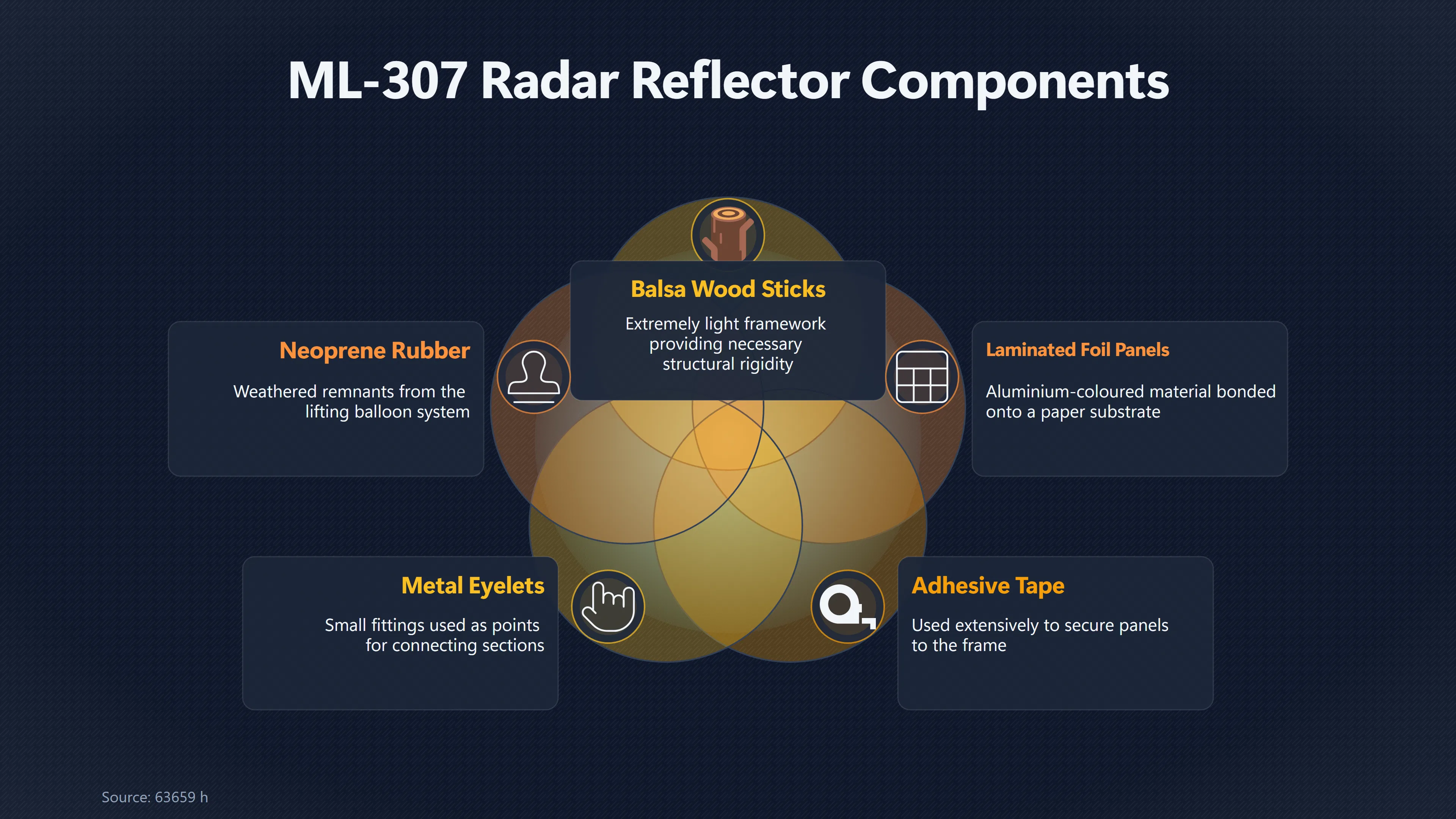
The radar reflectors used with Project Mogul were not rigid aircraft structures. The commonly discussed ML-307 radar target consisted of an extremely light framework assembled from:
- Thin balsa-wood sticks.
- Aluminium-coloured foil laminated onto a paper backing.
- Adhesive tape securing the panels to the frame.
- Glue, string or twine for assembly.
- Small metal eyelets used as attachment points.
When assembled, the reflector resembled a lightweight box kite with several reflective surfaces angled to improve radar visibility. If a balloon train failed and struck the ground, these delicate structures could break into numerous small pieces scattered over a wide area rather than remaining as recognisable equipment. Air Force investigators later obtained original blueprints and surviving examples of the reflector and concluded that its construction closely matched many of the materials described in 1947.[Globalnet]users.globalnet.co.ukAir Force Roswell Report…
The fragile nature of the reflector also explains why many reported fragments appeared unusual despite being made from ordinary materials. Aluminium-coated paper, thin wooden spars and decorative tape would not have resembled typical military aircraft wreckage familiar to local observers in New Mexico.
Which reported debris details match the reflector materials?
The comparison between witness descriptions and known radar reflector components centres on several specific details rather than a general impression.
Foil-like material. Contemporary newspaper accounts and later witness statements repeatedly mention thin metallic material described as foil or “tinfoil.” The reflector panels consisted of aluminium-coloured reflective material bonded to paper rather than thick sheet metal, matching this description more closely than aircraft skin.[Project Gutenberg]gutenberg.orgProject GutenbergThe Roswell Report: Case Closed, by James McAndrew—A Project Gutenberg eBookNovember 7, 2020…
Paper-backed fragments. Witnesses referred to paper-like material among the debris. Surviving ML-307 construction specifications show that the reflective surfaces were not pure metal but laminated onto a stronger paper substrate. Torn fragments could therefore appear partly metallic and partly paper.[Globalnet]users.globalnet.co.ukAir Force Roswell Report…
Lightweight wooden sticks. Mac Brazel described sticks among the recovered material, while photographs associated with the military investigation also show narrow wooden members. The radar targets used balsa wood because it was exceptionally light while providing sufficient rigidity for the reflector frame.[Project Gutenberg]gutenberg.orgProject GutenbergThe Roswell Report: Case Closed, by James McAndrew—A Project Gutenberg eBookNovember 7, 2020…
Adhesive tape. Tape appears in several early descriptions of the Roswell debris. Radar reflector construction relied extensively on adhesive tape to secure reflective panels to the balsa framework. Later examination of original specifications confirmed tape as a standard component rather than an unusual addition.[Globalnet]users.globalnet.co.ukAir Force Roswell Report…
Eyelets and attachment points. Brazel reportedly noted the presence of eyelets while observing that no obvious wire or string remained attached. The reflector blueprints include metal eyelets used for connecting sections and suspension lines, providing one of the more specific points of correspondence between the debris descriptions and the known hardware.[Globalnet]users.globalnet.co.ukAir Force Roswell Report…
Rubber fragments. Although not part of the reflector itself, neoprene weather balloons formed the lifting system of Mogul balloon trains. Weathered balloon remnants would be expected alongside broken reflector components, corresponding with reports of rubber strips found at the site.[Muller Lab]muller.lbl.govMuller Lab Project MogulMuller Lab Project Mogul

The question of the patterned tape
One of the most discussed details concerns witness descriptions of unusual markings on tape found with the debris.
Former Project Mogul engineer Charles B. Moore and other participants later recalled that some radar targets incorporated decorative tape obtained through a toy manufacturer. They described the tape as carrying stylised floral or geometric designs that could easily have appeared unfamiliar or symbolic when viewed out of context. Air Force investigators considered these recollections consistent with later witness descriptions of tape bearing unusual coloured figures or “hieroglyphic-like” markings.[Muller Lab]muller.lbl.govMuller Lab Project MogulMuller Lab Project Mogul
This point remains controversial because recollections of the markings evolved over several decades. Early newspaper reports did not emphasise mysterious symbols, whereas later accounts sometimes portrayed them as highly unusual. Whether this reflects ordinary memory evolution or genuinely distinctive tape remains debated.
Where the comparison remains uncertain
Although the material correspondence is substantial, it is not perfect.
One difficulty is that many detailed witness accounts were recorded decades after 1947. Human memory can change over long periods, especially after extensive publicity surrounding a famous event. Historians therefore generally give greater weight to the earliest documented descriptions than to much later recollections.[Muller Lab]muller.lbl.govRoswell IncidentMuller LabROSWELL INCIDENT REPORTJuly 1, 1994…
Another uncertainty concerns the quantity and distribution of debris. Some witnesses described a relatively ordinary debris field consistent with a balloon train, while others later recalled a much larger area or more unusual materials. Because the original recovery site was not scientifically documented before military collection, these differing accounts cannot be completely reconciled.
There is also continuing disagreement over whether all reported material is represented in surviving Mogul documentation. Supporters of the official explanation argue that the combination of balloon remnants, radar reflectors, cords and associated equipment accounts for the descriptions as a whole. Critics contend that some witness claims—particularly later descriptions of exceptionally strong or unusual material—are not adequately explained by balsa wood, paper and foil alone. Those claims, however, rely largely on retrospective testimony rather than contemporary physical evidence.[Muller Lab]muller.lbl.govMuller Lab Project MogulMuller Lab Project Mogul
Why the debris comparison remains central
Among the various arguments for the Project Mogul explanation, the radar reflector comparison is one of the most concrete because it can be tested against surviving hardware, engineering drawings and documented witness descriptions. The combination of balsa wood, foil-backed paper, adhesive tape, rubber balloon fragments and metal eyelets corresponds closely with the materials reported in the earliest newspaper accounts from July 1947 and with the construction of ML-307 radar targets recovered from military archives.[gutenberg.org]gutenberg.orgProject GutenbergThe Roswell Report: Case Closed, by James McAndrew—A Project Gutenberg eBookNovember 7, 2020…
At the same time, the comparison does not eliminate every question surrounding Roswell. It explains the physical composition of much of the reported debris but depends on identifying the recovered material with a specific type of classified balloon equipment and on weighing contemporary descriptions more heavily than later recollections. As a result, the radar reflector evidence remains one of the strongest pillars supporting the Mogul explanation while also illustrating why the Roswell incident continues to generate debate decades after the original recovery.[Muller Lab]muller.lbl.govMuller Lab Project MogulMuller Lab Project Mogul
Amazon book picks
Further Reading
Books and field guides related to Did Radar Reflectors Leave the Roswell Debris?. Use these as the next step if you want deeper reading beyond the article.
Crash at Corona
IF UFOS DON'T EXIST, THEN THEY CAN'T CRASH. But something did crash near Corona, a tiny town not far from Roswell, New Mexico, in 1947. A...
Roswell: Inconvenient Facts and the Will to Believe
For over fifty years an incident near Roswell, New Mexico, has sparked the imaginations of UFO enthusiasts. Did the military recover a cr...
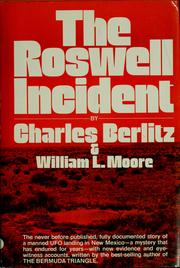
The Roswell Incident
The Roswell Incident was the most important UFO encounter of our century. But the facts about the incident are still being hidden from th...
Area 51
The explosive, untold story of the Cold War's biggest secret from the bestselling author of NUCLEAR WAR: A SCENARIO 'An extraordinary boo...
eBay marketplace picks
Marketplace Samples
Live-tested eBay searches with available results related to this page.
Selected fromweather balloon model oneBay.co.uk.

Endnotes
1.
Source: gutenberg.org
Link:https://www.gutenberg.org/files/63659/old/63659-h/63659-h.htm
Source snippet
Project GutenbergThe Roswell Report: Case Closed, by James McAndrew—A Project Gutenberg eBookNovember 7, 2020...
Published: November 7, 2020
2.
Source: dev.gutenberg.org
Title: 63659 h
Link:https://dev.gutenberg.org/files/63659/63659-h/63659-h.htm
3.
Source: muller.lbl.gov
Title: Muller Lab Project Mogul
Link:https://muller.lbl.gov/teaching/physics10/Roswell/USMogulReport.html
4.
Source: users.globalnet.co.uk
Link:https://www.users.globalnet.co.uk/~hex/ufo/text/pages026-050/page33.html
Source snippet
Air Force Roswell Report...
5.
Source: noufors.com
Title: Roswell debris
Link:https://noufors.com/Documents/Books%2C%20Manuals%20and%20Published%20Papers/ROSDEBRI.pdf
Source snippet
Roswell debris...
6.
Source: muller.lbl.gov
Title: Roswell Incident
Link:https://muller.lbl.gov/teaching/physics10/Roswell/RoswellIncident.html
Source snippet
Muller LabROSWELL INCIDENT REPORTJuly 1, 1994...
Published: July 1, 1994
7.
Source: wikidisc.org
Title: Roswell incident | Wiki Disc
Link:https://www.wikidisc.org/wiki/Roswell_incident
Source snippet
Roswell incident | WikiDiscJuly 2, 2026 — ^{[8]} The radar reflectors found in the debris contained small metal eyelets, similar to those...
Published: July 2, 2026
8.
Source: history.com
Link:https://www.history.com/articles/roswell
9.
Source: sgp.fas.org
Link:https://sgp.fas.org/othergov/roswell.html
Additional References
10.
Source: theoriesofanything.com
Title: Roswell Incident: Historical Analysis | Theories of Anything
Link:https://theoriesofanything.com/research/roswell-incident-historical-analysis
Source snippet
VERIFIED CLAIMS (TIER 1 — PEER-REVIEWED / SCHOLARLY CONSENSUS) 1.1 THE CORE EVENTS * Mack Brazel discovered debris on the J.B. Foster ran...
11.
Source: youtube.com
Link:http://www.youtube.com/watch?v=zoCtyFNNB20
Source snippet
Roswell debris radar target 1947 reports Roswell Unpacked: 1947 Debris, Project Mogul, 1994 Air Force Report...
12.
Source: apeirron.com
Title: The Roswell Incident — Apeirron
Link:https://www.apeirron.com/node/roswell
Source snippet
The central physical question at Roswell is deceptively simple: what was the material that Mac Brazel found on the Foster Ranch? The answ...
13.
Source: youtube.com
Link:http://www.youtube.com/watch?v=vp36IwCs9_k
Source snippet
Technical Analysis of the Roswell Incident: What Really Crashed in 1947?...
14.
Source: youtube.com
Link:http://www.youtube.com/watch?v=_ZE9oNXP9-U
Source snippet
Conspiracy Theory Declassified | Roswell 1947: Project Mogul Cover‑Up or UFO Crash?...
15.
Source: youtube.com
Link:http://www.youtube.com/watch?v=qwgYcnatLm0
Source snippet
Roswell: The Real Cover-Up Wasn't Aliens...
16.
Source: [ramey-memo]({{ ‘ramey-memo/’ | relative_url }}). com
Link:https://www.ramey-memo.com/indestructible-material/
17.
Source: astronomyufo.com
Link:https://www.astronomyufo.com/UFO/Mogul.htm
18.
Source: asios.org
Link:https://asios.org/reports/roswell
19.
Source: newspaceeconomy.ca
Link:https://newspaceeconomy.ca/2026/01/04/challenges-to-the-project-mogul-explanation-for-the-roswell-incident/?amp=1