Within The Role
Did Interviewers Put Details Into Roswell Memories?
Leading questions could supply witnesses with objects, locations or assumptions that later felt like part of the original memory.
On this page
- Open questions versus suggestive prompts
- Roswell interview practices and missing transcripts
- How to identify interviewer supplied details
Page outline Jump by section
Introduction
One of the most important questions in the Roswell debate is not simply what witnesses remembered, but how they were asked to remember it. Most of the interviews that produced the now-familiar Roswell narrative took place more than three decades after the 1947 events, often after investigators had already formed a working hypothesis that an extraterrestrial craft had crashed. This does not mean interviewers deliberately manufactured testimony, nor does it mean witnesses were dishonest. However, decades of psychological research show that the wording of questions can influence later recollections, especially when memories are old, incomplete or repeatedly revisited.[ScienceDirect]sciencedirect.comScienceDirect Leading questions and the eyewitness reportLeading questions and the eyewitness report - ScienceDirect…
For Roswell, this creates a practical historical problem. Many early interviews were informal, only partially recorded or never fully transcribed, making it difficult to distinguish details that originated with witnesses from details that may have emerged during lengthy conversations with investigators. Historians therefore examine not only what witnesses eventually said, but also how those accounts were elicited and whether key details appeared only after repeated questioning.
Open questions versus suggestive prompts
Modern investigative interviewing distinguishes between open-ended questions and suggestive questions because they produce different kinds of evidence.
An open question encourages a witness to retrieve information without introducing new ideas:
- “Tell me everything you remember about that day.”
- “What happened after you arrived?”
A suggestive prompt instead embeds assumptions into the question itself:
- “When did you realise it was a spacecraft?”
- “Did you see the bodies before the military removed them?”
- “How unusual was the metal?”
Psychological research led by Elizabeth Loftus demonstrated that such wording can alter later recollection. Even subtle assumptions about an object’s existence or appearance can increase the likelihood that people later report remembering those details. This phenomenon is known as the misinformation effect and has been replicated across many decades of eyewitness research.[ScienceDirect]sciencedirect.comScienceDirect Leading questions and the eyewitness reportLeading questions and the eyewitness report - ScienceDirect…
The relevance to Roswell is methodological rather than accusatory. If an investigator already believed a crashed alien craft existed, questions framed around that belief could unintentionally encourage witnesses to organise uncertain memories around the same narrative.
Roswell interviews were rarely conducted under controlled conditions
The principal Roswell interviews conducted from the late 1970s onwards were not police interviews or contemporary witness statements. They were retrospective conversations between UFO researchers and elderly witnesses recalling events from the 1940s.
Several characteristics made these interviews especially vulnerable to memory reconstruction:
- the passage of more than thirty years before many interviews;
- repeated follow-up conversations with the same witnesses;
- widespread media coverage that exposed witnesses to other people’s stories;
- investigators who often knew existing Roswell claims before conducting interviews;
- limited preservation of complete interview recordings or verbatim transcripts.
These conditions differ markedly from best practice in eyewitness interviewing, which emphasises recording first accounts before memories are repeatedly revisited or influenced by outside information.[Office of Justice Programs]ojp.govOffice of Justice ProgramsUnderstanding rapport-building in investigative interviews: Does rapport's effect on witness memory and suggest…
Importantly, these limitations affect both believers and sceptics. Without comprehensive first-interview records, later researchers cannot always determine whether a specific detail originated spontaneously with the witness or appeared after discussion.
Why missing transcripts matter
Many famous Roswell quotations survive only in books, summaries or edited interviews rather than complete contemporaneous transcripts.
This creates several historical difficulties.
First, questions themselves may disappear. A published account often preserves only the witness’s answer, making it impossible to know whether the interviewer suggested an idea immediately beforehand.
Second, editing removes hesitation. Long interviews typically contain uncertainty, corrections and speculation. Condensed quotations can unintentionally make memories appear more definite than they originally were.
Third, repeated interviews may gradually expand a narrative. If only the final published version survives, historians cannot easily reconstruct when individual details first appeared.
This does not prove interviewer influence in any particular case. Instead, it limits confidence about the origin of later-added details and makes independent corroboration especially valuable.

How details can gradually become part of memory
Memory researchers describe recall as reconstructive rather than reproductive. People do not retrieve a perfect recording of past events; they rebuild memories from surviving fragments, expectations and later information.
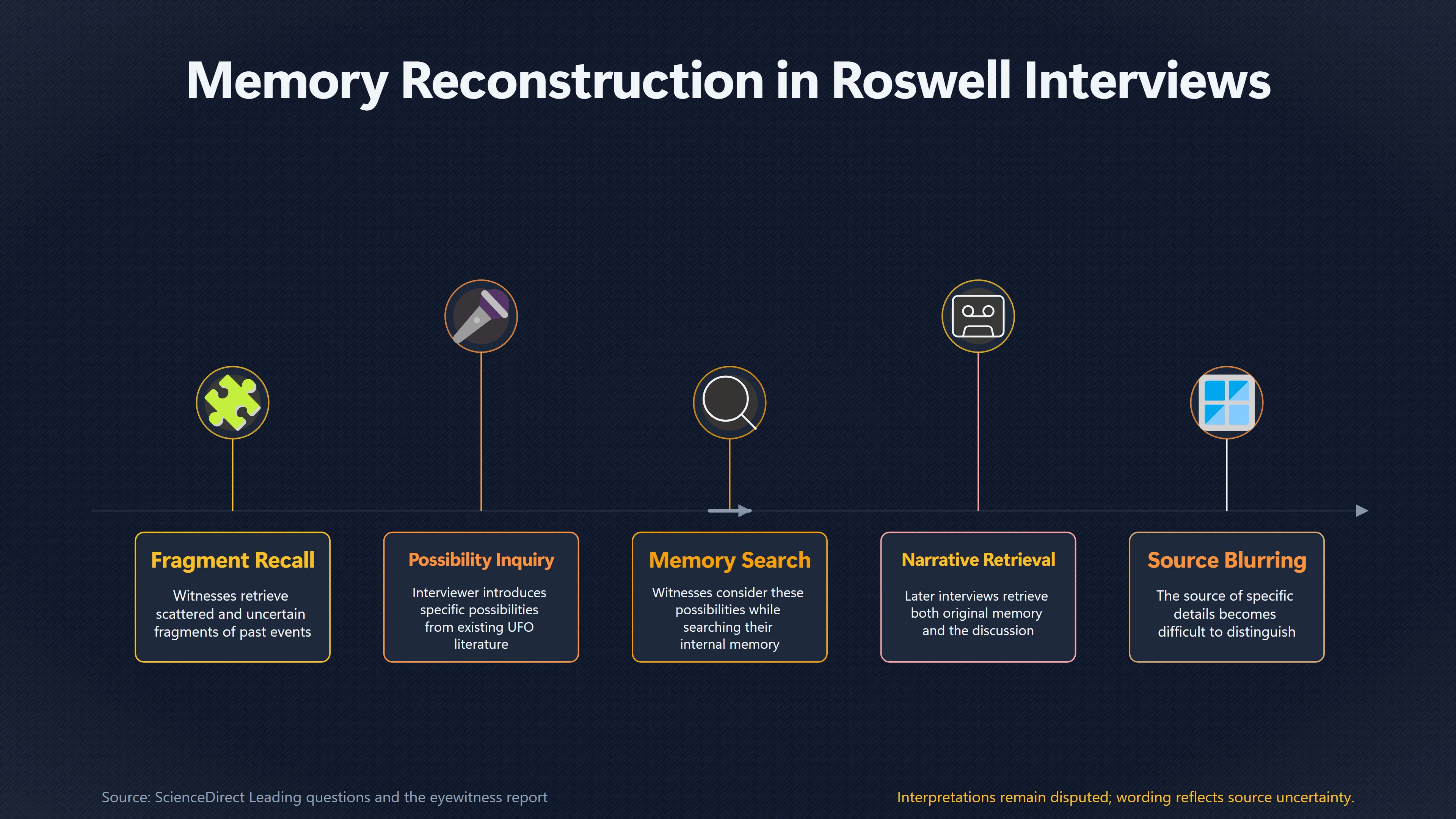
In Roswell, this means an interview sequence could unfold in several stages:
- A witness recalls scattered, uncertain fragments.
- The interviewer asks about specific possibilities already circulating within UFO literature.
- The witness considers those possibilities while searching memory.
- Later interviews retrieve both the original memory and the discussion itself.
- Over time, the source of particular details may become difficult to distinguish.
This process is known as a source-monitoring problem. People may accurately remember hearing a detail but incorrectly attribute its source, believing it came from direct observation rather than a later conversation or publication. The phenomenon is well documented within eyewitness memory research and does not require deception or bad faith.[ScienceDirect]sciencedirect.comScienceDirect Misinformation EffectMisinformation Effect - an overview | ScienceDirect Topics…
Did Roswell investigators deliberately plant memories?
The available evidence does not justify a general claim that Roswell investigators intentionally implanted false memories.
Researchers such as Stanton Friedman, William Moore, Kevin Randle and others were typically attempting to gather testimony supporting or testing their respective interpretations of the case. Like investigators in many controversial historical inquiries, they often asked detailed follow-up questions designed to clarify inconsistencies or explore possibilities.
The methodological concern is subtler. Interviewers who strongly expect a particular explanation may unintentionally shape interviews through:
- selecting which topics receive the most attention;
- returning repeatedly to dramatic claims rather than ordinary ones;
- asking increasingly specific follow-up questions;
- treating uncertain statements as leads for future interviews.
Such interviewer expectancy effects are well recognised across psychology and investigative interviewing and need not involve conscious bias.[Office of Justice Programs]ojp.govOffice of Justice ProgramsUnderstanding rapport-building in investigative interviews: Does rapport's effect on witness memory and suggest…

How to identify interviewer-supplied details
Because complete interview records are often unavailable, historians look for indirect indicators that a detail may have emerged during the interview process rather than existing in the witness’s earliest recollection.
Useful questions include:
- Did the witness volunteer the information? Details offered spontaneously generally carry more evidential weight than those appearing only after prompting.
- When does the detail first appear? Elements absent from earlier accounts but present decades later deserve closer scrutiny.
- Is the wording similar across multiple witnesses? Shared language may reflect common interviewing, media exposure or mutual discussion rather than independent observation.
- Are original recordings available? Audio or complete transcripts allow researchers to distinguish spontaneous recollection from responses to leading questions.
- Did the witness express uncertainty? Published summaries sometimes omit qualifications such as “I think,” “perhaps” or “I’m not sure,” making memories appear more confident than they originally were.
These criteria do not prove a claim true or false. They help assess whether a particular detail is more likely to represent independent recollection or retrospective reconstruction.
Why this issue remains central to Roswell
The debate over interviewer influence is important because many of Roswell’s most extraordinary claims emerged through retrospective interviews rather than contemporary documentation.
Supporters of the extraterrestrial interpretation argue that persistent witness testimony points to genuine concealed events. Critics argue that decades of repeated interviews, media exposure and suggestive questioning created conditions under which sincere memories could gradually absorb new details. The available historical record cannot completely resolve every disputed recollection because many of the earliest interviews were incompletely documented.
For that reason, historians generally give greatest weight to details that were recorded closest to 1947, were volunteered without prompting, remained consistent across time and were independently corroborated. Later recollections remain valuable historical evidence, but they are interpreted alongside the well-established finding that interview questions themselves can influence what people eventually come to remember.[sciencedirect.com]sciencedirect.comScienceDirect Leading questions and the eyewitness reportLeading questions and the eyewitness report - ScienceDirect…
Amazon book picks
Further Reading
Books and field guides related to Did Interviewers Put Details Into Roswell Memories?. Use these as the next step if you want deeper reading beyond the article.
The Seven Sins of Memory
Rating: 3.5/5 from 5 Google Books ratings
A New York Times Notable Book: A psychologist's "gripping and thought-provoking" look at how and why our brains sometimes fail us (Steven...
Eyewitness Testimony
Every year hundreds of defendants are convicted on little more than the say-so of a fellow citizen. Although psychologists have suspected...
Witness for the Defense: The Accused, the Eyewitness, and the...
Traditional Chinese edition of Witness for the defense: the accused, the eyewitness, and the expert who puts memory on trial
The Memory Illusion: Remembering, Forgetting, and the Science...
THE INTERNATIONAL BESTSELLER 'Truly fascinating.' Steve Wright, BBC Radio 2 - Have you ever forgotten the name of someone you’ve met doze...
eBay marketplace picks
Marketplace Samples
Live-tested eBay searches with available results related to this page.
Selected fromUFO poster oneBay.co.uk.
Endnotes
1.
Source: sciencedirect.com
Title: ScienceDirect Leading questions and the eyewitness report
Link:https://www.sciencedirect.com/science/article/pii/0010028575900237
Source snippet
Leading questions and the eyewitness report - ScienceDirect...
2.
Source: sciencedirect.com
Title: ScienceDirect Misinformation Effect
Link:https://www.sciencedirect.com/topics/social-sciences/misinformation-effect
Source snippet
Misinformation Effect - an overview | ScienceDirect Topics...
3.
Source: sciencedirect.com
Title: Misinformation Effect
Link:https://www.sciencedirect.com/topics/psychology/misinformation-effect
4.
Source: sciencedirect.com
Title: Leading questions and the eyewitness report
Link:https://www.sciencedirect.com/science/article/abs/pii/0010028575900237
5.
Source: youtube.com
Link:https://www.youtube.com/watch?v=NwrIpg4TCFQ
Source snippet
The misinformation effect | Elizabeth Loftus | Nobel Prize Summit 2023...
6.
Source: youtube.com
Link:https://www.youtube.com/watch?v=3RKDVB6qizA
Source snippet
A-Level Psychology (AQA) - Eyewitness Testimony and Misleading Information...
7.
Source: ojp.gov
Title: Office of Justice Programs EYEWITNESS TESTIMONY
Link:https://www.ojp.gov/ncjrs/virtual-library/abstracts/eyewitness-testimony-final-report-september-1975
Source snippet
Office of Justice ProgramsEYEWITNESS TESTIMONY - FINAL REPORT, SEPTEMBER 1975 | Office of Justice Programs...
Published: SEPTEMBER 1975
8.
Source: ojp.gov
Link:https://ojp.gov/ncjrs/virtual-library/abstracts/effects-questioning-upon-witness-later-recollections
9.
Source: ojp.gov
Link:https://ojp.gov/library/publications/understanding-rapport-building-investigative-interviews-does-rapports-effect
Source snippet
Office of Justice ProgramsUnderstanding rapport-building in investigative interviews: Does rapport's effect on witness memory and suggest...
10.
Source: ojp.gov
Link:https://ojp.gov/ncjrs/virtual-library/abstracts/reports-suggested-memories-do-people-truly-believe-them-adult
Source snippet
(From Adult Eyewitness Testimony: Current Trends and Developments, P 3-26, 1994, David Frank Ross, et al, eds. -- See NCJ-159543) | Offic...
11.
Source: ojp.gov
Link:https://www.ojp.gov/library/publications/eyewitness-responses-leading-and-misleading-questions-under-cognitive
Source snippet
January 1, 1986 — EYEWITNESS RESPONSES TO LEADING AND MISLEADING QUESTIONS UNDER THE COGNITIVE INTERVIEW NCJ Number 142377 Journal Journa...
Published: January 1, 1986
12.
Source: ojp.gov
Link:https://www.ojp.gov/ncjrs/virtual-library/abstracts/distortions-eyewitness-memory-postevent-information-part-3
Additional References
13.
Source: youtube.com
Title: THE COGNITIVE INTERVIEW
Link:https://www.youtube.com/watch?v=q5m5GlFNSLI
Source snippet
Leading questions investigative interviewing misinformation effect Loftus How ACCURATE is Eyewitness Testimony?| Leading Questions & Post...
14.
Source: youtube.com
Title: A-Level Psychology (AQA)
Link:https://www.youtube.com/watch?v=dwfBQ0fZ1SY
Source snippet
How ACCURATE is Eyewitness Testimony?| Leading Questions & Post Event Discussion...
15.
Source: youtube.com
Title: How ACCURATE is Eyewitness Testimony?| Leading Questions & Post Event Discussion
Link:https://www.youtube.com/watch?v=DLiMHJFD7YU
Source snippet
THE COGNITIVE INTERVIEW - Geiselman (1984) & Fisher (1987)...
16.
Source: staff.washington.edu
Link:https://staff.washington.edu/eloftus/Articles/hoff.htm
Source snippet
Loftus, Hunter G. Hoffman, "Misinformation and Memory, The Creation of New Memories," Journal of Experimental Psychology: General 118(1)...
17.
Source: pubmed.ncbi.nlm.nih.gov
Link:https://pubmed.ncbi.nlm.nih.gov/9648524/