Within Military Secrecy
Why Detecting a Soviet Bomb Had to Stay Secret
Detecting a Soviet atomic blast was a top intelligence priority, and revealing the effort could expose American methods and weaknesses.
On this page
- The uncertainty surrounding the Soviet bomb program
- What detection systems could reveal to an adversary
- Why strategic urgency justified unusual secrecy
Page outline Jump by section
Introduction
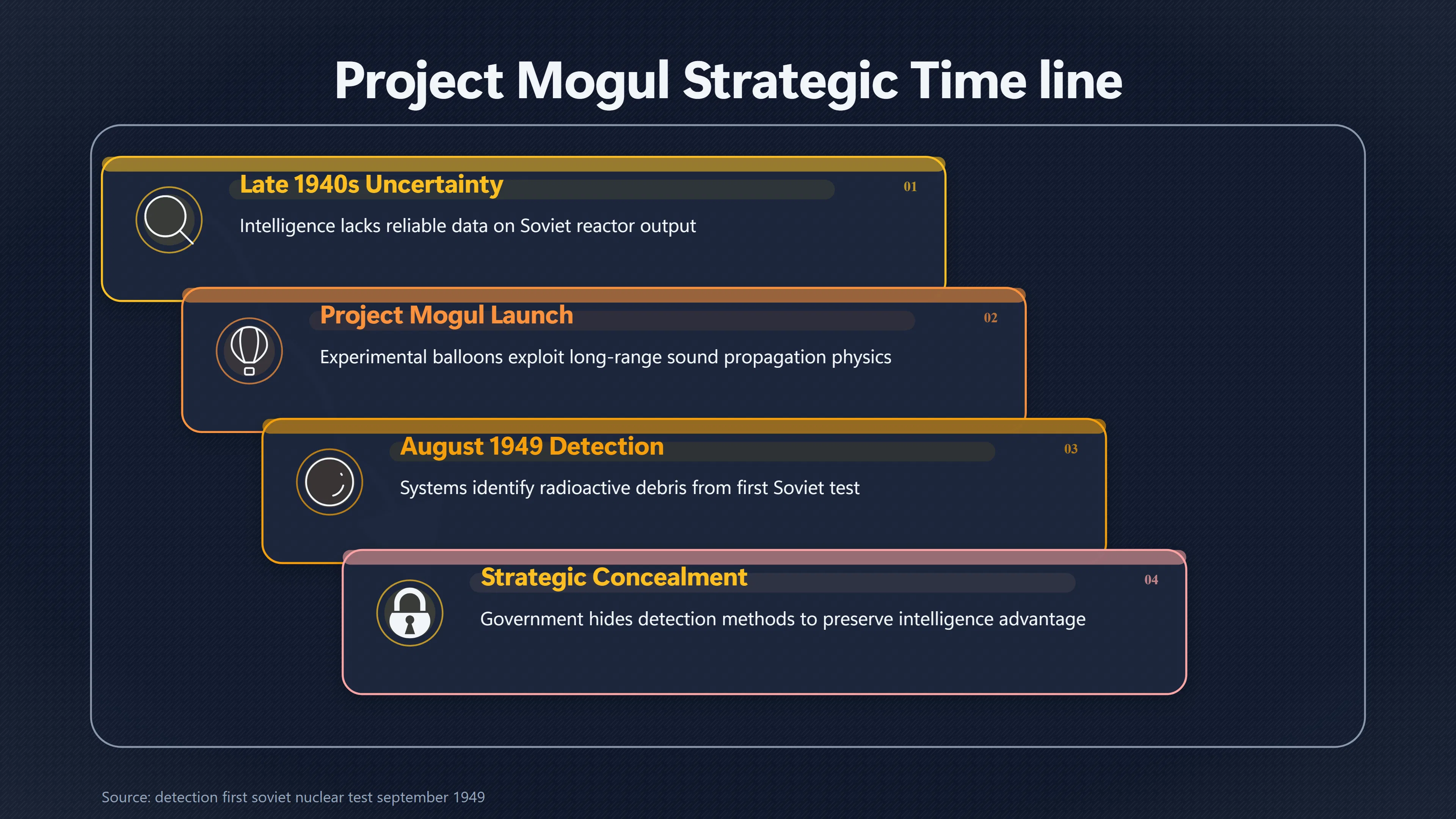
Understanding the secrecy surrounding Project Mogul requires understanding the problem it was designed to solve. In 1947, the United States did not know when the Soviet Union would produce its first atomic bomb, yet the answer would fundamentally alter the global balance of power. Detecting a Soviet nuclear test before Moscow announced it—or if it never announced it at all—became one of the highest intelligence priorities in the early Cold War. Within the broader story of the Roswell incident, this urgency explains why seemingly ordinary balloon equipment was attached to an exceptionally sensitive intelligence mission. The classified element was not the balloons themselves but the surveillance system they supported, the methods it employed and the strategic capabilities it revealed.[National Security Archive]nsarchive2.gwu.eduOpen source on gwu.edu.
The uncertainty surrounding the Soviet bomb programme
In the late 1940s, American intelligence possessed only fragmentary information about Soviet nuclear progress. Analysts knew that the Soviet Union was investing heavily in atomic research but lacked reliable intelligence on uranium production, reactor output and weapons design. Estimates therefore varied widely, with official assessments suggesting that a Soviet bomb might not appear until the early 1950s while acknowledging considerable uncertainty. Only weeks before the first Soviet test, senior intelligence estimates still regarded 1950 or later as the most likely timeframe.[National Security Archive]nsarchive.gwu.eduAtomic Energy Project – 1 July 1949,” Top Secret, attached to U.S. Air Force, Executive Directorate of Intelligence, "Estimate of Soviet…
This uncertainty created a strategic dilemma. If intelligence estimates proved too optimistic, the United States risked losing its nuclear monopoly without warning. If they proved too pessimistic, policymakers might overreact and divert enormous resources unnecessarily. Rather than relying solely on espionage or analysis of Soviet industry, American planners sought an independent means of detecting an actual nuclear explosion.
Project Mogul emerged within this atmosphere of uncertainty. Its objective was to exploit scientific knowledge about long-range sound propagation in the upper atmosphere, where low-frequency acoustic waves from a distant nuclear detonation might travel thousands of kilometres. Although experimental, the concept promised a way to obtain direct evidence that a Soviet test had occurred without requiring agents inside the Soviet Union.[Wikipedia]WikipediaProject MogulProject Mogul
What detection systems could reveal to an adversary
The value of secrecy extended far beyond hiding the existence of balloon launches. Intelligence collection systems are vulnerable because their effectiveness depends partly on an adversary not understanding exactly how they operate.
Had the Soviet Union learned the details of American detection efforts, it could have gained valuable intelligence about:
- which physical effects the United States believed were most detectable;
- the geographical areas under surveillance;
- the sensitivity and likely limitations of American sensors;
- how quickly the United States could confirm a nuclear explosion; and
- which types of testing might escape detection altogether.
Even unsuccessful experiments had intelligence value. If Soviet planners understood that the United States was investing heavily in acoustic detection, they could infer American assumptions about atmospheric physics and evaluate whether alternative testing methods or locations might reduce detectability.
This explains why Project Mogul remained highly compartmentalised despite relying on many commercially available materials. Security classification protected the operational purpose and the intelligence concept rather than every individual component. Balloons, radar reflectors, cords and tape were not inherently secret; the integrated surveillance mission was.[Wikipedia]WikipediaProject MogulProject Mogul

Why strategic urgency justified unusual secrecy
Project Mogul formed part of a broader effort that evolved into the Atomic Energy Detection System (AEDS), a programme intended to discover foreign nuclear explosions using multiple scientific techniques. As the system matured, it incorporated radiological air sampling, seismic monitoring, acoustic detection and other methods. Much of this work remained hidden for decades because revealing the existence or effectiveness of the network would have compromised its future usefulness.[National Security Archive]nsarchive2.gwu.eduOpen source on gwu.edu.
The secrecy was reinforced by the strategic consequences of success. When the Soviet Union detonated its first nuclear device on 29 August 1949, American detection systems identified radioactive debris carried across the Pacific before Moscow made any public announcement. President Harry Truman announced that the United States had evidence of a Soviet atomic explosion, but the government deliberately concealed how the evidence had been obtained. According to later declassified records, Soviet leaders apparently did not realise that the United States possessed such detection capabilities, preserving an important intelligence advantage.[National Security Archive]nsarchive.gwu.edudetection first soviet nuclear test september 1949National Security ArchiveDetection of the First Soviet Nuclear Test, September 1949 | National Security Archive…
This episode demonstrates why officials regarded surveillance methods as intelligence assets comparable to cryptographic systems or espionage networks. Once an opponent understands how it is being watched, it can begin adapting its behaviour.
How this secrecy shaped the Roswell response
Within the Roswell context, the security challenge was practical rather than theoretical. If debris recovered in New Mexico originated from a classified surveillance experiment, officials faced a choice between protecting the programme and providing a complete public explanation.
The secrecy surrounding Soviet test detection helps explain why the military was unwilling to discuss the true purpose of the recovered equipment. A straightforward admission that the debris belonged to an experimental long-range nuclear detection project would have disclosed precisely the type of capability that American intelligence was attempting to conceal. Instead, the operational mission remained compartmentalised, while public explanations focused on less sensitive descriptions of balloon equipment.
The resulting information gap became fertile ground for later speculation. People who encountered unusual debris but were denied an accurate explanation naturally searched for alternatives. In retrospect, declassified records indicate that the principal secret was not evidence of extraterrestrial technology but an emerging intelligence programme designed to provide strategic warning of a Soviet atomic breakthrough.
Amazon book picks
Further Reading
Books and field guides related to Why Detecting a Soviet Bomb Had to Stay Secret. Use these as the next step if you want deeper reading beyond the article.
Spying on the Bomb: American Nuclear Intelligence from Nazi G...
'Spying on the Bomb' focuses on the past & present nuclear activities of various countries, intermingling what the US believed was happen...
Dark Sun: The Making of the Hydrogen Bomb
Here, for the first time, in a brilliant, panoramic portrait by the Pulitzer Prize-winning author of The Making of the Atomic Bomb, is th...
The Wizards of Armageddon
This is the untold story of the small group of men who have devised the plans and shaped the policies on how to use the Bomb. The book (f...
The Dead Hand: The Untold Story of the Cold War Arms Race and...
WINNER OF THE PULITZER PRIZE The first full account of how the Cold War arms race finally came to a close, this riveting narrative histor...
eBay marketplace picks
Marketplace Samples
Live-tested eBay searches with available results related to this page.
Selected fromCold War poster oneBay.co.uk.
Endnotes
1.
Source: nsarchive2.gwu.edu
Link:https://nsarchive2.gwu.edu/NSAEBB/NSAEBB7/nsaebb7.htm
2.
Source: nsarchive.gwu.edu
Title: detection first soviet nuclear test september 1949
Link:https://nsarchive.gwu.edu/briefing-book/nuclear-vault/2019-09-09/detection-first-soviet-nuclear-test-september-1949
Source snippet
National Security ArchiveDetection of the First Soviet Nuclear Test, September 1949 | National Security Archive...
Published: september 1949
3.
Source: nsarchive.gwu.edu
Link:https://nsarchive.gwu.edu/document/19581-national-security-archive-doc-10-document-4
Source snippet
Atomic Energy Project – 1 July 1949,” Top Secret, attached to U.S. Air Force, Executive Directorate of Intelligence, "Estimate of Soviet...
Published: July 1949
4.
Source: nsarchive.gwu.edu
Title: 19580 national security archive doc 09 untitled
Link:https://nsarchive.gwu.edu/document/19580-national-security-archive-doc-09-untitled
Source snippet
National Security ArchiveUntitled estimate, 10 December 1948, Top Secret | National Security Archive...
Published: December 1948
5.
Source: Wikipedia
Title: Project Mogul
Link:https://en.wikipedia.org/wiki/Project_Mogul
Additional References
6.
Source: youtube.com
Title: The Roswell Incident Mystery Solved
Link:https://www.youtube.com/watch?v=Pz0vYcc4KiI
Source snippet
Roswell UFO: What Really Happened?...
7.
Source: youtube.com
Title: Roswell UFO: What Really Happened?
Link:https://www.youtube.com/watch?v=8ua33uwRTMM
Source snippet
Roswell Debris and Project Mogul...
8.
Source: youtube.com
Title: Roswell Debris and Project Mogul
Link:https://www.youtube.com/watch?v=TV0Xm9ZgiKQ
Source snippet
The [Roswell UFO Crash]({{ 'roswell-ufo-crash/' | relative_url }}) Overview...
9.
Source: youtube.com
Title: Project Mogul Overview
Link:https://www.youtube.com/watch?v=mBcYtSsPIuU
Source snippet
The Roswell Incident Mystery Solved...
10.
Source: youtube.com
Title: [The Roswell UFO]({{ ‘the-roswell-ufo/’ | relative_url }}) Crash Overview
Link:https://www.youtube.com/watch?v=ZltLHh_WsZs